
Affiliate Disclosure: This article contains affiliate links. If you purchase through these links, I may earn a commission at no additional cost to you. I only recommend products I personally use and trust.
What’s in my bag at 56 today looks nothing like what was in my bag 17 months ago. Back then I was a 7 handicap swinging the driver at 89 mph, carrying clubs built for a slower, shorter game. Now I am a 3 handicap competing in SCGA tournaments with driver swing speed at 111 mph, and what’s in my bag has evolved with the game.
This is the complete breakdown of what’s in my bag at 56: every club, every spec, every reason behind the choice. If you are a senior golfer thinking about your own setup, or just curious what a competitive amateur at 56 actually carries, this is the honest answer. No sponsorships dictating my gear. No filler. Just what’s in my bag because it works.
What’s in My Bag: The Quick Overview
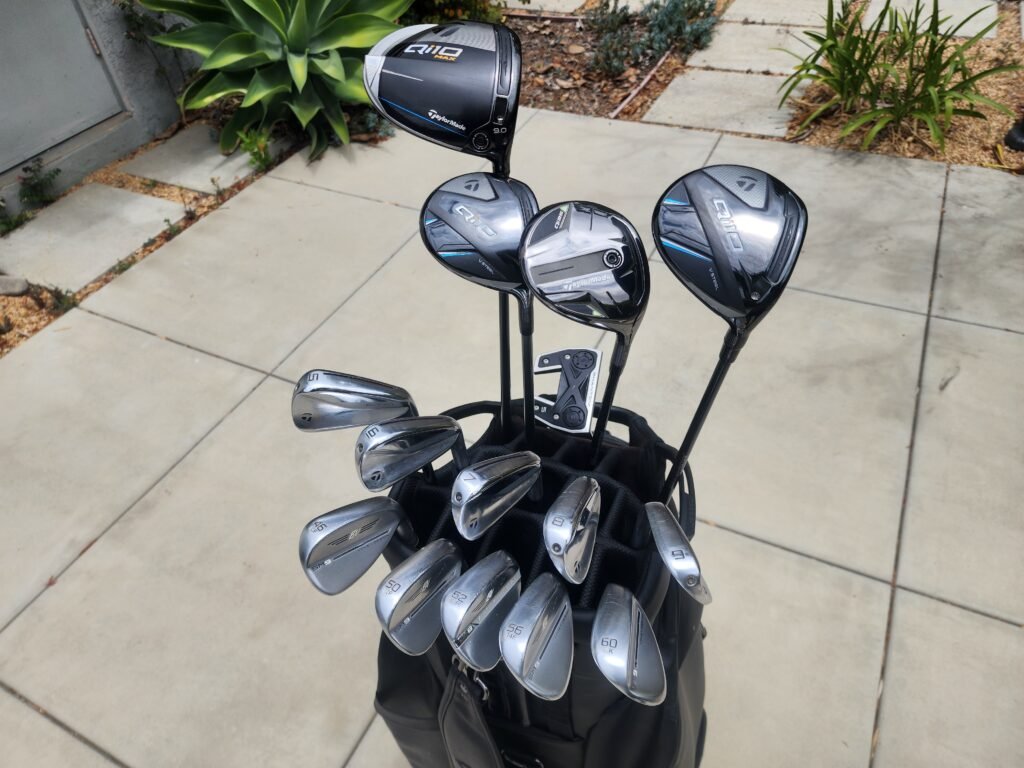
Here is the full breakdown of what’s in my bag at 56, all 14 clubs plus the gear that makes it work on tournament day:
- Driver: TaylorMade Qi4D (warranty replacement for Qi35 Max that broke at Desert Springs)
- 3-Wood: TaylorMade Qi10, 15°, HZRDUS Blue RDX Smoke 6.0 stiff
- 7-Wood: TaylorMade Qi10 Max, 21°, Gloire 5000L stiff
- 9-Wood: TaylorMade Qi35 Max, 24°, HZRDUS Blue RDX Smoke 6.0 stiff
- Irons (5–9): TaylorMade P770, Dynamic Gold 105 S300, 2° flat
- Wedges: Vokey SM9 Tour Chrome — PW 46°, GW 50°, SW 56°, LW 60°, Dynamic Gold 105 S300
- Putter: Scotty Cameron Phantom X5, 33″
- Ball: Callaway Chrome Tour Triple Track
- Bag: Vessel LuxPro 15-Way (black)
- Rangefinder: Bushnell V6 Shift
- Stats Tracking: Arccos Smart Sensors Gen 4 + Arccos Air
- Glove: FootJoy StaSof (black)
- Tees: Martini 3 1/4″ Step-Up
- Divot Tool: Scotty Cameron silver divot repair tool
- Club Brush: D-Brush pocket golf club brush
- Ball Markers: Two Filipino peso coins
Now let me walk through what’s in my bag in detail, club by club, and explain why each one earned its spot.
What’s in My Bag: The Driver (Qi4D, Warranty Replacement)
The driver in what’s in my bag has a story. The TaylorMade Qi35 Max at 9° with the HZRDUS Green Smoke 6.0 stiff shaft was my tournament driver — until it broke apart in my hands at the Desert Springs SCGA tournament on May 23. The head cracked by the weight on hole 2 and the weight broke off inside the head two holes later. I still shot 75 to finish 5th, but the driver was done.
Golf Mart honored the warranty quickly — by early June I had a brand-new TaylorMade Qi4D driver head to replace it. While waiting, I cycled through a TaylorMade Stealth 2 and an older Qi10 to keep my game going. The Qi4D is the newest addition to what’s in my bag, and a full review is coming after I have tournament Arccos data on it — starting with Morongo in June.
The evolution of what’s in my bag at the driver position reflects the speed training journey directly. At 89 mph, I needed a high-launch, forgiving setup. At 111 mph, I can play a standard 9° loft with a low-launch stiff shaft and get exactly the launch and spin I want. Gear has to match where your swing actually is — not where you wish it was. My longest measured drive of the 2026 season is 326 yards at Anaheim Hills in April. That’s what’s in my bag producing results.
What’s in My Bag: The Fairway Wood Stack (3, 7, and 9-Wood)
Here is where what’s in my bag gets unusual. Most senior golfers carry a 3-wood and then hybrids. What’s in my bag instead is three fairway woods — a 3-wood, a 7-wood, and a 9-wood — with no hybrids at all. This is a deliberate setup that took two years of testing to land on, and it is one of the biggest reasons I score well at 56.
3-Wood: TaylorMade Qi10 at 15° with the HZRDUS Blue RDX Smoke 6.0 stiff. My second tee club on tight holes and my long approach club from the fairway when I have the lie for it.
7-Wood: TaylorMade Qi10 Max at 21° with the Gloire 5000L shaft. The hero club in what’s in my bag. It carries 210 to 230 yards, lands soft on tournament greens, and hits greens at 67% from over 200 yards — the highest rate of any club in my bag at that distance. I covered it in detail in Better Par 5 Scoring at 56. If you are a senior golfer struggling with 200-yard shots, the 7-wood deserves a hard look before anything else in what’s in your bag changes.
9-Wood: TaylorMade Qi35 Max at 24° with the HZRDUS Blue RDX Smoke 6.0 stiff. Replaces a 4-iron or 4-hybrid. Launches higher, lands softer, and is significantly easier to hit from rough or uneven lies.
The three-fairway-wood setup is the single most important strategic choice in what’s in my bag at 56. It covers 180 to 260 yards with consistent, high-launching, soft-landing approach options — exactly the yardage band where senior golfers score or struggle.
What’s in My Bag: The Irons (TaylorMade P770, 5–9)
The irons in my bag are TaylorMade P770s, 5-iron through 9-iron, with Dynamic Gold 105 S300 stiff shafts at 2° flat lie angle. The P770 is a players’ distance iron — the look of a blade at address with the forgiveness of a cavity back. For a 3-handicap senior golfer who wants to work the ball but still needs help on mishits, the P770 is the sweet spot in what’s in my bag.
The Dynamic Gold 105 S300 shaft is heavier than what most senior golfers play but lighter than tour-weight X100. The 2° flat lie angle was custom fit based on impact tape testing — at my height and posture, a standard lie angle produces a slight pull. Two degrees flat eliminates that miss.
If you are reviewing what’s in your bag and wondering whether a custom fitting is worth it, the answer is yes. The 2° flat adjustment alone has been worth multiple strokes per round. I covered the iron game in detail in How to Hit Irons Better After 50.
What’s in My Bag: The Wedge System (Vokey SM9, Four Wedges)
My tournament wedge setup in what’s in my bag is Vokey SM9 Tour Chrome with four wedges spanning 14 degrees of loft: PW at 46°, GW at 50°, SW at 56°, and LW at 60°. All four have Dynamic Gold 105 S300 shafts to match the iron set.
At home for practice rounds I carry a fifth wedge — a Vokey SM9 52° — between the 50° and the 56°. I pull it for tournaments because USGA rules limit me to 14 clubs and the Arccos data showed the 50° and 52° hit greens at almost identical rates (53% vs 54%). That data made the decision easy. I broke it down in my golf club distance chart article.
The 4-degree gapping in what’s in my bag — 46, 50, 56, 60 — gives me a full-swing yardage for every distance from 60 to 130 yards. My target layup distance on unreachable par 5s is 80 yards, because 80 is a full-swing 60° for me. That precision is what turns par 5 third shots into legitimate birdie chances.
If you are reviewing what’s in your bag and your wedges are mismatched or have gaps wider than 5°, that is the highest-priority fix you can make before anything else.
What’s in My Bag: The Putter (Scotty Cameron Phantom X5, 33″)
The putter in what’s in my bag is a Scotty Cameron Phantom X5 at 33 inches. The Phantom X5 is a mid-mallet design with a single bend shaft and dual sight lines. Face-balanced, suits a straight-back-straight-through stroke, matches my natural motion.
Why 33 inches instead of standard 34 or 35? Putter length is a feel decision. I tested multiple lengths and 33 inches gave me the best posture and the most consistent contact. Most golfers play putters 1 to 2 inches too long, which forces a hunched setup and an off-path stroke.
The putter is the part of what’s in my bag I’m working hardest on right now. My Arccos data over 11 rounds shows 2.3 three-putts per round versus a scratch golfer’s 1.3. The putter is not the problem — my putting practice and routine are. I’m addressing that in How to Stop 3-Putting, which is built around the speed-first thesis I’ve been developing.
What’s in My Bag: The Ball (Callaway Chrome Tour Triple Track)
The ball is one of the most underrated parts of what’s in my bag. I play the Callaway Chrome Tour Triple Track — a premium tour ball with a soft urethane cover, high greenside spin, and consistent flight for hitting specific wedge yardages.
The Triple Track alignment lines are why I chose this model over the standard Chrome Tour. Three parallel lines give me a stronger visual reference for both tee shots and putts. On the tee I align them down the fairway. On the green I align the center line on my intended putting line. Small detail, 18 holes of repetition.
For senior golfers asking what ball belongs in their bag: it depends on swing speed. At 111 mph, I want a tour ball that gives me full spin and feel around the greens. At 89 mph, I was playing a softer two-piece for more distance. As your speed changes, the ball in what’s in your bag should change too.
What’s in My Bag: The Bag (Vessel LuxPro 15-Way)
The bag holding what’s in my bag is the Vessel LuxPro 15-Way in black. Premium cart bag, 15-way divider top, full-length individual dividers so clubs don’t clack against each other, built like a piece of luggage. It looks the part on the first tee and holds up to a full SCGA tournament season.
The 15-way top matters. With four fairway woods, five irons, four wedges, a putter, and a driver, dedicated slots prevent any club from being squeezed next to another. The full-length dividers protect shafts and heads. If you compete in tournaments or play 50+ rounds a year, a quality cart bag is worth the investment.
What’s in My Bag: The Tech (Bushnell V6 Shift + Arccos Gen 4)
There are two pieces of tech in what’s in my bag that I would not play tournament golf without: a Bushnell V6 Shift laser rangefinder and a full set of Arccos Smart Sensors Gen 4 with Arccos Air subscription.
The Bushnell V6 Shift gives me precise yardages, slope information when I need it (slope off for tournament rounds), and the JOLT feature that confirms when the laser locks onto the flag. I use it on every shot from outside 100 yards. Knowing the exact yardage is what lets me commit to club selection — and committed club selection is what saves strokes. My full review is at the link above.
The Arccos Gen 4 sensors screw into the grip of every club and automatically track every shot during a round. Strokes gained by category, club distance averages, dispersion patterns — all logged without any effort. The data has changed how I think about scoring and what’s in my bag. The Arccos data is what drove my wedge gapping decisions and identified my 24% short-miss pattern on approach shots that led to taking one more club — which helped produce a career-low 67 at Coronado Municipal.
What’s in My Bag: The Accessories
The smaller things in what’s in my bag matter more than most golfers realize.
Glove: FootJoy StaSof in black. Premium cabretta leather, perfect grip when dry, soft as a second skin. I go through one every four to six rounds.
Tees: Martini 3 1/4″ Step-Up. The step-up design means the same exact tee height on every drive. Consistent tee height equals consistent launch conditions. Most golfers don’t think about this. They should.
Divot Tool: Scotty Cameron silver divot repair tool. Ties the bag together visually with the putter.
Club Brush: D-Brush pocket golf club brush. Clean grooves matter — dirty wedge grooves are the difference between a backed-up wedge and a flyer. I brush the wedges before every approach shot.
Ball Markers: Two Filipino peso coins. The most personal item in what’s in my bag. A reminder of family heritage and a small piece of luck I carry into every round. Find a marker that means something to you.
What’s Not in My Bag (And Why)
What’s in my bag tells one story. What’s not in my bag tells another.
No hybrids. Three fairway woods replace what would be hybrids for most senior golfers. The launch profile and forgiveness of fairway woods works better for my game.
No 4-iron. The 9-wood at 24° handles everything a 4-iron would, with a higher launch and softer landing.
No 64° wedge. The 60° LW handles every greenside flop I need.
No training aids during tournaments. The Stack System weighted training club stays home. What’s in my bag during a round is built for execution, not swing thoughts.
What’s in My Bag: How the Stack System Changed Everything
The single biggest reason what’s in my bag today looks different than what was in my bag at 89 mph is the Stack System overspeed training program. The Stack took me from 89 to 111 mph over 17 months — 22 mph of swing speed gain at age 56.
That gain changed every club in what’s in my bag. The driver shaft profile changed from high-launch to low-launch. The fairway wood selection expanded to cover 180 to 260 yards. The iron shaft weight increased. The wedge bounce options changed. The ball changed from a soft two-piece to a premium tour ball.
If you are thinking about what’s in your bag and you are a senior golfer who is not currently doing swing speed work, that is the single biggest opportunity in front of you. You can try the Stack System with my 10% discount link — it is what got me here and what’s in my bag is the proof.
What’s in My Bag: The Priority Checklist for Senior Golfers
If you are reviewing what’s in your own bag at 50 or older, here is the priority order I would attack it in:
- Wedges first. Four wedges with 4° gapping is the highest-ROI move in any senior bag.
- Fairway wood gapping next. If you struggle with 200-yard shots, try a 7-wood before anything else.
- Get fit for irons. Lie angle, shaft weight, and flex all matter more than the model.
- Match your ball to your swing speed. Tour balls reward speed. Soft balls reward slower swings.
- Add Arccos sensors. The Arccos Smart Sensors Gen 4 bundle will change how you think about your bag and your game.
- Carry tech you trust. A quality rangefinder is non-negotiable for tournament golf.
- Personalize it. The bag becomes yours when it tells your story.
Frequently Asked Questions: What’s in My Bag at 56
What driver is in your bag at 56?
The TaylorMade Qi4D — a warranty replacement for the Qi35 Max that broke at the Desert Springs SCGA tournament in May 2026. Before that, what’s in my bag at the driver position was the Qi35 Max at 9° with the HZRDUS Green Smoke 6.0 stiff shaft. A full Qi4D review is coming after I have a few tournaments of Arccos data on it. I’ve been a TaylorMade player throughout this journey — the platform fits my eye and my swing at 111 mph.
Why no hybrids in your bag?
Three fairway woods — 3-wood, 7-wood, 9-wood — replaced hybrids in what’s in my bag after two years of testing. The launch profile and forgiveness of fairway woods works better for my game from 180 to 260 yards than any hybrid I tried. The 7-wood in particular hits greens at 67% from over 200 yards, which is the highest rate of any long club in my bag. Senior golfers who haven’t tried a 7-wood are missing the most underrated club in the game.
What ball is in your bag?
Callaway Chrome Tour Triple Track. I switched to a premium tour ball when my swing speed crossed 100 mph — at that speed you can compress the cover and access the full spin and feel the ball was designed to provide. The Triple Track alignment lines are an underrated alignment aid for both tee shots and putting. At 89 mph, what’s in my bag at the ball slot was a softer two-piece. The ball should match your speed.
How has what’s in your bag changed with swing speed training?
Almost everything changed. Going from 89 to 111 mph through Stack System training over 17 months meant: the driver shaft changed from high-launch to low-launch, the fairway wood selection expanded, the iron shafts got heavier, the ball upgraded to a tour model, and my approach to wedge gapping became more precise. What’s in my bag is a direct reflection of where my swing speed is. The Stack System is the reason what’s in my bag today looks the way it does.
What rangefinder is in your bag?
Bushnell Tour V6 Shift. Slope-enabled laser rangefinder with JOLT vibration confirmation when it locks onto the flag. I use it on every shot from outside 100 yards in tournament play. Knowing the exact yardage eliminates a huge source of indecision and second-guessing at address. My full review is at Bushnell V6 Shift Review.
What tracking system is in your bag?
Arccos Smart Sensors Gen 4 on every club, with Arccos Air subscription. The sensors automatically track every shot and feed strokes-gained data, club distances, and dispersion patterns to the app. The Arccos data changed what’s in my bag — specifically the wedge gapping decisions and the one-more-club approach discovery that improved my approach SG from −2.0 to −0.8. Arccos Gen 4 bundle on Amazon.