
Affiliate Disclosure: Some links in this article are affiliate links. If you purchase through them, I may earn a small commission at no extra cost to you. I only recommend products I personally use and trust.
The short game for golfers over 50 is where rounds are saved or lost. You can hit the ball well off the tee, stripe your irons, and still walk off the 18th green frustrated if your chipping, pitching, and bunker play aren’t dialed in. I know this from experience — competing in the SCGA One Day Series at 56 with a 3 handicap, my short game is one of the most important scoring tools I have.
This guide breaks down exactly how I approach every short game situation — the decision process, the club selection, the technique, and the mindset. No generic tips. Just what actually works for a competitive amateur golfer over 50 who plays real tournament rounds and needs real results.
For the full picture of how the short game fits into scoring lower overall, check out the 50+ Golfer’s Guide to Scoring Lower — this article goes deep on one of its most critical sections.
The Short Game Philosophy: Get It Rolling
Before we get into technique, let’s talk philosophy — because the right mindset around your short game for golfers over 50 determines every club selection and shot decision you make around the green.
My philosophy is simple: get the ball rolling on the green as soon as possible. About 80% of the time, I’m choosing a shot that lands just on the fringe or just onto the putting surface and rolls out like a long putt. Why? Because rolling is easier to control than spinning. A chip that rolls out is predictable. A high spinning wedge shot that checks and releases unpredictably is not — especially under tournament pressure.
I’m also a firm believer that a bad putt is better than a good chip. When the lie is decent and there’s nothing between my ball and the green, I will putt from off the green without hesitation. A putter from 10 yards off the green is a higher percentage shot for most golfers than a chip. Never be too proud to use the flatstick.
The other 20% — the high spinning shots, the flop shots, the delicate downhill checks — those situations call for a different approach. And I’ve put in the work to have those shots available when I need them.
Chipping: Club Selection and the 80/20 Rule
My chipping philosophy follows the same logic as my full swing club selection: use the least amount of loft necessary to get the job done. For the short game for golfers over 50, that usually means reaching for a pitching wedge or gap wedge before going to higher lofted clubs.
Here’s my chipping club selection process in order:
- 48-degree pitching wedge or 52-degree gap wedge (80% of the time). My go-to for most chip shots. I land the ball just on the putting surface and let it roll out to the hole. Predictable, consistent, low risk.
- 8-iron for bump and run. When I have a lot of green to work with and a clean lie, I’ll go as low as an 8-iron to get the ball running early with minimal air time. Think of it as a long putt with a little loft.
- 56-degree sand wedge or 60-degree lob wedge (20% of the time). When I need height, spin, or have to carry an obstacle between me and the hole. The lie has to be right — sitting up clean with room to get the clubface on the ball without grass getting between the face and the ball.
That last point about the lie is critical. Before I ever pull a high-lofted wedge for a chip, I check the lie. Is the ball sitting up? Can I get clean contact? If the ball is sitting down in rough or tight against a collar, a lob wedge is a dangerous choice. Take your medicine with a lower lofted club and get it on the green.
The questions I ask before every chip shot:
- How much green do I have to work with?
- Do I need spin or can I let it roll?
- How high do I need to hit it?
- What is my lie — sitting up or sitting down?
- Can I get the clubface cleanly on the ball?
Answer those five questions and the right club becomes obvious.
Pitching: The Same Philosophy, More Loft
My pitching approach mirrors my chipping philosophy — get the ball on the green and rolling as quickly as the shot allows. The main difference is that pitch shots carry farther through the air before landing, so I’m managing a longer carry with more precision.
For most pitch shots, I’m still thinking about landing zone first. Where do I want this ball to land and what will it do when it gets there? A pitch that lands on a flat section of green and rolls out is far more controllable than one that lands on a slope and takes an unpredictable bounce. Pick your landing spot, commit to it, and execute.
The swing thought on pitch shots is the same as my full swing: smooth. I’m not trying to manufacture spin or force trajectory. I’m making a controlled, smooth swing with the right club and letting the loft do the work. This is especially important for golfers over 50 — fighting your swing on delicate shots leads to tension, and tension leads to fat and thin contact.
The Flop Shot and the 60-Degree Lob Wedge
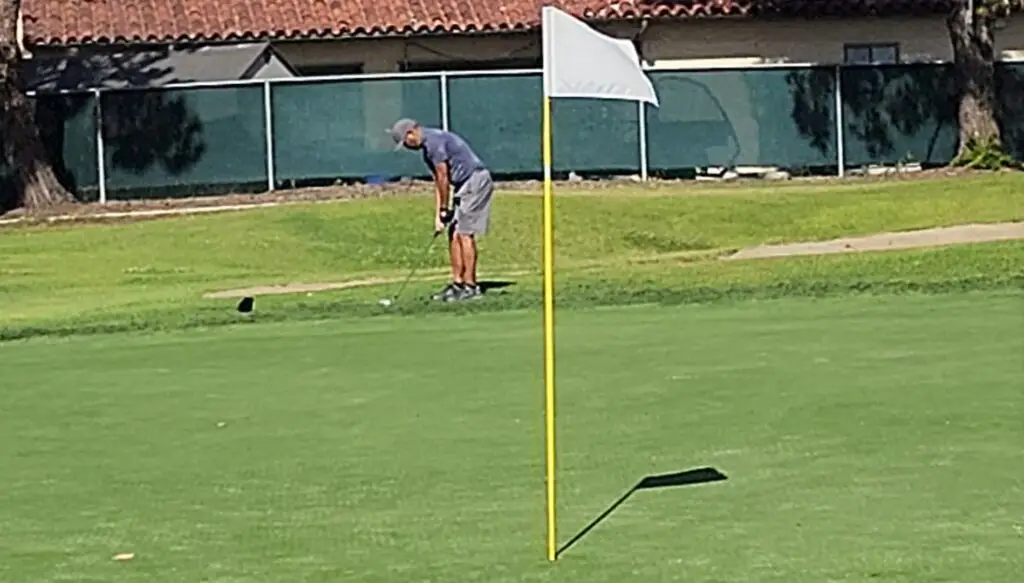
Here’s where I’ll admit something most golfers won’t: I love my 60-degree lob wedge. It’s my favorite short game club. And the flop shot — when I need to hit it high with spin and stop it fast — is a shot I’ve put serious practice time into.
The flop shot is a high-risk, high-reward play. It requires a clean lie, a committed swing, and complete trust in the technique. For golfers over 50 who haven’t practiced it, the flop shot can be a card-wrecker. But for those who have put in the reps, it’s an irreplaceable weapon.
My flop shot setup with the 60-degree:
- Open the clubface significantly — I’m adding loft beyond the 60 degrees already built in
- Open my stance to match the clubface angle
- Make a full, committed swing — the biggest mistake on flop shots is decelerating through impact
- Trust the loft and let the ball pop up — don’t try to help it into the air
The result when executed correctly is a high, soft shot that lands with spin and stops quickly. It’s a shot that requires the right lie and the right situation — but when those conditions are there, the 60-degree flop is the most satisfying shot in golf.
Bunker Play: The 60-Degree Out of the Sand
I’ll be honest about my bunker play: I’m a competent sand player, not an expert. Nine times out of ten, I’m reaching for the 60-degree lob wedge in the bunker. I open the face, open my stance, and cut across the ball to generate spin and height. When I execute it well, I can spin it close and give myself a makeable putt.
The one challenge I have with my 60-degree in bunkers is the high bounce. My lob wedge has significant bounce, which is designed to prevent the club from digging too deep into the sand. But at times — especially in firm sand — I tend to dig too much and skull the ball over the green. It’s an area where I know I need more practice, and I’m honest about that. Understanding your wedge specs — especially bounce — is one of the most overlooked factors in short game improvement, and the USGA has great resources on equipment rules and specs worth bookmarking.
For golfers over 50 working on bunker play, here are the fundamentals that help me most:
- Open the face before you grip the club. Set the face angle first, then take your grip. This keeps the face open through impact.
- Dig your feet in. Getting your feet below the sand level lowers your swing arc and helps you contact the sand behind the ball consistently.
- Hit the sand, not the ball. Pick a spot an inch or two behind the ball and make that your target. The sand pushes the ball out.
- Commit and accelerate. A decelerated bunker shot is a disaster. Make a full swing and follow through completely.
- Goal number one: get out. In tournament play, getting out of the bunker in one shot is always the priority — worry about proximity after.
Around the Green: When to Chip, Pitch, or Putt
One of the most important decisions in the short game for golfers over 50 is choosing the right shot type before you even pull a club. Chip, pitch, or putt — the wrong choice costs strokes even with perfect execution.
My decision tree:
- Putt first. If the lie is clean and there’s nothing between my ball and the hole — no rough, no collar, no significant fringe — I putt. Always. A bad putt is better than a good chip. The putter is the highest percentage club in your bag from short distances.
- Chip second. When I can’t putt but the lie allows me to land just on the green and roll, I chip with my PW or GW. Simple, controlled, predictable.
- Pitch or flop last. Only when I need height to carry an obstacle, need spin to stop the ball quickly, or the lie demands a higher lofted club.
The most common mistake I see amateur golfers make around the green is reaching for the lob wedge first. They want to look cool hitting a high spinning shot when a simple chip or putt would have been 10 times more effective. Short game for golfers over 50 is about getting the ball close with the highest percentage shot available — not the most impressive one.
The Twin Oaks Chip-In: Trust the Read, Trust the Feel
The best short game shot I’ve hit in tournament play came at Twin Oaks in an SCGA One Day Series event. I was on a 500-yard par 5 and had worked my way up to a delicate chip shot — about 8 feet from the hole with the green running sharply away from me downhill.
This is exactly the situation where the short game for golfers over 50 gets tested. Too much club, too much speed — and the ball races well past the hole on a sloping green. Not enough and I’m leaving myself a difficult downhill putt with serious break. The green sloping away meant I needed height, soft hands, and total commitment to the read.
I was in the rough. I pulled my 60-degree lob wedge, opened the face, and made a smooth committed swing — landing the ball just 18 inches into the rough, before the fringe. It checked up immediately, held for a split second, then released and trickled through the fringe and 6.5 feet across the sloping green and into the hole for a birdie 4 on the par 5.
Think about what that shot required. I wasn’t landing it on the green — I was landing it in the rough before the fringe and trusting the spin to check it, then the slope to carry it the rest of the way. The read, the feel, the commitment to the 60-degree out of the rough — everything had to be right. That kind of shot only works when you trust it completely before you pull the trigger. No adjustments mid-swing, no second-guessing the club choice. That’s the mental side of the short game for golfers over 50 that never gets talked about enough: once you commit to the shot, you commit completely.
You can read the full round recap in the Twin Oaks SCGA recap.
Build Your Short Game: The Over-50 Approach
The short game for golfers over 50 doesn’t require elite athleticism or perfect technique. It requires smart decision-making, the right club for each situation, and the willingness to practice the shots that show up most often in your rounds.
Start with the basics: putt when you can, chip with your PW or GW when you can’t, and save the high-lofted wedge for situations that actually demand it. Practice your 60-degree if you want to have the flop shot available — but earn it on the practice green before you pull it out in a tournament.
The short game is also closely tied to putting — specifically eliminating 3-putts after you get the ball on the green. For a complete breakdown of my putting routine and practice process, check out the full 50+ Golfer’s Guide to Scoring Lower. And follow the @115at56 journey as I keep competing, keep training, and keep lowering scores at 56.