
Affiliate Disclosure: This article contains affiliate links. If you purchase through these links, I may earn a commission at no additional cost to you. I only recommend products I personally use and trust.
Greens in regulation is one of the most cited statistics in golf — and one of the most misunderstood. Tour pros average around 65 percent GIR. Scratch amateurs hit around 50 percent. Most weekend golfers are between 20 and 30 percent. The conventional wisdom says: hit more greens, score lower. That math seems obvious. Except the data from my own 2026 season tells a different story.
At the SCGA Senior Amateur Qualifier at El Camino CC in May 2026, I hit 13 greens on 18 holes — 72 percent GIR, my best ball-striking round of the year. I shot 83. The qualifying number was 77. I missed by six strokes with a GIR percentage better than most tour pros. That round taught me everything I needed to know about why greens in regulation is not the scoring stat most golfers think it is.
This article explains what GIR actually means, how the math works, why it matters less than you have been told, and what I learned at age 56 about which stats actually predict scoring. If you have ever wondered why your handicap is not dropping despite hitting more greens, this is your answer.
What Does GIR Mean in Golf?
GIR stands for greens in regulation. It is the standard abbreviation used on tour broadcasts, amateur scorecards, and every golf stat tracking app from Arccos to GolfShot to the PGA Tour’s own ShotLink system. When you see GIR next to a player’s name on a leaderboard, it is telling you what percentage of holes that player reached the putting surface in the expected number of strokes.
The GIR abbreviation shows up constantly in golf media, but the definition is often assumed rather than explained. GIR golf meaning breaks down simply: it is a binary stat. Either you hit the green in the regulation number of strokes or you did not. There is no partial credit for hitting the fringe, no bonus for getting close from a difficult position, and no penalty calculation for how far from the hole you finished. One green, one question — were you on the putting surface in the right number of strokes?
The stat originated as a way to separate ball-striking quality from putting quality on tour. If a player hits 16 greens in regulation and shoots 75, the analysis becomes interesting: the ball-striking was exceptional, so the scoring problem was elsewhere. GIR golf stat analysis at the tour level triggered the entire strokes-gained revolution in golf statistics, which is now the gold standard for understanding where strokes are actually gained and lost. For amateurs, GIR remains useful as a simpler proxy — but the limitations of that simplicity are exactly what this article addresses.
What Are Greens in Regulation?
Greens in regulation is a simple statistic with a precise definition. You hit a green in regulation when your ball is on the putting surface in the following number of strokes:
- Par 3: 1 stroke (your tee shot lands on the green)
- Par 4: 2 strokes or fewer
- Par 5: 3 strokes or fewer
The rule is simple: par minus two equals the number of strokes you have to reach the green. Anything beyond that, and you have missed the green in regulation, even if you are inches off the putting surface in the fringe or just-off rough. GIR is measured strictly — fringe does not count as on the green for the stat.
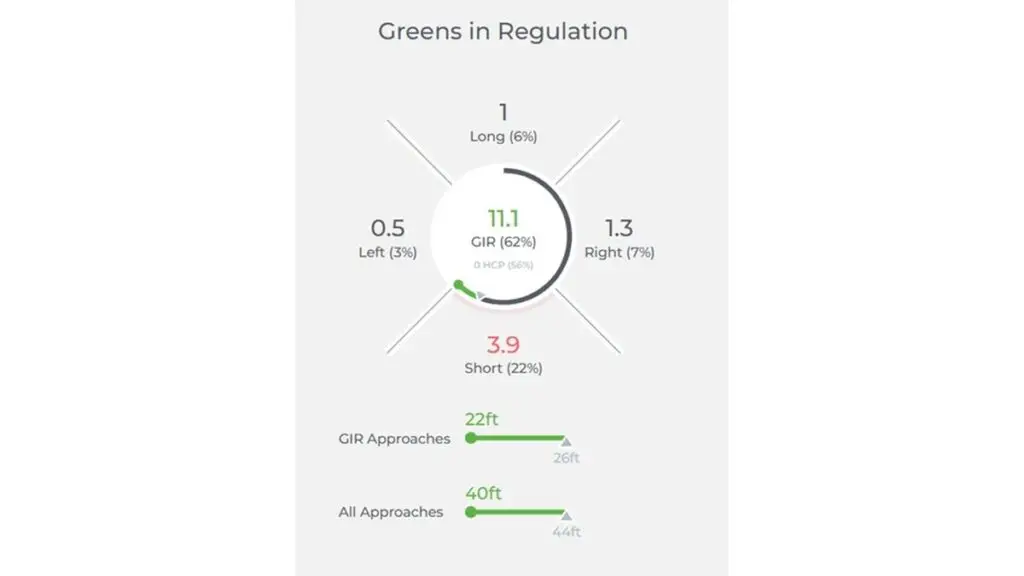
A typical round has 18 GIR opportunities, one per hole. If you hit 9 of them, you have 50 percent GIR. If you hit 13, you have 72 percent. The number you see on your scorecard tracker, on Arccos, on GolfShot, or on any modern golf app is calculated this way.
Does the Fringe Count as a Green in Regulation?
No. The fringe does not count as a green in regulation. This is one of the most common greens in regulation questions I get, and the answer is unambiguous: the ball must be on the actual putting surface — not in the fringe, collar, or apron. Even if your ball is one inch off the putting surface in the fringe, it is a missed greens in regulation. There is no partial credit for close misses.
The fringe — sometimes called the collar or the apron — is the short grass immediately surrounding the green that is cut slightly longer than the putting surface itself. It looks close enough to count. It is not. If your approach shot rolls through the green and stops in the fringe three inches from the putting surface, you have missed the green in regulation.
This matters more than it sounds. Many amateur golfers mentally give themselves partial credit for a “close miss” when their ball lands in the fringe. That mental accounting makes GIR look better than it is and obscures where the real work needs to happen. On Arccos, the sensors detect your location precisely enough that fringe shots are typically recorded correctly — you will not get GIR credit for a fringe position. If you are manually tracking greens in regulation on a paper scorecard, be strict about the definition. The fringe does not count.
The one nuance: what counts as a green in regulation from a rules perspective is about the putting surface boundary, which is marked by where the cut of grass changes. On well-manicured courses this is obvious. On older or less-maintained courses it can be ambiguous at the edges. When in doubt, if you needed a putter to make a normal putting stroke, it probably counted. If you were debating between a chip and a putt, you were probably in the fringe — and that is a miss.
Why Greens in Regulation Is the Most Tracked Stat in Golf
Greens in regulation became the dominant amateur scoring stat for a simple reason: it is easy to measure, it correlates loosely with skill, and tour broadcasts cite it constantly. Hit more greens, the logic goes, and you give yourself more birdie putts, which lowers your score.
The correlation between GIR and scoring is real. On the PGA Tour, the top GIR leaders are typically among the better scorers. Across large amateur samples, players with higher percentages score better on average. As a directional indicator that your ball-striking is improving, GIR is useful. As an indicator that your scoring will improve, it is far less reliable than golfers have been led to believe.
The trap is that this stat only measures one thing: did you reach the putting surface in the expected number of strokes. It says nothing about how close to the hole you finished. It says nothing about what you do after you reach the green. It says nothing about how you score on the holes where you miss the green. And it especially says nothing about putting — which is where most rounds are won and lost.
My El Camino Round: 72 Percent Greens in Regulation, 83 Total
Here is the round that taught me to stop trusting greens in regulation as a scoring predictor. At the SCGA Senior Amateur Qualifier at El Camino Country Club in May 2026, I hit 13 of 18 greens. That is a 72 percent GIR clip — better than the PGA Tour average of approximately 65 percent and dramatically better than the typical senior amateur in the 30 to 40 percent range.
A 72 percent GIR round should produce a score in the high 60s to mid 70s for a player of my skill level. Instead, I shot 83. I missed the qualifying number by six strokes. The stat painted a picture of a strong ball-striking round — which it was. The scoreboard told a different story.
The reason was putting. I had seven three-putts on those fast El Camino greens. Forty putts total over 18 holes. The greens were running 12 to 13 on the stimpmeter and I had never played the course before. Every long lag putt was either three feet long or four feet short. The math was unforgiving: 13 GIR meant 13 chances to two-putt for par. I missed seven of those chances by three-putting. That is seven strokes given back on the greens — strokes that no amount of additional greens in regulation could have saved.
The El Camino round is the single best example I can give of why GIR is not the scoring stat amateur golfers should obsess over. Putting is. I covered the full breakdown in the El Camino recap and built a follow-up article on how to stop 3-putting that turned out to be the real lesson from the round.
Greens in Regulation Versus Putts Per Round
If greens in regulation is overrated as a scoring predictor, what is the better stat to track? The answer is some combination of putts per round, putts per GIR, and three-putt percentage. Here is why.
Putts per round measures total strokes spent on the green. Tour pros average around 29 putts per round. Scratch amateurs average around 31. Most weekend golfers average 33 to 36. Every putt above the average is a stroke you could be saving. My El Camino round had 40 putts. That alone explains most of the 83 score.
Putts per GIR is more revealing because it normalizes for ball-striking. Tour pros average around 1.78 putts per green hit. Scratch amateurs average around 1.85. If your putts per GIR is above 2.0, you are giving back strokes on every green you hit. My El Camino putts per GIR was approximately 2.3 — disaster putting on a high-GIR round.
Three-putt percentage is the simplest scoring leak indicator. Tour pros three-putt under 3 percent of greens. Scratch amateurs around 5 percent. Most amateurs are at 10 to 20 percent. My El Camino three-putt percentage was 54 percent — seven three-putts on 13 GIR greens. That is the kind of stat that ends qualifying chances regardless of how many greens you hit.
When Greens in Regulation Actually Matters
Greens in regulation is not useless. It is just over-relied-upon as the single answer to “am I getting better at golf.” There are specific situations where GIR is meaningful.
First, GIR is a useful trajectory indicator. If your percentage is climbing season-over-season, your iron play is improving. That is real progress, even if your scoring is not yet reflecting it. For me, my swing speed work over the past 17 months shows up clearly in my GIR numbers — I went from being a 40 percent player at 89 mph to a 55 percent player at 111 mph. The gain is real even when individual scores fluctuate.
Second, GIR matters for comparing yourself to skill benchmarks. If you want to know whether your ball-striking is at a 5-handicap level versus a 15-handicap level, this is one of the cleanest comparisons available. Just do not assume your GIR alone predicts your score.
Third, GIR matters in conjunction with proximity-to-hole data. Hitting 13 greens means nothing if you average 50 feet from the hole. Hitting 9 greens with an average proximity of 20 feet is a more productive round. The stat needs context from proximity to be useful — which is exactly what tools like Arccos Smart Sensors provide.
Greens in Regulation by Handicap: The Real Benchmarks
Here are honest greens in regulation benchmarks by handicap level, based on USGA handicap data and PGA Tour statistics:
- PGA Tour average: 65 to 68 percent (about 12 of 18 greens)
- Scratch amateur (0 handicap): 50 to 55 percent (about 9 to 10 greens)
- 5 handicap: 40 to 45 percent (about 7 to 8 greens)
- 10 handicap: 30 to 35 percent (about 5 to 6 greens)
- 15 handicap: 20 to 25 percent (about 4 to 5 greens)
- 20 handicap: 15 to 20 percent (about 3 to 4 greens)
If your GIR percentage is well above your handicap-implied range but your scores are not dropping, putting is almost certainly your scoring leak. That is the El Camino lesson in one sentence. If your greens in regulation is below your handicap-implied range, then iron play is your priority.
How to Actually Improve Your Greens in Regulation
For golfers who do want to genuinely raise their GIR percentage, the answer is rarely “hit more iron shots at the range.” It is almost always about course management, club selection, and proximity off the tee. Here are the highest-ROI moves.
Club up on approach shots. Most amateurs under-club because they remember their best swing instead of their average swing. If your 7-iron carries 150 yards on a perfect swing but averages 140 yards including mishits, you should be hitting 6-iron from 150 yards. That single shift in club selection raises GIR more than any swing change.
Aim for the center of the green. Pin-hunting is the enemy of greens in regulation. Even tour pros aim for the fat of the green on most approach shots. Eliminate the short-side miss and you instantly raise your percentage.
Improve your tee-shot proximity. GIR correlates more strongly with how far you hit your tee shot than with iron skill. Shorter approach shots produce higher GIR. That is one of the reasons swing speed affects scoring so directly — every extra 10 mph of driver speed shortens your approaches, which raises your hit rate.
Use the right club from the rough. Most missed greens come from rough lies where amateurs use their normal-distance club. Take an extra club, accept the lower trajectory, and you turn 40 percent green-find rates from the rough into 60 percent.
How Greens in Regulation Affects Your Score: The Real Math
Here is the specific math on how greens in regulation affects your score — and why the effect is smaller than most golfers expect. The calculation starts with a simple assumption: every green you hit in regulation gives you two putts to make par. Miss the green and you need a chip or pitch plus one putt — also roughly two strokes — to save par. So in theory, hitting more greens in regulation should be neutral on par saves and only positive for birdie chances.
The problem is that assumption breaks down in both directions. When you hit greens in regulation, you do not always two-putt. If your approach leaves you 40 feet from the pin, you are going to three-putt a meaningful percentage of those. When you miss greens in regulation, you do not always bogey. A skilled short game converts a lot of misses into par saves. The scoring effect of greens in regulation is therefore highly dependent on proximity and putting — two things the stat itself does not measure.
The actual scoring math from USGA research and strokes-gained data suggests that each additional green in regulation is worth approximately 0.3 to 0.5 strokes — not the full stroke that conventional wisdom implies. The reason the value is less than one stroke is exactly the above: missed greens do not automatically cost you a stroke, and hit greens do not automatically save one. The putting and short game layer on top of GIR is where the rest of the scoring equation plays out.
For me at a 3 handicap, hitting one additional green per round in regulation is worth roughly 0.4 strokes in scoring. That is real value over a full season. But seven three-putts in a single round cost me seven strokes — seventeen times the value of one additional green. Greens in regulation affects your score at the margin. Putting affects it in bulk. That is the math the stat does not show you.
Frequently Asked Questions About Greens in Regulation
What does GIR mean in golf?
GIR stands for greens in regulation. It measures whether you reached the putting surface in the expected number of strokes: one shot on a par 3, two shots on a par 4, three shots on a par 5. A greens in regulation percentage is the number of holes where you accomplished this divided by total holes played. Tour pros average around 65 to 68 percent greens in regulation. Most amateur golfers range from 20 to 50 percent depending on handicap level.
Does the fringe count as a green in regulation?
No. The fringe does not count as a green in regulation. Your ball must be on the actual putting surface — not in the fringe, collar, or apron. Even if your ball is one inch off the putting surface in the fringe, it is a missed greens in regulation. There is no partial credit for close misses. Stat tracking apps like Arccos record fringe positions accurately and will not give you GIR credit for a fringe lie.
What is a good greens in regulation percentage for an amateur?
A good greens in regulation percentage depends on your handicap. A scratch golfer (0 handicap) typically hits 50 to 55 percent of greens in regulation. A 5-handicap hits 40 to 45 percent. A 10-handicap hits 30 to 35 percent. A 15-handicap hits 20 to 25 percent. If your greens in regulation percentage is significantly higher than your handicap-implied range, putting is likely your primary scoring leak — not ball-striking.
How many greens in regulation do pros hit per round?
PGA Tour pros average 11 to 12 greens in regulation per round, which works out to 65 to 68 percent. The tour leaders in greens in regulation typically hit 13 to 14 per round (72 to 78 percent). These numbers are dramatically higher than amateur averages because tour players hit longer and more accurate approach shots from shorter distances due to their driving distance advantage.
How does greens in regulation affect your score?
Each additional green in regulation is worth roughly 0.3 to 0.5 strokes in scoring, according to strokes-gained research. The effect is smaller than most golfers expect because missed greens do not always cost a stroke (a good chip saves par) and hit greens do not always save one (a three-putt wastes the advantage). Greens in regulation affects your score at the margin. Putting and proximity-to-hole data have a much larger per-stroke impact on scoring than GIR alone.
What is the difference between greens in regulation and fairways hit?
Greens in regulation measures whether you reached the putting surface in the expected stroke count. Fairways hit measures whether your tee shot on par 4s and par 5s landed in the fairway. Both are ball-striking stats, but they measure different things. Fairways hit tracks driving accuracy. Greens in regulation tracks approach shot accuracy. Neither stat measures putting, short game, or scoring efficiency. Both are most useful as trajectory indicators over a full season rather than round-by-round scoring predictors.
Greens in Regulation Is a Starting Point, Not the Answer
After 25 years of competitive amateur golf and 17 months of detailed Arccos data, here is what I have learned about greens in regulation: it is a useful stat for tracking ball-striking trajectory, comparing yourself to skill benchmarks, and identifying whether iron play or short game is your priority. It is not a reliable predictor of any single round score. It is not the answer to lower scoring. And it is not where most amateurs should be focusing their practice time.
If your goal is to score lower, start with putts per round and three-putt percentage. Fix those before you obsess over greens in regulation. The El Camino round taught me that lesson at 56 years old, and I am still working through the implications. My 13 GIR that day were the best ball-striking of my season. My seven three-putts were what cost me the qualifying number. That is the truth about greens in regulation that the conventional golf wisdom does not tell you.
For more on the scoring leaks that actually predict your handicap, read The 50+ Golfer’s Guide to Scoring Lower. For the putting work that turns high-GIR rounds into low scores, read How to Stop 3-Putting. GIR gets you to the green. Putting is what gets you in the hole.