
This article may contain affiliate links. If you click one and make a purchase, I may earn a commission at no extra cost to you. I only recommend products I personally use and believe in.
If you want to know how to hit irons better after 50, here’s the truth from a 56-year-old 3-handicap who learned it the hard way: iron consistency is the most overlooked weakness in the golfer-over-50 game. We chase distance off the tee, we grind on putting, and we let our irons quietly fall apart. Then a windy day on a tight course exposes everything.
This guide breaks down exactly how to hit irons better — the drills, the swing thoughts, the practice structure, and the mental discipline that turns mediocre iron play into the strongest part of your scoring game. No generic tips. No “just swing slower.” Real changes that work for amateur golfers competing after 50. If you’ve been searching for how to hit irons better and getting the same recycled advice every time, this is the article that actually delivers — written by a competitive golfer who learned how to hit irons better the hard way.
Why Your Iron Game Falls Apart After 50
Three things happen to most amateur golfers as they age past 50:
1. Training time gets reallocated. If you’re working on swing speed, your range time becomes speed work. If you’re focused on putting, your short game time becomes putting drills. Iron practice gets the leftover minutes — which usually means nothing. I know this because I lived it for 15 months.
2. Decel creeps in. As we age, we instinctively start “guiding” the ball instead of swinging through it. The body protects itself. The result: fat shots, thin shots, and a sudden inability to commit to any iron shot under 150 yards. Most fat shots after 50 aren’t a swing flaw — they’re a deceleration habit.
3. Setup drifts without us noticing. Ball position migrates forward. Posture rounds. Weight stays back through impact. Small drifts that wouldn’t show up at 35 absolutely show up at 55, especially when the wind blows.
The result is the pattern I lived through Vegas: 77% fairways hit, 33% greens in regulation. The driving was elite. The iron game ate me alive. If you want the full story behind that lesson, see my Vegas iron game breakdown.
How to Hit Irons Better: The Five Things That Actually Work
After 15 months of focused training and one brutal Vegas wake-up call, here’s what genuinely moves the needle on iron consistency for the golfer over 50.
1. Commit to One Iron-Only Range Session Per Week
This is the foundation. One range session per week, dedicated to irons only. No driver. No speed sticks. No fairway woods. Just iron shots to specific targets at specific distances.
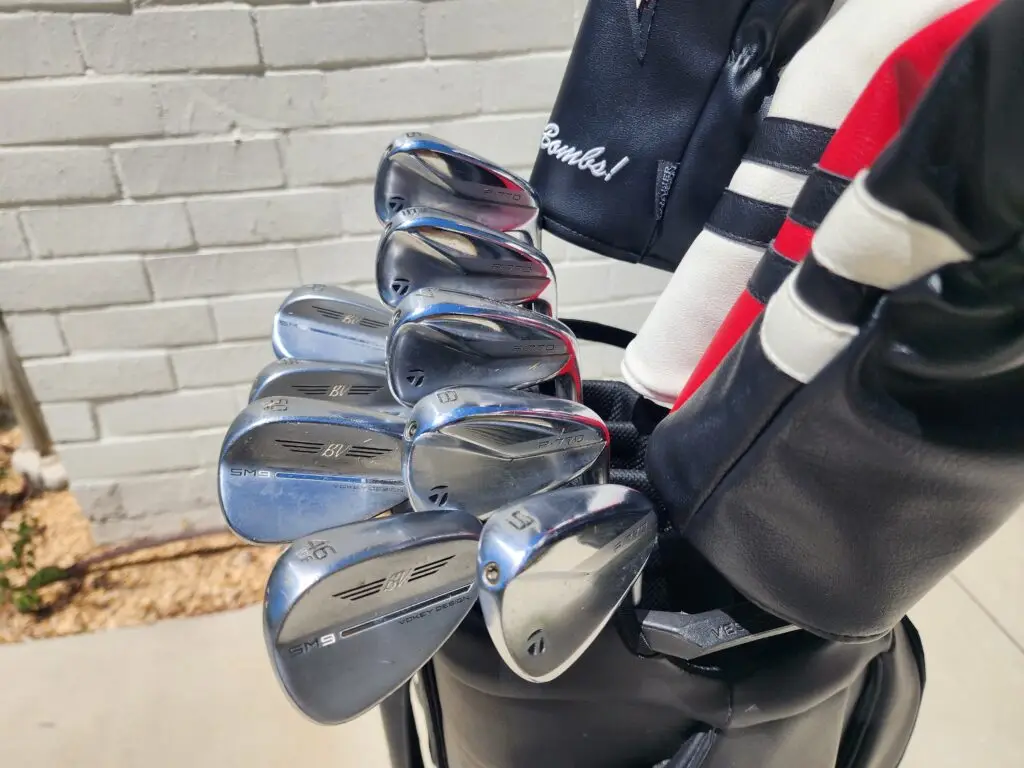
My current setup: 5-iron through 9-iron, plus my Vokey wedges (46° PW, 50°, 56°, 60°). I work through the bag in order. Ten balls per club. Every shot has a target. Every shot has a distance.
Why one session per week and not three? Because you also need to keep your other practice going — speed work, putting, short game. Iron consistency comes from focused repetition, not maximum repetition. Sixty quality iron shots once a week beats two hundred careless shots spread across three sessions.
2. Distance Control: The Three-Distance Drill
If you want to hit irons better, you have to know exactly how far each iron goes — not the maximum, not the average, but the controlled distance you can hit on demand under pressure.
Here’s the drill: with each iron, hit five shots at three different distances:
- Full swing distance — your stock yardage
- Three-quarter swing — your “knock down” yardage
- Half swing — your “punch shot” yardage
Track each one. Write the distances down. After three or four sessions, you’ll have a complete chart of every iron at three different commitment levels. That’s gold on the course — especially when the wind blows.
My 7-iron numbers from this drill: full swing 165, three-quarter 145, half swing 125. When I’m 145 into the wind, I don’t try to “ease back” my full 7-iron. I commit to a three-quarter 7-iron at exactly 145. Different shot. Same commitment. For reference on every iron in my bag, see my full golf club distance chart at 106 mph — Arccos-tracked carry distances, dispersion patterns, and the iron data that revealed where my own gaps live.
3. Wind Shots: Punch It and Knock It Down
Most golfers over 50 don’t have wind shots. We have one shot — full swing — and we hope. That’s why a 15 mph headwind turns a 150-yard approach into a guessing game.
Two shots you should own:
The knock-down. Take one or two clubs more than your stock yardage. Move the ball back in your stance one ball width. Choke down half an inch. Three-quarter swing, finish low. The ball comes out lower with less spin and bores through the wind.
The punch. Take three or four clubs more. Ball back two ball widths. Full grip-down. Half swing. Hands stay low through impact. This shot stays under 20 feet of trajectory. Ugly but effective.
You can’t develop these shots on the course. You build them on the range. Five knock-downs per club, every iron-only session.
4. Read Your Divot Patterns
Your divots tell you everything about whether you’re hitting irons better or just hoping. Most golfers ignore them. Don’t.
What good divots look like:
- Thin and shallow — about the depth of a credit card
- Starts forward of the ball position (target side)
- Points slightly left of target (right-handed golfer) — this is normal swing path
- Consistent length and depth shot to shot
What bad divots tell you:
- No divot at all → you’re hitting up on the ball (deceleration or weight back)
- Deep divots → you’re casting from the top, too steep
- Divot starts behind the ball → fat shot pattern, weight back at impact
- Divot points hard left → over-the-top swing path
- Divot points hard right → coming too far from inside, blocked shot
After every iron-only range session, look at five of your divots. Pattern matters more than any single shot. If you’re consistently leaving no divot, you have a deceleration problem. If you’re taking deep gouges, you’re getting too steep. The divots don’t lie. For a deeper look at swing path and impact mechanics, the TPI golf fitness research covers what your divot patterns reveal about your body’s movement at impact.
5. Preshot Routine on Every Swing — Including the Bad Ones
The single biggest reason golfers over 50 hit poor irons isn’t physical. It’s mental disengagement. We get tired. We rush. We stop visualizing. We just hit the ball.
A real preshot routine before every iron shot — every single one — is non-negotiable. Mine takes about 12 seconds:
- Stand behind the ball. Pick a target.
- Visualize the shot shape and trajectory.
- Two practice swings — same tempo I want for the real swing.
- Step in. Align club face first, then feet.
- One look at the target, one look at the ball, swing.
When I skipped this routine on the back nine at Paiute Wolf, I shot 51 on nine holes. When I held the routine for the next four tournament rounds, I shot 84-74-74-75. Same golfer. Same swing. Different commitment to staying present. The mental game on the course isn’t a separate skill — it’s the foundation that lets every other skill show up.
My Iron Setup (For Reference)
For credibility, here’s exactly what I’m playing right now:
- Irons: TaylorMade P770s, 5-iron through 9-iron
- Shafts: Dynamic Gold 105 Stiff S300
- Lie angle: 2 degrees flat (custom fit)
- Wedges: Vokey SM9 — PW (46°), GW (50°), SW (56°), LW (60°)
The lie adjustment matters. At 5’8″, standard lie irons sat too upright for me, sending shots left. The custom 2° flat fitting fixed a directional miss I’d fought for years. If you’re playing standard lie clubs and consistently missing one direction, get fitted. Custom lie and length are the cheapest distance/accuracy upgrades available to a golfer over 50.
Want to see exactly what those P770s produce on the course? My complete golf club distance chart at 106 mph breaks down every iron with Arccos-tracked carry distance, typical range, and longest tracked shot — plus the dispersion patterns that revealed a 6-iron deceleration problem I never knew I had until I looked at the data.
How Speed Training and Iron Play Work Together
There’s a misconception that working on swing speed hurts your iron game. It doesn’t — but ignoring iron practice while you train speed will. The speed work I’ve done with the Stack System took my driver baseline from 89 mph to 106 mph in 15 months. That same training shows up in iron distance: I’m hitting my 7-iron 165 yards consistently versus 152 yards before training.
The problem isn’t the speed work. The problem is letting iron practice atrophy while the speed work happens. Both can — and should — coexist in your weekly schedule:
- Speed days: 3 sessions per week (Stack System or your overspeed protocol)
- Iron-only range session: 1 session per week, 60 quality shots
- Short game / putting: 1-2 sessions per week
- Course play: 1-2 rounds per week
That’s a complete weekly schedule. Speed training adds distance. Iron practice maintains accuracy. Neither cancels the other when you give both real time.
Common Iron Mistakes Golfers Over 50 Make
A few patterns I see constantly — and have lived through myself:
Trying to lift the ball. The clubface is designed to do this for you. Trust the loft. Hit down on the ball, take a divot in front of it, let the design lift the shot.
Decelerating into impact. Almost all fat shots after 50 come from this. The body anticipates contact and pulls back. The fix: commit to accelerating through impact every single shot. If you’re going to miss, miss aggressive.
Playing the wrong yardage. Most amateurs play their absolute maximum yardage as their “stock” number. That’s a mistake. Stock yardage should be your relaxed yardage — what you can repeat under pressure. Knock 5-10 yards off your max distance and use that.
Ignoring lie angle. If you’ve never been fitted, your lie angle is probably wrong for you. This single fitting variable affects directional accuracy more than almost anything else. A standard fitting takes an hour and pays back in every round you play.
Practicing on flat range mats. Range mats lie to you. The mat lets you bounce the club into the ball even on a fat strike, so your divot pattern looks fine when your contact is actually terrible. Hit at least some of your iron-only sessions off real grass when you can.
A 4-Week Plan to Hit Irons Better
If you’re starting today, here’s a structured four-week approach:
Week 1 — Establish Distances. One iron-only session. Run the three-distance drill on every iron from 5-iron through 9-iron and your PW. Write down full, three-quarter, and half-swing distances for every club. This is your reference chart.
Week 2 — Wind Shot Foundation. One iron-only session. Spend it entirely on knock-downs and punch shots. Every iron, five knock-downs and five punches. Track distances on these too.
Week 3 — Divot Pattern Audit. One iron-only session. After every five shots, walk forward and study your divots. Photograph them if needed. Identify the pattern. If you have no divots at all, your priority going forward is committing through impact. If your divots are deep gouges, you’re casting — work on a smoother transition.
Week 4 — Pressure Reps. One iron-only session, but every shot must follow your full preshot routine. No casual swings. Every shot gets the 12-second routine. This is the closest thing to tournament pressure you can simulate on a range.
After four weeks of this structure, you’ll know your real distances, you’ll have wind shots in the bag, you’ll understand your divot pattern, and you’ll have built the preshot habit that holds up under pressure. That’s the foundation.
When Your Iron Game Will Actually Show Up
Iron consistency doesn’t show up on calm days at familiar courses. You can fake it there. Your weakness only reveals itself when conditions get hard — wind, unfamiliar courses, tournament pressure, tight pin positions.
That’s exactly what happened to me at Paiute Wolf in Vegas. 35 mph wind on a Pete Dye course I’d never played. My driving was elite — 77% fairways, 270+ yard drives into the wind. But when I had the second shot, the iron game weakness showed up immediately. 33% greens in regulation. Three holes worth of doubles and a quad. A 93 in conditions where my actual game shoots 78.
Two days later on shorter, calmer courses, I shot 74-74-75 in tournament play. Same golfer. Same irons. Different conditions. The lesson: scoring lower after 50 isn’t about playing well in good conditions. Anyone can do that. It’s about your bad days being a 78 instead of a 93.
The work outlined above — distance control, wind shots, divot patterns, preshot routine, dedicated weekly practice — is what closes that gap. Not theory. Real reps that prepare you for the day the wind blows on a course you’ve never played before.
The Bottom Line on How to Hit Irons Better After 50
If you want to hit irons better, the fundamentals are simple but the discipline isn’t:
- One dedicated iron-only range session per week, every week.
- Know your full, three-quarter, and half-swing distance for every iron.
- Build at least two real wind shots — knock-down and punch.
- Read your divot patterns honestly. They tell you what your swing is actually doing.
- Run a full preshot routine on every shot, every time. No exceptions.
None of this is glamorous. None of it gets posted on Instagram. It won’t add 20 yards or trend on TikTok. But this is genuinely how to hit irons better after 50 — the work that turns iron play from your weakness into your strength, and that’s where lower scores come from when you’re past 50.
My next iron-only session is Tuesday. Range opens at 7:00 AM, I’ll be there with the 5-iron through 9-iron plus PW and my divot eyes on. Same as last week. Same as next week. That’s the entire secret.
Related reading: