
Affiliate Disclosure: This post contains affiliate links. If you purchase through my link, I earn a small commission at no extra cost to you — and you automatically get 10% off the Stack System. I only recommend tools I’ve personally used.
If you’re weighing the Stack System vs SuperSpeed for overspeed golf training, I’ve been in your shoes — literally. I’ve used both. Not back-to-back in a controlled test, but in the real-world, busy-golfer-over-50 way where you try something, stick with it as long as you can, measure the results, and decide. Here’s my honest Stack System vs SuperSpeed take after two years and 17 mph of gains.
How I Ended Up Comparing Stack System vs SuperSpeed
About two years ago I had no idea overspeed training for golf even existed. A friend mentioned SuperSpeed and I figured it was worth a shot. I was sitting somewhere around 87 mph driver swing speed — not terrible, but not where I wanted to be. I bought the SuperSpeed system and committed to it seriously for two months. Then I found the Stack, traded in my SuperSpeed clubs, and everything changed. I’m now at 106 mph and climbing, working through Program 7 of the Stack. My handicap dropped from 7 to 3. I’m 56 years old. So yes — I have opinions on the Stack System vs SuperSpeed question, and they’re based on actually using both.
Stack System vs SuperSpeed: What SuperSpeed Actually Is
Before getting into the Stack System vs SuperSpeed differences, you need to understand what SuperSpeed is. It’s a three-club system. Each club has a different weight and a different color so you know which one you’re grabbing — typically a green (lightest, ~20% lighter than a standard driver), a blue (roughly driver weight), and a red (heaviest, ~5% heavier than a driver).
The protocol involves swinging each club at maximum effort — and here’s the part most people don’t mention upfront — you swing both right-handed and left-handed. The theory is that training your non-dominant side helps unlock speed on your dominant side. That’s actually a legitimate training concept. My issue wasn’t the theory. My left side was noticeably weaker. Swinging from the opposite side felt awkward and unnatural, especially early on. There’s a learning curve there that nobody really prepares you for.
The protocol asks you to swing each club a set number of times per session, typically three days a week, with rest days in between — and honestly, even getting clear answers about how to progress between protocols required digging through their website and YouTube content.
The bigger Stack System vs SuperSpeed problem for me was the accountability structure — or the lack of one. When I used SuperSpeed two years ago, there was no app. You tracked your swing speeds on paper. You scheduled your own sessions. You decided when to move forward in the protocol. For some people that’s fine. For me, with a job, a life, and a golf game I’m trying to improve on top of everything else, it felt like one more thing I had to manage manually. And over time, manually managed things slip.
After two months I had no measurable speed gains. I threw away my logs because they felt pointless without anything pulling the data together into something meaningful. The whole process started feeling obsolete. I stopped.
Important note: SuperSpeed launched an app in late 2024 — available on iOS and Android — that now includes progress tracking, guided protocols, and data analytics. I haven’t used it, so I can’t review it firsthand. But I’ll say this: the fact that they built it validates exactly what was missing from my experience. The need for digital accountability is real, and SuperSpeed recognized that. If you’re considering SuperSpeed today, the app changes the Stack System vs SuperSpeed picture somewhat compared to what I used.
The Science Behind the Stack System vs SuperSpeed Approach
Both products are trying to do the same thing. Overspeed training is built on a concept called the overload-underload principle — alternating between swinging implements that are lighter than your normal club (to teach the body to move faster) and heavier than your normal club (to build strength through that movement pattern). The brain learns that moving fast is possible, and the body adapts.
Peer-reviewed research supports the underlying mechanism. A 2021 systematic review published in the Journal of Strength and Conditioning Research examined resistance training methods for golf performance and concluded that 8-week programs incorporating golf-specific movements performed at high velocities were the most effective approach for increasing clubhead speed and hitting distance.
That’s the foundational principle both systems share. The Stack System vs SuperSpeed debate is not really a debate about whether overspeed training works — both systems exploit the same mechanism. The mechanism works. That’s the easy part.
The hard part — and the thing that actually differentiates Stack System vs SuperSpeed in practical terms — is sustaining a protocol long enough to get those adaptations. Studies are run on subjects who show up and do the work because they’re being measured. Real life doesn’t have a lab tech checking on you. That’s where systems design matters more than the underlying physics, and it’s where my experience with the two products diverged sharply. If you want a deeper look at why consistency matters more than program choice, my full guide to swing speed for golfers over 50 goes into the long-term picture.
Stack System vs SuperSpeed: The Core Differences
When I came across the Stack and eventually traded in my SuperSpeed clubs for a discount on it, I immediately noticed how different the Stack System vs SuperSpeed experience was.
The app changes everything. Every session is logged automatically. Your speed numbers from every swing are tracked, charted, and analyzed. You can see your progress across sessions, across programs, across months. That feedback loop is what keeps you coming back. When you swing and the app registers a personal best, you feel it. You want to come back tomorrow and beat it. When I used SuperSpeed, I was writing numbers in a notebook. With the Stack I’ve been watching my eSpeed trend upward over 15 months. SuperSpeed has since built an app, which is worth noting in any Stack System vs SuperSpeed comparison — but the Stack’s app has been the backbone of the system from day one. It’s mature, refined, and tightly integrated with the programming. That head start matters.
The protocol structure is tighter. The Stack gives you a specific program — Program 1, Program 2, and so on — with defined sets, reps, and weights. You’re not guessing when to progress. The app tells you. That structure removes the cognitive load of figuring out what to do next, which matters when you’re trying to make training a consistent habit.
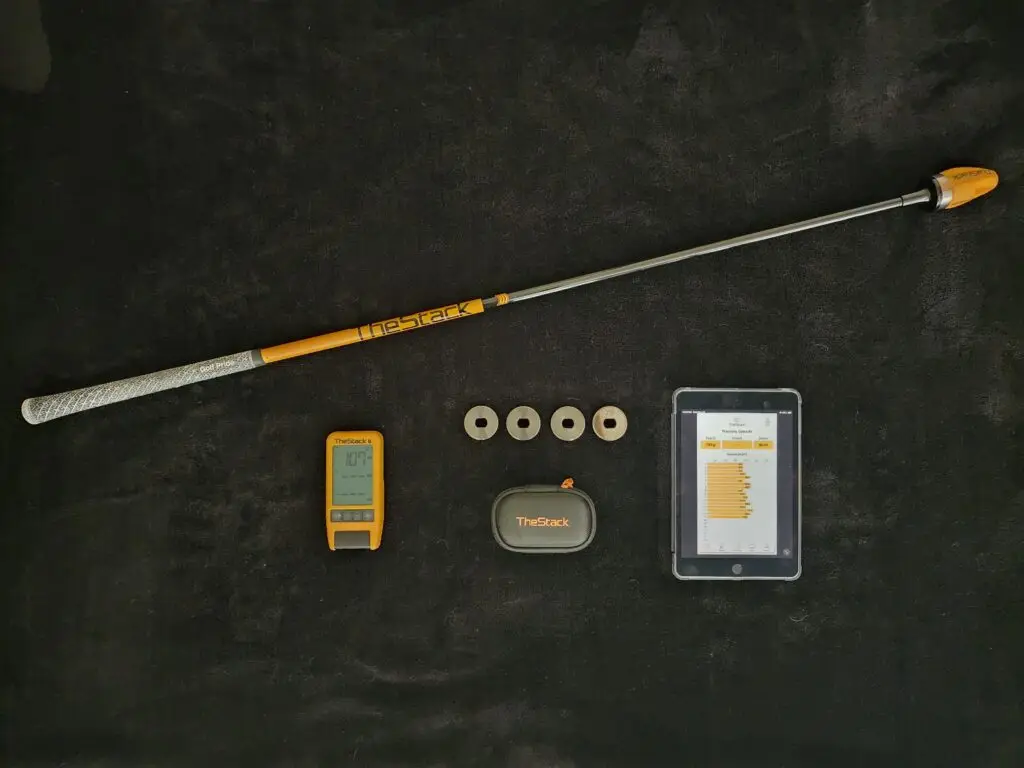
The weight system works differently. SuperSpeed uses three fixed-weight clubs. The Stack uses a single adjustable weighted attachment that works with a provided shaft, covering a range of loads across a single session. The Stack’s approach is built around maximizing neuromuscular adaptation through varied loads in a specific sequence — light, medium, heavy, in the right order. The science behind the Stack’s programming is detailed and clearly communicated, which builds trust in the process.
The opposite-side swinging. SuperSpeed requires left-side swings as part of the protocol. The Stack does not. For golfers over 50 where the non-dominant side may be considerably weaker, eliminating that friction lowers the barrier to consistency. I’m not saying opposite-side training has no value — but if it’s a reason you skip sessions, it’s working against you. For more on how I’ve structured my own training over time, my full Stack System review covers the long view.
Why Stack System vs SuperSpeed Came Down to Accountability for Me
I want to be fair here. I don’t think SuperSpeed is a bad product. The physics of overspeed training are real and well-documented. Other golfers have gotten results from it. But for me, the system as it existed at the time required a level of self-discipline and manual tracking that I couldn’t sustain — and I think that’s true for a lot of busy golfers over 50.
Without an app logging my sessions, tracking my numbers, and giving me something to react to, the motivation just wasn’t there. I needed feedback. I needed accountability. I needed to see the graph moving. The Stack gave me all three. And it’s given me that from the very beginning — not as a feature added years later. That’s the heart of the Stack System vs SuperSpeed difference in real-world use.
If you’re the kind of person who thrives on self-directed programs with manual tracking, SuperSpeed might work well for you. But if you need structure, accountability, and data — and most golfers over 50 who are serious about improvement do — the Stack is a different level of tool. The mental game of swing speed is a real factor, and a well-designed app addresses it directly.
My Stack System vs SuperSpeed Results in Numbers
Starting from roughly 89 mph when I began the Stack (I had actually picked up a couple of mph just from playing more consistently before I started), I’ve worked up to 106 mph over 15 months. I’m currently in Program 7. That’s a 17 mph gain. My handicap went from 7 to 3. I’m competing in the SCGA One Day Series and holding my own.
The gains are real and they’re documented — you can follow the full journey on my speed log, and the deeper progression breakdown lives on the Stack System swing speed results page. Could SuperSpeed have gotten me there if I’d stuck with it longer and stayed more disciplined about the manual tracking? Maybe. But that’s a big ask. In my Stack System vs SuperSpeed experience, the Stack made it easy to stay consistent. And consistency is everything in overspeed training.
If you want context on how this fits the broader picture for older golfers, the average golf swing speed by age data is a useful benchmark — 106 mph at 56 is well above the average.
Stack System vs SuperSpeed: Which One Should You Buy
Here’s the honest answer to the Stack System vs SuperSpeed question.
If you’re a self-starter on a tighter budget, SuperSpeed is a legitimate entry point into overspeed training. They now have an app, so the accountability gap I experienced has been addressed to some degree. The protocol works in theory and the price point is lower.
If you’re over 50, serious about measurable improvement, and want a system built around accountability from the ground up — get the Stack. The app isn’t an add-on. It’s the engine. Every program, every set, every swing feeds into a long-term data picture that keeps you coming back. That’s what moved the needle for me.
I traded in my SuperSpeed for the Stack and haven’t looked back. Going from 87 mph two years ago — where SuperSpeed couldn’t move the needle — to 106 mph and still climbing tells the Stack System vs SuperSpeed story better than I can.
If you want to try the Stack, you can use my link below. It automatically applies 10% off at checkout and helps support this site at no cost to you.
Get 10% Off the Stack System → Use Code 115@56
Have questions about either system or want to know more about what Program 7 looks like? Drop them in the comments below.