
Disclosure: This post contains affiliate links. If you purchase through my Stack System link, I earn a small commission at no extra cost to you — and you get 10% off automatically. I only recommend products I use and train with personally.
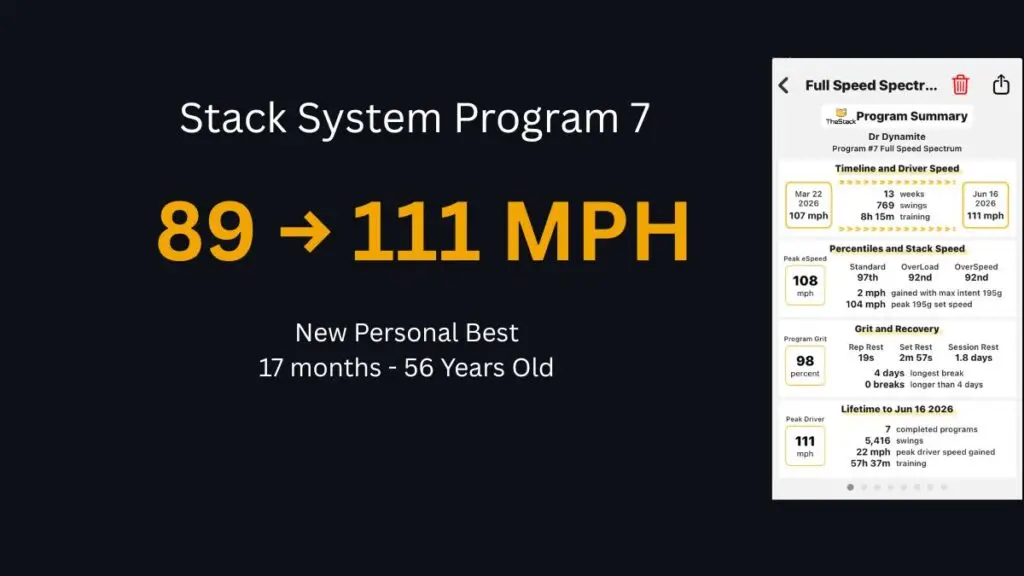
Stack System Program 7 is complete. After 17 months of Stack System training, 7 completed programs, 5,416 total swings, and 57 hours and 37 minutes of logged training time, I hit a new personal best driver speed of 111 mph — up from 89 mph when I started. This is my complete Stack System Program 7 review: the data, the plateau, the breakthrough, and what comes next.
If you’ve been following the 115 mph journey, you know this program came after five consecutive programs stuck at 106 mph. Something had to change. Here’s exactly what happened.
Stack System Program 7 Complete: The Numbers at a Glance
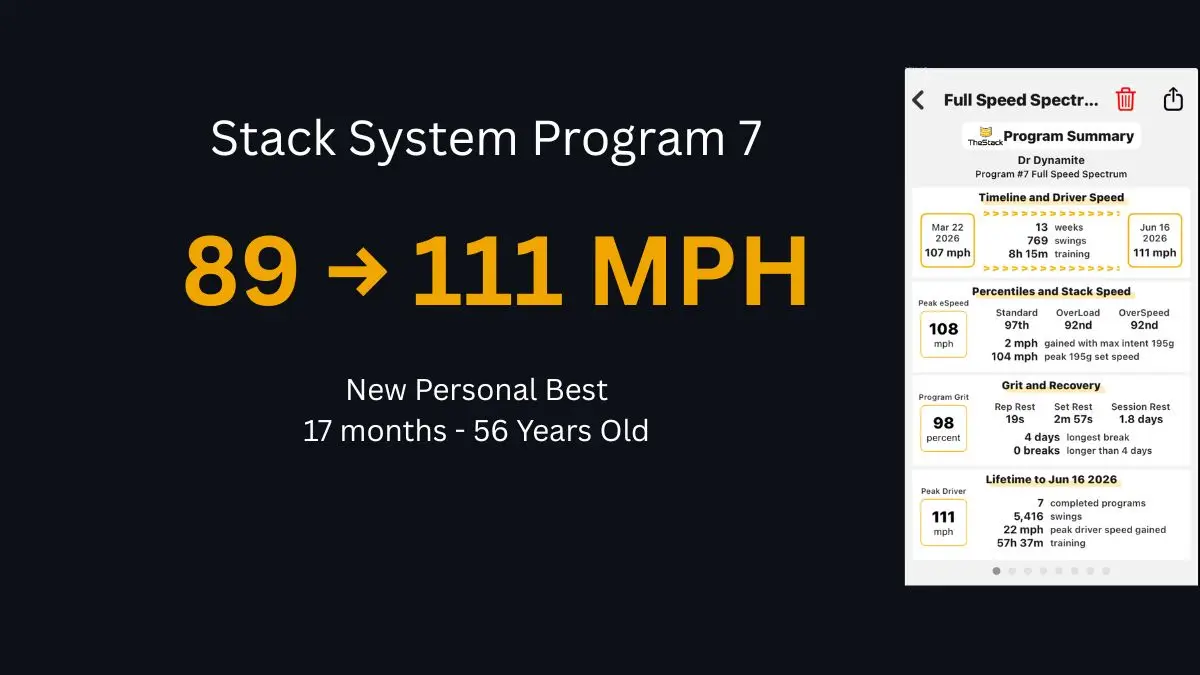
Before diving into the full Stack System Program 7 story, here’s the complete data summary straight from the app:
- Program: #7 Full Speed Spectrum
- Timeline: March 22, 2026 → June 16, 2026 (13 weeks)
- Sessions: 24 of 24 completed
- Total swings this program: 769
- Training time this program: 8 hours 15 minutes
- Starting driver speed: 107 mph
- Progress check driver speed: 111 mph
- Peak eSpeed this program: 108 mph
- Standard percentile: 97th
- OverLoad percentile: 92nd
- OverSpeed percentile: 92nd
- Program Grit: 98%
- Lifetime peak driver speed: 111 mph
- Lifetime speed gained: 22 mph (89 → 111)
- Lifetime completed programs: 7
- Lifetime total swings: 5,416
- Lifetime training time: 57 hours 37 minutes
That’s the Stack System Program 7 summary. Now let me walk you through how we got here.
Stack System Program 7 Training: Where I Started
Stack System Program 7 began on March 22, 2026 with a baseline driver speed of 107 mph. That number tells part of the story — I had actually been stuck near 106–107 mph for five consecutive Stack System programs before this one. The speed gains that came quickly in the early programs had plateaued hard.
For context: I started Stack System training in January 2025 at 89 mph. Programs 1 through 3 produced significant gains. Then somewhere around Program 3 the speed stopped moving. I kept training, kept showing up, kept logging sessions — but the Stack System progress check results weren’t improving.
I had two choices: blame the program, or look in the mirror. I chose the mirror. And what I found there was a strength problem, not a Stack System problem. More on that in a moment.
You can track every session going back to the beginning on my Speed Log page, which has all the raw Stack System data from Program 1 through today. For the complete program-by-program breakdown across all 7 programs, see my full Stack System swing speed results.
Stack System Program 7 Grit Score: What 98% Actually Looks Like
The Stack System Program 7 grit score came in at 98% — and when you look at the session-by-session breakdown, that number means something.
Of 24 Stack System sessions:
- Sessions 1–12: all 100% grit
- Sessions 13–17: 99–100%
- Sessions 18–19: 95–96%
- Session 20: 74% (one off day in 24 sessions)
- Sessions 21–24: back to 99–100%
No breaks longer than 4 days. Zero breaks longer than 4 days across the entire Stack System program. Average session rest of 1.8 days. The Stack System works when you work it — and 98% grit over 13 weeks is what consistent Stack System training actually looks like.
I’ll be honest: session 20 at 74% was a tournament week. Life happens. The important thing is sessions 21 through 24 were all back at 99–100%. You don’t abandon the Stack System process because of one difficult session.
Stack System Program 7 Training Speeds: The Session-by-Session Data
The Stack System Full Speed Spectrum program trains across multiple club weights — underload, standard, and overload — in a structured pattern designed to stimulate speed gains across the full spectrum. Here’s what the Stack System training speed data showed across Program 7:
Driver eSpeed by session (24 sessions): The Stack System driver eSpeed ranged from 104 to 108 mph throughout Program 7, with most sessions landing at 106–107. Consistent. Trained. No dramatic swings.
195g training speeds: The Stack System 195g overload work stayed remarkably consistent — 99 to 103 mph across all 24 sessions, with 141 total swings at this weight. The consistency in the overload training is what builds the foundation for driver speed gains.
Distance potential: At 85°F and 0 FT altitude, the Stack System distance potential data showed most sessions producing 284–297 yards of calculated carry distance, with a peak session at 297 yards.
The Stack System training data told a consistent story all program: a trained, committed golfer whose speed had plateaued — not because the Stack System wasn’t working, but because the engine underneath needed an upgrade.
Stack System Program 7 Progress Check: The Reveal
The Stack System progress check for Program 7 happened on June 16, 2026. Here’s exactly what the Stack System app showed:
Set 1 — Driver Full (last 5 median): 111 mph
Individual Stack System progress check driver readings: 110, 111, 111, 108, 111, 110, 111, 111, 108, 111.
Not one big outlier. Not a single lucky swing. The Stack System progress check showed consistent 110–111 mph driver speed across all driver sets. That’s a real number.
Full Stack System progress check results by weight:
- Driver: 111 mph (up from 107 baseline)
- 280g: 91 mph (up from 89)
- 195g: 100 mph (up from 98)
- 145g: 103 mph (up from 104 — essentially flat)
- 95g: 108 mph (flat)
- Trail 0g: 109 mph (down from 110)
- Lead 0g: 103 mph (up from 101)
The Stack System progress check confirmed what the email said: 4 mph gained on driver speed, median 107 to 111. New personal best.
Stack System Program 7 Complete: What the Email Said
After completing the Stack System Program 7 progress check, this landed in my inbox from the Stack System team:
“In your previous Checkpoint completed on 03/16/2026, you recorded a median driver speed of 107 mph. You just recorded a median driver speed of 111 mph, marking a 4 mph increase in driver speed! These gains mean longer drives and lower scores are on the way!”
107 to 111. Four miles per hour. A new Stack System personal best. And confirmation that the changes I made going into Program 7 were working.
Stack System Program 7 Baseline vs Progress Check: The Visual Comparison
The Stack System app produces a side-by-side bar chart comparing your baseline at the start of the program against your Stack System progress check results at the end. For Program 7, that comparison tells the story clearly:
Baseline (March 22, 2026):
- Driver: 107 mph
- 280g: 89 mph
- 195g: 98 mph
- 145g: 104 mph
- 95g: 108 mph
- Trail 0g: 110 mph
- Lead 0g: 101 mph
Progress Check (June 16, 2026):
- Driver: 111 mph (+4)
- 280g: 91 mph (+2)
- 195g: 100 mph (+2)
- 145g: 103 mph (-1)
- 95g: 108 mph (flat)
- Trail 0g: 109 mph (-1)
- Lead 0g: 103 mph (+2)
The Stack System progress check gains are concentrated at the driver and heavier overload weights — exactly where you want them. The lighter overspeed weights (95g, 0g) were already well-developed from previous Stack System programs. The gap that needed closing was in the foundational strength numbers, and Program 7 closed it.
Stack System Program 7 Complete: Why This Program Was Different
Five Stack System programs stuck at 106 mph. One program that broke through to 111. What changed?
Going into Stack System Program 7, I got a professional TPI performance assessment that identified two critical limiters:
1. Rotational power deficits. Core rotation was at the 20th percentile. Full body rotation at the 31st percentile. The Stack System was trying to produce speed through a body that didn’t have the rotational power to deliver it. No program fixes that — only strength training does.
2. Hip rotational mobility. Despite 15 months of regular yoga practice, my hip rotational mobility — the specific type the golf swing demands — wasn’t where it needed to be. Yoga flexibility and golf rotational mobility are not the same physical quality. That was a wake-up call.
The prescription: daily TPI corrective exercises targeting hip mobility, combined with a structured strength program focused on rotational power. I started both before Program 7’s progress check. The 111 mph result suggests the approach is working.
The Stack System didn’t fail during those five programs. My body was the limiting factor. Once I started addressing the actual limiters, the Stack System speed training had something to work with.
Stack System Program 7 Personal Best Speeds: The Full Spectrum
One of the most useful Stack System data screens is the Personal Best Speeds chart — it shows your all-time best at every training weight. Here’s where the Stack System personal bests stood after Program 7:
- 45g (lightest overspeed): 117 mph (May 26)
- 65g: 114 mph (May 2)
- 75g: 111 mph (May 17)
- 80g: 110 mph (May 26)
- 95g: 108 mph (Apr 29)
- 105g: 110 mph (Jun 3)
- Driver (0g standard): 111 mph (Jun 16 — today)
The lightest Stack System overspeed weights are already touching 115+ mph territory. The personal best at 45g is 117 mph. That speed exists in the nervous system — the Stack System work has already trained the pattern. The goal now is building the physical strength to access that speed with the standard driver consistently.
That’s what the next 10–12 weeks of strength training is designed to accomplish.
Stack System Program 7 Complete: 17 Months of Lifetime Data
The Stack System lifetime numbers after 7 completed programs tell the full story of this journey:
- Starting speed (Jan 2025): 89 mph
- Current speed (Jun 2026): 111 mph
- Total gain: 22 mph
- Programs completed: 7
- Total swings logged: 5,416
- Total training time: 57 hours 37 minutes
- Goal: 115 mph
- Remaining gap: 4 mph
Four miles per hour. That’s what stands between where I am today and the goal I set 17 months ago. The Stack System has delivered 22 mph of gains. Four more is not a moonshot — it’s a specific, achievable target with a specific plan to get there.
Stack System Program 7 Complete: What the Competition Data Says
The Stack System training gains don’t just show up in app data — they show up on the golf course. I compete in the SCGA One Day Series and track every round with Arccos Smart Sensors, so the data is honest. You can read more about what I’ve learned competing in SCGA events here.
Since starting Stack System training my handicap has dropped from 7 to 3. Par 5 scoring is now at scratch level — a direct result of the Stack System speed gains translating to shorter approach shots. When you’re hitting 6-iron into par 5s instead of hybrid, the scoring opportunities multiply.
The Stack System pitch is that speed gains lead to lower scores. In my case, the data supports that. The handicap movement is real and it tracks directly with the Stack System speed progress across these 7 programs.
Stack System Program 7 Complete: What’s Next
The Stack System app recommended starting Program 8 by June 20, 2026. That’s the plan. But Program 8 will be different from Programs 1 through 7 in one critical way: I’m running a parallel strength program for the first time.
Three days a week at the gym, focused on:
- Rotational power: Cable rotations, med ball throws, anti-rotation work — directly targeting the percentile weaknesses the assessment identified
- Lower body strength: Squats, deadlifts, lateral patterns — building the foundation the Stack System needs to produce more speed
- Hip mobility: Daily TPI corrective routine targeting the specific rotational range the golf swing demands
The Stack System got me from 89 to 111 mph on its own. The assessment confirmed the Stack System speed pattern is excellent — the limiter is physical capacity. Add the strength foundation, and the projection is that 115 mph is achievable.
Program 8 + strength training. Check back in 10–12 weeks for the next Stack System progress check results.
Stack System Program 7 Complete: Is the Stack System Worth It?
After 7 Stack System programs and 17 months of training, here’s my honest Stack System assessment:
What the Stack System does exceptionally well:
- The Stack System app accountability is unmatched — grit scores, session tracking, progress checks, and email confirmations create a feedback loop that keeps you honest and consistent
- The Stack System Full Speed Spectrum training protocol is scientifically structured — it’s not just swinging a weighted stick, it’s training across the full speed spectrum with intentional overload and overspeed work
- The Stack System progress check system provides objective, program-to-program data — you know exactly where you are at all times
- The Stack System produced 22 mph of speed gain over 17 months — that’s real, documented, and measured
What the Stack System can’t do alone:
- The Stack System cannot compensate for an underpowered engine — if your rotational strength is at the 20th percentile, the Stack System will train your nervous system to move faster but eventually hit a physical ceiling
- The Stack System is not a strength training program — it’s a speed training program. The two are complementary, not interchangeable
If you’re a golfer over 50 who wants to add real, measurable driver speed, the Stack System is the most accountable, data-driven speed training system I’ve used. I tried other approaches before the Stack System — nothing produced results like this.
You can get 10% off the Stack System automatically through my link: thestacksystem.com/discount/115@56. The discount applies at checkout.
Stack System Program 7 Complete: Full Speed Spectrum Data Summary
For Stack System users who want the complete Program 7 data, here’s the full Stack System Full Speed Spectrum summary:
Program: #7 Full Speed Spectrum (Dr Dynamite)
Sessions: 24/24
Total swings: 769
Training time: 8h 15m
Program Grit: 98%
Peak eSpeed: 108 mph
Standard percentile: 97th
OverLoad percentile: 92nd
OverSpeed percentile: 92nd
Longest break: 4 days
Breaks longer than 4 days: 0
Progress check driver speed: 111 mph
Gain vs baseline: +4 mph
New personal best: Yes
Stack System Program 7 Complete: Frequently Asked Questions
How long does Stack System Program 7 take to complete? Stack System Program 7 is a 24-session program designed to be completed in roughly 8–12 weeks. My Stack System Program 7 took 13 weeks because of one tournament-week break, but most users following the recommended cadence finish in 8–10 weeks. The Stack System app sets the session-to-session pacing based on recovery — you cannot rush Program 7 by stacking sessions back-to-back.
What driver speed gain should I expect from Stack System Program 7? The honest answer: it depends on where you started and how many Stack System programs you have completed before. Early Stack System programs (1–3) often produce 5–10 mph gains. Later programs like Stack System Program 7 typically produce 2–4 mph gains as the system gets harder to extract additional speed from a trained nervous system. My Program 7 produced 4 mph (107 to 111).
Is Stack System Program 7 harder than earlier programs? Stack System Program 7 (Full Speed Spectrum) is more demanding than Programs 1–3 because the prescribed training weights and rep counts are calibrated to your current speed. As you get faster through the Stack System, the training intensifies. Program 7 had me hitting overload weights at speeds that would have been impossible during Program 1.
Can I do Stack System Program 7 without strength training? You can — most golfers do. But my Stack System Program 7 broke a 5-program plateau specifically because I added structured strength training before the progress check. If your speed has stalled across multiple Stack System programs, strength training is almost certainly the missing piece, just like it was for me.
Stack System Program 7 Complete: The Bottom Line
Stack System Program 7 is the program that broke the plateau. Five programs stuck at 106 mph. One program, with the right physical preparation alongside it, produced a 4 mph gain and a new lifetime personal best of 111 mph.
The goal is 115 mph. The gap is 4 mph. The plan is Program 8 plus a serious strength commitment for the first time in this journey.
If you’re a golfer over 50 chasing speed, studying the average swing speed benchmarks for your age is a good starting point. Understanding where you are relative to your peers puts the Stack System gains in context — and makes the goal feel less abstract.
89 mph to 111 mph. 17 months. 56 years old. 4 mph to go.
The Stack System journey continues. Check back for the Program 8 progress check — and follow along on YouTube at @115at56 for the full video breakdown of today’s Stack System results.
→ Get 10% off the Stack System here (discount auto-applies)