
Disclosure: This post contains affiliate links. If you purchase through my links, I may earn a small commission at no extra cost to you. I only recommend products I personally use and trust.
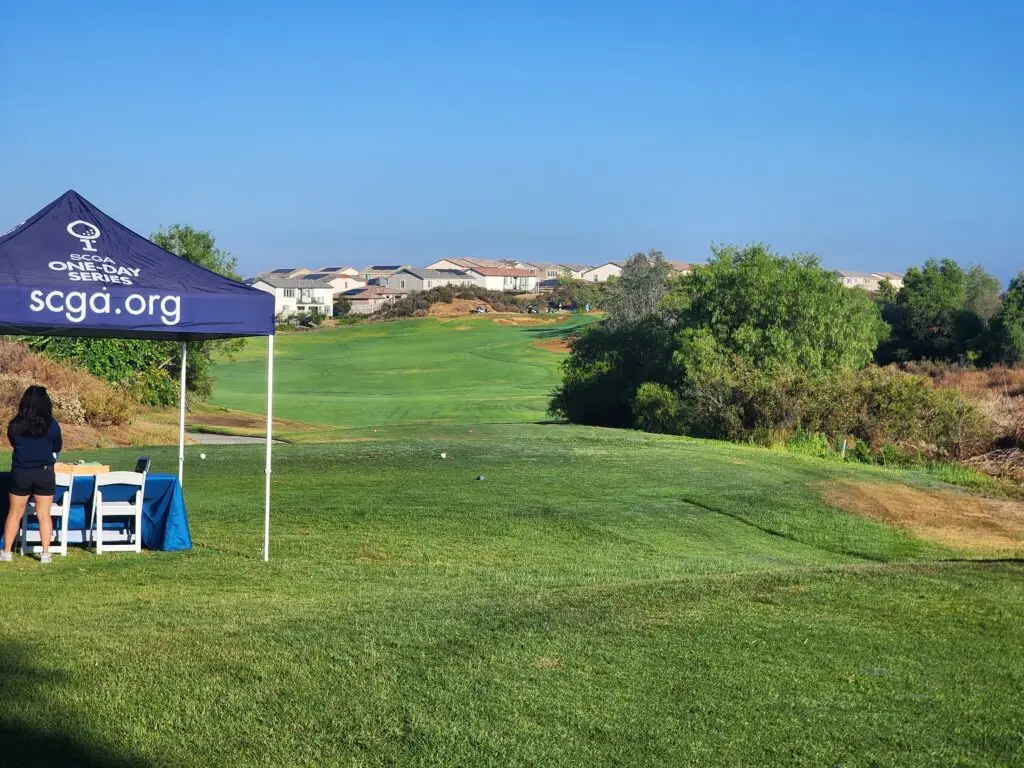
I shot an 83 at Morongo Golf Club at Tukwet Canyon yesterday — net 79, 28 points net stableford, 28th place — in the SCGA One Day Series Four-Ball event. The number doesn’t tell the whole story. I hit the ball farther than I ever have in competition, drove the green on a 378-yard par 4, made eagle distance on a 551-yard par 5, and still walked off the Champions Course wondering where the round went. The answer, according to my Arccos Smart Sensors, was brutally clear: the flatstick. A -6.1 strokes gained putting performance on a day when everything else was trending in the right direction makes for a complicated debrief.
My brother played as my Four-Ball partner, and he brought his best stuff — which helped carry us on some holes where I was writing disaster into the scorecard. That’s the beauty and the cruelty of the Four-Ball format: your partner can bail you out, but you can’t bail yourself out from 2 feet.
Oh — and I limped the entire 18 holes. The plantar fasciitis that derailed my training earlier this year came back with a vengeance at Morongo. Every time I planted my front foot taking my stance, every time I loaded into my backswing, there was pain. Not soreness — pain. I was managing it hole by hole. That context matters when you’re trying to make sense of a -9.2 strokes gained day.
The Morongo Four-Ball: What the SCGA One Day Series Format Means
The SCGA One Day Series Four-Ball format pairs two players, each playing their own ball, with the team score being the lower of the two on each hole. It rewards aggression — go for it, because your partner covers you if it goes wrong. The problem is that even in Four-Ball, you still have to hole the putts you’re supposed to make. There’s no bail-out partner for a 2-foot lip-out.
Morongo Four-Ball Pre-Round Routine: Two Hours Before the First Tee
Morongo is a two-hour drive from San Diego. That’s a 4:30 AM alarm, a Starbucks stop for oatmeal on the way, and arriving in the inland hills with a mission. What I’ve learned from playing enough of these SCGA events is that the pre-round routine isn’t optional — it’s the difference between standing on the first tee ready to compete and standing on the first tee still waking up.
I pulled into Morongo, plugged in to charge the car, and used the wait time to run through my 15-minute pre-round yoga stretch routine right there in the parking lot. Hip flexors, thoracic rotation, hamstrings — the same sequence every time. The foot was already aching. I stretched through it, knowing the plantar fasciitis was going to be a factor all day, and tried to get as much mobility as the situation allowed.
By the time I got to the first tee, I was as ready as I was going to be. The foot wasn’t going anywhere. The only question was whether I could manage it well enough to compete.
Morongo Golf Club at Tukwet Canyon is a serious test. The Champions Course was playing firm and fast in some spots, wet and punishing in others. Bunkers throughout the round were filled with mud — I watched legitimate fairway strikes get penalized by conditions that had nothing to do with the quality of the shot. Tight pin placements on edges and slopes made every approach a decision between attacking and playing for the center of the green. On a day when my short game and putting were going sideways, that tension became costly.
Morongo Four-Ball Driving: The Stack System Shows Up
I’m going to lead with the positive because it’s genuinely meaningful for the @115at56 journey. I drove the ball longer in this Morongo Four-Ball round than I have in any competitive round to date. Arccos logged an average driving distance of 272 yards with a longest drive of 310 yards. For context, when I started the Stack System I was averaging around 220 yards. Today I started Program 8 — and the Morongo numbers are proof that the speed is sticking when it counts.
Strokes gained driving told the same story: +1.2 SG on distance, +0.7 SG on accuracy, for a positive driving day despite the penalties. The -1.0 SG on penalties stings, but three drives into penalty areas on a course with firm, fast conditions and tight fairways isn’t a swing problem — it’s a course management conversation I’ll come back to.
The signature moment was hole #6. I flushed a drive 310 yards — one of the cleanest I’ve hit in competition. That’s the Stack System doing exactly what it promised. Program 7 brought me to a personal best of 111 mph driver swing speed, and that speed is now showing up in rounds, not just on the range.
Morongo Four-Ball Hole-by-Hole Highlights
Three holes from the Morongo Four-Ball are worth documenting in detail — two birdies and a near-eagle that showed what’s possible when the longer game is working.
#5 — 558-Yard Par 5: Birdie
Drove it 287 yards in the fairway. Caught a bad lie in the middle of the fairway — one of those Morongo conditions issues where a good shot still gets punished. Hit a 5-iron 210 yards, just short of the green. Chipped to 2 feet and made the birdie. This hole was a microcosm of the round: excellent tee shot, long approach, execution under pressure. A 4 on a 558-yard hole when your lie was compromised is a good number.
#9 — 551-Yard Par 5: Eagle Opportunity, Birdie Result
This was the most dramatic hole of the Morongo Four-Ball round. Drove it 292 yards, then hit my 9-wood 224 yards to set up a 57-foot eagle putt. I rolled it to 2 feet — which felt like the setup for a signature moment. Tapped in for birdie. Given the day I was having on the greens, making that 2-footer was a minor win in itself.
#13 — 378-Yard Par 4: Drove the Green, Birdie
I took the direct line with a 3-wood on a hole listed at 378 yards. Hit it 275 yards onto the green. Two-putted for birdie. This is what the Stack System speed does — it opens up holes that used to require a layup. Two years ago, a 378-yard par 4 was a driver-iron-putt sequence. Yesterday it was a one-shot-and-putt. That’s a structural advantage that compounds over a season.
Morongo Four-Ball Par 3s: Flying the Greens
Here’s the direct cost of carrying more speed into competition: I flew two par 3 greens for doubles, and both came from the same source — I’m hitting irons longer than I’m used to, and I haven’t fully recalibrated my distance perception under pressure.
#2 was playing 155 yards. I hit an 8-iron 163 yards, flew the green, and found a muddy bunker. The bunker conditions at Morongo were genuinely bad — mud, not sand — and the up-and-down from there wasn’t realistic. Double.
#8 was playing 180 yards. I hit a 7-iron 206 yards, flew the green completely, and ended up in a tree on the next tee box. Got lucky enough to hit a recovery shot, but it clipped a cart path curb and the hole unraveled from there. Double.
Arccos backed this up: par 3 tee shot SG was -2.1 on the round. That’s a direct consequence of flying greens with irons that are now carrying farther than their old yardage profiles suggest. The fix isn’t to stop training speed — it’s to update my mental yardage book. My 8-iron isn’t a 150-yard club anymore. My 7-iron isn’t a 180-yard club. I need to be playing one club less on par 3s until I build a new reference library for competition distances.
Morongo Four-Ball Approach Game: Close But Costly
Overall approach SG was -2.3 for the Morongo Four-Ball round, with the par 3 tee shots accounting for most of the damage. On approach shots from 150-200 yards, I lost 2.3 strokes — partially the par 3 flyovers landing in that distance bucket, partially some long iron approaches that didn’t hold the green. I hit 9 of 18 greens in regulation (50%), which is functional but not where I want to be.
Average approach distance to the pin was 53 feet — 9 feet farther than the 0-handicap benchmark of 44 feet. On a day with tough pin placements on slopes and edges, those extra 9 feet matter enormously for putting. More on that in a moment.
Morongo Four-Ball Short Game: Mixed Signals
Short game SG was -1.9 overall, which represents a significant decline from my recent 10-round average of +0.6. Arccos identified short game as the #1 “What to Work On” category for this round, specifically 25-50 yard chip shots (-2.4 SG, 0% up-and-down on 5 shots).
The 0-25 yard range was actually fine: +1.0 SG, 50% up-and-down, averaging 7 feet to the pin. That’s the scoring zone working. The 25-50 yard range fell apart — 0% up-and-down, averaging 32 feet to the pin. The muddy bunker condition (3 sand shots, -0.6 SG, 0% up-and-down) compounded the issue. You can’t practice out of mud at home.
Morongo Four-Ball Putting: Where the Round Went
-6.1 strokes gained putting. That’s the number. To put it in context, my 10-round putting average is -0.8 SG per round. Yesterday I was 5.3 strokes worse than that average on the greens. In a round where my driving was producing a legitimate competitive advantage and I was hitting the ball the farthest I’ve ever hit it in competition, the putter turned what could have been a special round into an 83.
The breakdown: 35 total putts, 1.9 per hole, 4 one-putts, 11 two-putts, 3 three-putts. The catastrophic number is 0-10 feet: -5.2 SG on 25 putts from inside 10 feet. I missed two putts from 2 feet — both with break, both lipped out. Those two misses aren’t just 2 strokes; they’re momentum killers that affect how you approach everything that follows.
The greens at Morongo were tricky reads — slopes, breaks, faster in some spots than others. But the Arccos data doesn’t lie. When you’re -5.2 SG from inside 10 feet, that’s not a green-reading problem. That’s execution under pressure. A TPI assessment — find a certified specialist at myTPI.com — identified rotational asymmetries; I’m curious whether there’s a connection between left-side imbalances and my tendency to lose putts left under pressure. Something to track.
The one bright spot: 50+ foot putting was +0.4 SG. I rolled my eagle putt from 57 feet to 2 feet. Speed control on long putts is clearly a strength right now. The short ones are a problem.
Morongo Four-Ball Arccos Strokes Gained Summary
Here’s the complete Arccos strokes gained breakdown from the Morongo Four-Ball round for the record:
- Total SG: -9.2
- Driving Distance: +1.2
- Driving Accuracy: +0.7
- Driving Penalties: -1.0
- Approach: -2.3
- Short Game: -1.9
- Putting: -6.1
The story in those numbers: I gained strokes on driving for the first time in a competitive round. Everything else — approach, short game, putting — went the wrong direction. The net result was an 83, net 79.
Morongo Four-Ball and the Plantar Fasciitis Factor
I need to be honest about this because it’s part of the record. The plantar fasciitis that first showed up during my Stack System training earlier this year came back at Morongo — and it came back hard. Every time I set my stance, every backswing, every step between holes: pain. I limped through 18 holes on a course that has significant elevation change and lots of walking between tee boxes and fairways.
Does it explain the putting? Partly — when your foot hurts, your setup changes, your balance shifts, and your ability to hold a consistent putting posture degrades. Does it explain the 25-50 yard chip shots going sideways? Possibly — that’s a shot where you’re loading weight onto your front foot through impact. Does it excuse the round? No. But it’s context that matters for anyone following this journey at 56.
Playing through pain is part of competing as an older golfer. The TPI work I’ve been doing — finding the right specialists through myTPI.com — is partly about building the structural foundation to reduce these flare-ups. In the meantime, I manage it, stretch through it, and keep playing. That’s the deal.
Morongo Four-Ball Lessons: What This Round Means for the Journey
I’ve been at this long enough to read a bad round without catastrophizing it. Here’s what I actually take from the Morongo Four-Ball:
The speed is real and it’s here to stay. 272-yard average, 310-yard longest drive, 292-yard drive on a par 5 that led to a near-eagle. This is not lucky yardage — this is what Program 7 of the Stack System built. Starting Program 8 today with that knowledge changes how I approach every par 5 and every long par 4 on every future course.
Iron distance recalibration is urgent. Flying par 3s for doubles because I haven’t updated my yardage profiles is fixable — but it has to be fixed now, before San Juan Hills on June 27. I need a real-world yardage chart of every iron based on current carry distances. Arccos will help with this over the next range session.
Short putting under pressure is the weak link. -5.2 SG from inside 10 feet is not a one-round blip — Arccos flagged short putting as my #1 issue. I’m going to spend the next week with a specific focus on 3-6 foot putts with break, which is exactly the range where the lip-outs happened at Morongo.
Course conditions were genuinely difficult. Muddy bunkers, penalty area drives on fair shots, tough pin placements — Morongo’s Champions Course in its current state added legitimate variance to the round. That’s not an excuse; it’s context. My brother navigating the same conditions and playing well is proof the course was manageable. I just needed to manage it better.
Morongo Four-Ball and the Four-Ball Format: A Note on Playing With My Brother
My brother has been my most frequent playing partner throughout the SCGA One Day Series, and he played his best competitive round in the Morongo Four-Ball. We finished with 28 points net stableford — 28th place in the field. Not the finish we were aiming for, but on a day with muddy bunkers, penalty-area conditions, and a putter that simply refused to cooperate, staying in the round long enough to post a score took some fight. Having a partner who’s bringing his A-game in a Four-Ball format is meaningful — it lets you take risks you wouldn’t take in stroke play, and it provides a genuine safety net when holes start unraveling. He covered holes where I was writing doubles. That’s exactly what Four-Ball is supposed to do, and it kept our team in contention despite my putting day.
The dynamic also works in reverse: on holes where I was making birdies — #5, #9, #13 — my score was the team score, and his pressure was off. That kind of complementary partnership is something we’ve been building all year across these SCGA events.
What’s Next: San Juan Hills and Program 8
San Juan Hills is June 27 — Individual Net format, which means there’s no partner to bail me out. I need to go in with an updated iron yardage chart, a plan for short putting practice this week, and a course management approach that accounts for the penalty area risk on aggressive drives.
Program 8 of the Stack System starts today. The timing feels right — Morongo showed me that the speed is real and it’s creating genuine birdie opportunities. The goal of 115 mph is still in front of me. My TPI assessment with Ryan Engstrom identified rotational power as the limiting factor, and the corrective work we’re doing is designed to unlock the next level of speed. After Morongo, I believe it’s possible.
The putter has to catch up to the driver. That’s the work for this week.
I track every round with Arccos Smart Sensors Gen 4 — without that data, a round like this Morongo Four-Ball would just feel like a bad day. With it, I know exactly what broke down and where to focus. That specificity is what makes the difference between a golfer who keeps shooting in the 80s and one who figures out how to get back to the 70s.
More from San Juan Hills soon.