
Affiliate Disclosure: This article contains affiliate links. If you purchase through these links, I may earn a commission at no additional cost to you. I only recommend products I personally use and trust.
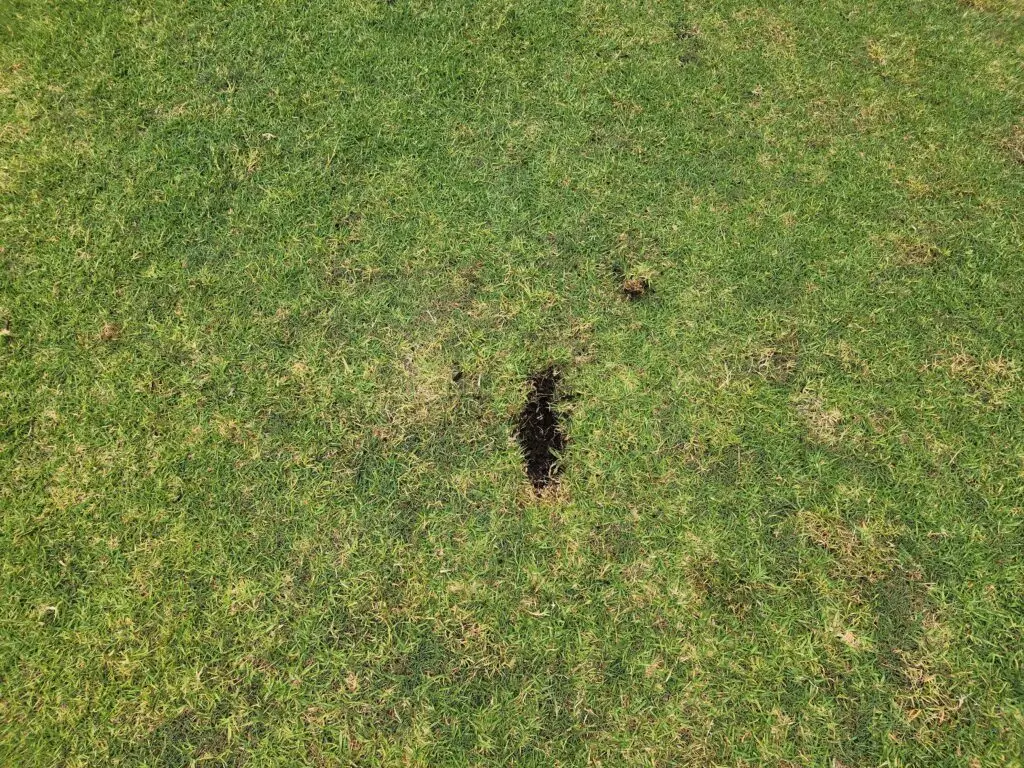
Your golf divot pattern is the most honest swing coach you will ever meet. It does not lie. It does not flatter you. It tells you exactly what your club did at impact — the path, the face angle, the attack angle, the strike location — every single swing, in a strip of grass you can read in real time on the range or on the course. This article is the complete guide to reading your golf divot pattern, with a specific focus on what my own divot pattern revealed when I cross-referenced it against 11 rounds of Arccos shot data showing a chronic 24% short miss on approach shots.
Most senior golfers ignore their golf divot pattern entirely. They take a swing, watch the ball, and walk away. That is a missed signal worth several strokes per round. The divot is the receipt for what you actually did — not what you felt or thought you did. Once I started reading my golf divot pattern after every iron shot in practice, my approach play improved from -2.0 strokes gained per round to -0.8 strokes gained per round. The Arccos data confirmed what the divots had been telling me all along.
Best Golf Divot Pattern Diagnosis: The Quick Verdict
If you only read one section of this article, here are the four things your golf divot pattern reveals about your swing:
- Direction: Which way your divot points relative to the target line tells you your swing path — left of target equals out-to-in, right of target equals in-to-out.
- Depth: How deep the divot cuts tells you your attack angle — deep means steep, shallow means level, no divot means up.
- Location: Where the divot starts relative to ball position tells you your low point — divot starts before the ball equals chunky, divot starts after the ball equals proper compression.
- Consistency: How similar your divots look over 10 swings tells you whether your swing pattern is repeatable or whether you are guessing.
That is the framework. The rest of this article is the detailed breakdown of each element — and the personal story of what my own golf divot pattern revealed once I matched it against Arccos approach shot data.
Why Your Golf Divot Pattern Matters More After 50
The golf divot pattern is useful information at any age. After 50, it becomes critical for one reason: senior golfers lose the feedback senses faster than they lose the physical skills. Your hands stop telling you exactly where the clubface was at impact. Your eyes track ball flight but miss the strike. Your body’s proprioception — the sense of where your limbs are in space — degrades naturally with age. A professional TPI physical assessment can confirm exactly which proprioceptive and mobility deficits are affecting your swing, but the divot pattern is the at-home version of that diagnosis — free, immediate, and visible every iron shot.
The golf divot pattern bypasses all of those degraded senses and gives you objective, visible data. You walk up to your divot, look down, and you know exactly what happened. That kind of unfiltered feedback is what amateur golfers over 50 need more than any other coaching input.
I learned this lesson the hard way over my first season competing in SCGA tournaments. My approach shots were missing short and right with frustrating consistency, but my swing felt fine. The Arccos data showed 24% of my approach shots landing short of the green — a chronic pattern that no amount of “trust your swing” thinking would fix. When I finally started reading my golf divot pattern after every iron shot in practice, the answer was right there in the grass. The senior golfer who reads his divot pattern after every swing is the senior golfer who diagnoses his own breakdown before it costs him a tournament.
Golf Divot Pattern Direction: Reading Swing Path
The first element of golf divot pattern reading is direction — which way does your divot point relative to the target line?
Divot points left of target (right-handed golfer): Your swing path is out-to-in. Common cause of the slice and the pulled iron shot. The clubhead is moving across the ball from outside the target line to inside the target line through impact. This is the most common amateur miss pattern.
Divot points right of target (right-handed golfer): Your swing path is in-to-out. Can produce a push, a hook, or — combined with an open face — a push-slice. Less common in amateur golf but produces an inconsistent ball flight when paired with face angle changes.
Divot points straight at target: Your swing path is on-plane and on-line. This is what you want — but it is rare. Even tour players show small path variations through impact. The goal is not perfect divot direction every swing, but consistent direction over 10 swings.
My own golf divot pattern direction revealed a mild in-to-out tendency on iron shots — divot pointing roughly 3 to 5 degrees right of target. When combined with my Arccos miss data showing 1.3 yards right average miss, the diagnosis was unambiguous: in-to-out path with face slightly open relative to path. The push-fade I had been fighting on the course had a measurable, visible explanation in the grass.
Golf Divot Pattern Depth: Reading Attack Angle
The second element of golf divot pattern reading is depth — how deeply does the club cut into the turf?
Deep divot (1+ inch): Your attack angle is steep. The club is descending sharply through impact. Produces high ball flight, lots of spin, and a divot the size of a dollar bill. Most common in golfers who set the wrists early in the backswing and drop the club down on the ball.
Shallow divot (1/4 to 1/2 inch): Your attack angle is more level. The club is sweeping through impact rather than descending sharply. Produces a lower ball flight, less spin, and more roll. This is the senior-golfer-friendly attack angle for most iron shots.
No divot (turf brushed but not cut): Your attack angle is up (relative to ground) or your bottom of the swing arc is happening before the ball. Often a sign of chunked-fat strikes, deceleration, or hitting up at the ball. This is the senior golfer’s most common failure mode on iron shots.
My own golf divot pattern depth was inconsistent for years — sometimes deep, sometimes shallow, occasionally non-existent on longer irons. The 6-iron in particular showed deceleration patterns where the divot was barely there. The Arccos data confirmed it: the 6-iron was the club where my approach SG was worst. Inconsistent depth equals inconsistent compression equals inconsistent distances equals chronic short misses. The diagnosis was in the divot all along.
Golf Divot Pattern Location: Reading Low Point
The third element of golf divot pattern reading is location — where does your divot start relative to ball position?
Divot starts before the ball: Low point is behind the ball. Classic chunked-fat strike. Loses distance, loses ball compression, leaves shots short. The most common cause of the senior golfer’s chronic short miss on approach shots.
Divot starts at the ball: Low point is at the ball. Topped or bladed strike. Produces a thin shot with no compression, no spin, and unpredictable distance. Common when amateurs try to “scoop” the ball or hit up on iron shots.
Divot starts just after the ball (target side): Low point is past the ball. This is the proper compression strike. The clubface compresses the ball first, then the club continues down and forward to cut a divot starting at the ball’s original position and extending toward the target. This is what you want.
My own golf divot pattern location was the single biggest insight from this diagnosis. My divots were starting before the ball roughly 30% of the time. Low point was behind the ball on approach shots — exactly matching the 24% chronic short miss the Arccos data showed. Reading the location of my divot exposed the strike inconsistency that was costing me strokes on every par 4 and par 5 second shot.
My Golf Divot Pattern + Arccos Data: The 24% Short Miss Story
Here is the personal story behind this article. After 11 rounds of Arccos shot tracking in 2026, the strokes-gained data showed a consistent pattern in my approach play:
- Approach SG average: -2.0 strokes per round (early season)
- Average miss distance from pin: Long 1 yard, left 0.5 yard, right 1.3 yard, short 3.9 yards
- Chronic short miss percentage: 24% of approach shots landed short of the green
- Right-miss bias: Approach shots missed right 50% more often than left
That is what the Arccos data said. The full breakdown of how Arccos surfaces this kind of pattern is in my greens in regulation analysis, which dug into the same approach miss patterns from a scoring-truth perspective.
The question was: why? The Arccos data told me what was happening — short and right, repeatedly. But it could not tell me why. Was it club selection? Distance miscalculation? A swing flaw? A mental commitment issue?
The golf divot pattern told me the answer. I spent an hour on the range with my iron shots, taking time to walk up to each divot and read it. The pattern was unmistakable: deceleration on the 6-iron, in-to-out path through impact, low point behind the ball on roughly one of every three shots. Three swing flaws creating the same on-course result. The divots had been screaming this at me for months — I just had not been listening.
Golf Divot Pattern Analysis: How I Diagnosed My Approach Miss
Once I committed to reading my golf divot pattern on every iron shot, the diagnostic process took about 60 minutes on the range. Here is the exact protocol I followed:
Step 1 — Take 10 swings with the same iron. I used my 7-iron because it is the middle of the bag and the iron that produces the most reliable results to read.
Step 2 — Walk to each divot and photograph it. Yes, photograph. The divots disappear from your memory in seconds. The photos let you compare patterns later.
Step 3 — Note divot direction relative to target line. Stand behind the divot, look at the target, and identify whether the divot points left, right, or straight at the target. Be honest.
Step 4 — Note divot depth. Deep, medium, shallow, or absent. Use a consistent rating system across all 10 swings.
Step 5 — Note divot location. Did the divot start before the ball, at the ball, or after the ball? This requires careful observation and is the hardest element to read accurately.
Step 6 — Compare to Arccos data. If your divots are pointing right and your Arccos misses are right, you have a correlation. If your divots are inconsistent in depth and your Arccos distances are inconsistent, you have a correlation. The pattern matching is where the diagnosis lives.
Step 7 — Repeat with the 6-iron, 8-iron, and pitching wedge. Different irons produce different divot patterns for the same golfer. The 6-iron often reveals deceleration patterns that shorter irons hide.
This protocol took me one practice session to learn and apply. By the end of that session, I had a clear list of three specific swing flaws confirmed by both the golf divot pattern and the Arccos data. Diagnosis without ambiguity is what changes practice forever.
The Fix: Translating Golf Divot Pattern Insights to Better Approach Play
Diagnosis without action is just self-criticism. The real value of golf divot pattern reading is the prescription it produces. Here is what I changed once the divot patterns confirmed my approach issues:
Fix 1 — Commit to taking a divot. The mental cue I started using on every iron shot: “divot past the ball.” Not “hit down on it.” Not “compress the ball.” Just: take a divot, and make sure it starts where the ball used to be. The mental cue translated to better low-point control within 50 swings of practice.
Fix 2 — Square the path through impact. The in-to-out tendency was a swing pattern. I worked on a slightly more around-the-body backswing and a more direct release. The path correction took longer — closer to 200 to 300 swings — but the right miss frequency dropped over four weeks.
Fix 3 — Address the 6-iron deceleration specifically. The 6-iron deceleration was a confidence issue more than a swing issue. I started practicing 6-iron shots with full commitment to finish position — full follow-through, balance held, every swing. The deceleration disappeared within 100 swings of focused practice.
The Arccos data showed the result over the next 7 rounds: approach SG improved from -2.0 strokes per round to -0.8 strokes per round. That is a 1.2 stroke per round improvement — driven entirely by reading the golf divot pattern, diagnosing the issues, and making targeted fixes. For more on how iron play specifically improves after 50, see my how to hit irons better after 50 article.
Golf Divot Pattern Mistakes Senior Golfers Make
After applying this diagnostic to my own game and watching dozens of amateur golfers on the range and in tournament prep, here are the most common golf divot pattern mistakes senior golfers make:
Not reading the divot at all. By far the biggest mistake. Most amateurs take a swing, watch the ball, and walk away. The divot — the most honest piece of feedback in golf — sits there unread, fading into the turf. Hours of practice produce a fraction of the improvement they would produce if the divots were being read.
Trying to read divot pattern on a mat. Range mats lie. They do not produce real divots. They mask attack angle problems because the club bounces off the mat rather than cutting into it. If your range only has mats, the golf divot pattern diagnosis cannot happen there — find grass.
Reading one divot and drawing conclusions. A single divot is noise. Ten divots is signal. If you take one swing, look at the divot, and decide your whole swing is wrong, you are over-reacting to a single data point. Always read divots in groups of 10 from the same iron.
Confusing divot direction with face angle. Divot direction reveals swing path, not clubface angle at impact. The face angle is revealed by where the ball goes relative to the divot direction. Many amateurs confuse these two and end up working on the wrong thing.
Trying to read divots on tournament day. The pre-round warm-up is not the place for swing diagnostics. Reading your golf divot pattern is a practice-range exercise, not a tournament-day exercise. For tournament prep, see my driving range workout routine.
Golf Divot Pattern at the Practice Range: How to Use It
For golfers who want to make golf divot pattern reading a permanent part of their practice routine, here is how to integrate it without slowing down your sessions:
- Reserve 20% of your range session for divot reading. If you hit 50 balls in a session, the last 10 are diagnostic swings. Take them with one club, read the divots, document the pattern.
- Photograph patterns monthly. Phone photos of your divot patterns build a longitudinal record. You can see changes over time that single-session reading cannot reveal.
- Combine with launch monitor or Arccos data. Divots tell you what the club did. Launch monitor data tells you what the ball did. Arccos Smart Sensors tell you what happens on the course. Triangulating these three sources is the most powerful diagnostic system available to senior amateurs.
- Use a chalk line or alignment stick. Lay a chalk line or alignment stick on the ground at your target line before swings. Now your divots have a visible reference for direction reading. This single tool makes divot direction reading 10 times more accurate.
- Read your playing partner’s divots too. Sometimes seeing another golfer’s pattern helps you recognize your own. Tournament playing partners often show the same patterns you are working on.
Speed training is the other foundation of senior golf. If your golf divot pattern reading reveals deceleration patterns, the underlying issue is often a lack of speed reserve. The Stack System is what I have used to gain 22 mph of driver speed over 17 months — and the speed gain has translated directly to deeper, more confident divots with mid and short irons.
Golf Divot Pattern: Frequently Asked Questions
What is the ideal golf divot pattern for a senior amateur? The ideal golf divot pattern for a senior amateur is shallow (1/4 to 1/2 inch deep), pointing at the target line, and starting just past the ball position. This produces consistent compression, predictable distances, and minimal physical wear-and-tear on joints. Deep divots are not better — they often signal a steep attack angle that is hard on the body over many rounds.
Should my golf divot pattern look the same with every iron? No. Longer irons (4, 5, 6) produce shallower divots because the attack angle is naturally more level. Shorter irons (8, 9, PW) produce deeper divots because the attack angle is steeper. What should stay consistent across clubs is divot direction (should point at target line) and divot location (should start past the ball).
How does the golf divot pattern relate to ball flight? Divot direction reveals swing path. Ball flight starts on a line that combines path and face angle at impact. If your divot points right of target and your ball starts left of target, your face was closed relative to path at impact. If your divot points right and your ball starts right too, your face was square to path but the whole pattern is in-to-out. The golf divot pattern is the path data — ball flight is the path-plus-face combined data.
Can I diagnose my golf divot pattern without a coach? Yes. The protocol described in this article — 10 swings, photograph each divot, read direction/depth/location — is fully self-diagnostic. A coach helps when you need to translate the diagnosis into a specific swing change, but the diagnosis itself is something senior amateurs can do alone with their phones and a range bay.
How long does it take to fix issues identified by golf divot pattern analysis? Most senior amateurs see measurable improvement in 50 to 300 focused practice swings, depending on the issue. Low-point fixes (divot location) tend to improve fastest — 50 to 100 swings. Path fixes (divot direction) take longer — 200 to 300 swings. Confidence fixes (deceleration patterns) sit somewhere in the middle. The key is that the diagnosis tells you exactly what to practice — so the practice is targeted instead of generic.
Golf Divot Pattern: The Bottom Line
The golf divot pattern is the single most underused diagnostic tool in amateur golf. It is free. It is right in front of you on every iron swing. It tells you exactly what your swing did at impact — path, attack angle, low point, consistency — and it does so without ambiguity or interpretation. Senior golfers who learn to read their divot pattern give themselves a coaching feedback loop that most amateurs never access.
My own golf divot pattern revealed three specific swing flaws that the Arccos approach data had been hinting at for months: in-to-out path, inconsistent low point control, and 6-iron deceleration. Reading those patterns over a single practice session — and committing to targeted fixes — produced a 1.2 stroke per round improvement in approach SG over the next 7 tournament rounds. The data does not lie. Neither does the grass.
If you are a senior amateur looking to improve your approach play, start with this single change: read your golf divot pattern on every iron shot in your next practice session. Photograph 10 divots. Note direction, depth, and location. Compare to whatever shot-tracking data you have — Arccos, launch monitor, or just your own scorecard miss patterns. The diagnosis will be there. The fixes follow naturally.
For more on how iron play, scoring, and approach shot data all connect for golfers over 50, see the 50+ golfer’s guide to scoring lower and my Arccos-verified golf club distance chart at 106 mph. The golf divot pattern is one input. The complete picture comes from putting all the inputs together. Follow the journey at @115at56.