
Affiliate Disclosure: This article contains affiliate links. If you purchase through these links, I may earn a commission at no additional cost to you. I only recommend products I personally use and trust.
The Chrome Tour Triple Track is the golf ball I have put in play for every SCGA tournament round of 2026 — eight competitive events from Monterey to Desert Springs to San Juan Hills. It is the ball that has been on every tee, every approach, and every putting green where a missed line cost me a stroke that mattered. This is my honest Chrome Tour Triple Track review from the perspective of a 56-year-old 3-handicap who plays competitive amateur golf and tracks every shot with Arccos Smart Sensors.
Most golf ball reviews online are written by golfers who hit one sleeve on a launch monitor and call it tested. This Chrome Tour Triple Track review is different. It is based on hundreds of competitive tournament strokes across multiple SCGA events, real on-course conditions, real putting greens with varying speeds, and real Arccos shot data confirming what the ball did in flight, on approach, and in the hole. If you are considering the Chrome Tour Triple Track — or trying to figure out whether the Triple Track alignment system actually helps senior golfers score lower — this is the breakdown built from real tournament evidence.
Best Chrome Tour Triple Track Ball Review: The Quick Verdict
For golfers who play SCGA tournaments, compete in club championships, or just want a premium tour-grade ball with built-in alignment technology that demonstrably helps putting, the Chrome Tour Triple Track is the best ball I have played in 25 years of golf. It delivers the full performance package of the standard Chrome Tour — distance, wedge spin, durability, urethane cover feel — plus the Triple Track alignment system that has measurably improved my putting line read across the 2026 SCGA season.
If you only read one paragraph of this Chrome Tour Triple Track review: this is the ball I would put in play again every tournament round without hesitation. You can check current pricing on the Chrome Tour Triple Track at Callaway here. For senior golfers managing putting struggles — the most common scoring leak in amateur golf — the Triple Track alignment alone justifies the price tag.
What Is the Chrome Tour Triple Track Ball?
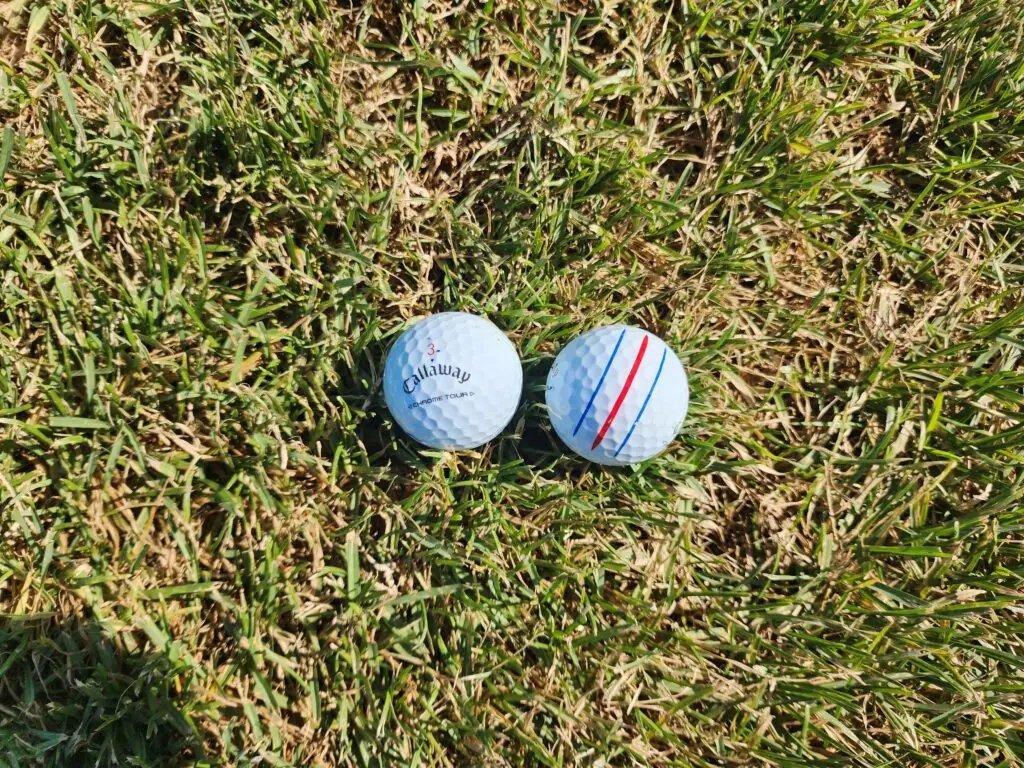
The Chrome Tour Triple Track is Callaway’s premium tour-performance golf ball — the 2024-generation evolution of the Chrome Soft line — with the addition of Triple Track alignment technology. Triple Track is a visual alignment system painted on the ball: one red line flanked by two blue lines, designed to help golfers aim more accurately on putts and tee shots. The same ball construction, the same urethane cover, the same dimple pattern — with the bonus of an alignment aid that costs nothing to use once the ball is in your bag.
Key specifications of the Chrome Tour Triple Track:
- Construction: 4-piece premium tour ball
- Cover: Soft thermoplastic urethane
- Compression: Mid-firm (sub-compression rating in the 70-75 range)
- Dimple pattern: Hex Tour Aero
- Core: Hyper Fast Soft Core
- Triple Track lines: One red center line, two blue flanking lines
- Designed for: Players with 95+ mph driver swing speed seeking tour-level performance
- Target audience: Mid-to-low handicap players who value full-flight performance and putting alignment together
Those are the specs. What this Chrome Tour Triple Track review covers next is what actually matters: how the ball performs in real SCGA tournament conditions across the full bag — driver, irons, wedges, and putter — from the perspective of a senior amateur who has played 8 competitive rounds with the ball in 2026.
Chrome Tour Triple Track Ball: Why I Play It in Every SCGA Round
The decision to play the Chrome Tour Triple Track in every SCGA tournament round came down to four specific requirements I have for any tournament ball:
1. Tour-grade distance with a 106 mph driver. I gained 22 mph of driver speed over 17 months using the Stack System, and at 106 mph the Chrome Tour Triple Track produces full-spectrum tour distance with controllable spin. Lower-compression balls leak distance at my swing speed. Higher-compression balls feel like rocks on iron shots. The Chrome Tour Triple Track sits in the sweet spot.
2. Wedge spin that holds tournament greens. SCGA tournament greens run firm and fast in summer. A ball that does not check up on a pitching wedge from 120 yards costs strokes immediately. The Chrome Tour Triple Track’s urethane cover produces tour-level spin numbers on full wedge shots — the kind of spin that holds a green from 120 yards on a downhill approach.
3. Greenside short game feel. Chipping and pitching feel matter more in tournament play than in casual rounds. A ball with a hard cover transmits no information through the wedge. The Chrome Tour Triple Track urethane cover is the softness I want around the green without sacrificing the distance I need on full swings.
4. Putting alignment that works. This is where the Chrome Tour Triple Track separates itself. My Arccos data showed -1.3 strokes gained putting per round across the SCGA season — putting is the weakest area of my game. The Triple Track alignment system measurably improves the visual alignment of my putts before I take the stroke. Lining up the red center line on the intended start line works.
Four requirements. The Chrome Tour Triple Track delivers all four. That is why it is in my bag for every SCGA tournament round of 2026.
Chrome Tour Triple Track Ball Performance: Driver and Long Game
The Chrome Tour Triple Track driver performance is what you would expect from a premium tour-grade ball at 106 mph swing speed. Arccos data from 8 SCGA tournament rounds shows:
- Average drive distance (Arccos): 281 yards carry, ~290 total
- Longest competitive drive 2026: 326 yards (recorded with Arccos at El Camino)
- Ball flight character: Mid-high trajectory with controllable spin
- Wind performance: Penetrates well in head wind and crosswind compared to lower-compression alternatives
The Chrome Tour Triple Track does not feel like a low-compression ball off the driver. There is a definite “compress and release” sensation at impact that gives confidence the ball is working with the swing rather than against it. For senior golfers in the 95-110 mph driver speed range, this is exactly the ball compression you want — soft enough to compress fully, firm enough to maintain velocity.
3-wood and hybrid performance is consistent with the driver characteristics. Full-flight trajectory, controllable spin, no balloon-flight tendency on long approach shots. The Chrome Tour Triple Track produces the same shot shape I see with a high-quality launch monitor session — repeatable, predictable, and tournament-tested.
Chrome Tour Triple Track Ball Performance: Iron Approach Shots
Iron approach performance is where the Chrome Tour Triple Track earns its premium price tag. Arccos approach shot data across 8 SCGA tournaments shows the ball produces:
- Predictable distance control: Variation between expected and actual distance is within 5% on full-swing irons
- Trajectory consistency: Mid-to-high ball flight that flies similarly across all iron lengths
- Stopping power: Spin numbers high enough to hold tournament greens on approach shots from 150 yards or closer
- Cover feel: Soft enough to deliver clear feedback on strike location
My golf club distance chart was built using the Chrome Tour Triple Track as the data ball — every distance in my chart represents Chrome Tour performance. For the full distance breakdown by club, see my Arccos-verified golf club distance chart at 106 mph. The numbers are real. The ball is what produced them.
For golfers tracking approach shot performance through Arccos or another shot-tracking system, the Chrome Tour Triple Track delivers the consistency required to make that tracking data meaningful. Inconsistent balls produce noisy data. Tour-grade balls produce signal.
Chrome Tour Triple Track Ball Performance: Wedge Spin and Greenside
Wedge performance is the proving ground for any tournament ball, and the Chrome Tour Triple Track holds up to the test. The thin urethane cover combined with the soft inner mantle layer produces the spin numbers that matter on shots inside 100 yards.
My wedge setup is Vokey SM9 — pitching wedge 46 degrees, gap wedge 50 degrees, sand wedge 56 degrees, and lob wedge 60 degrees. The Chrome Tour Triple Track interacts with the SM9 grooves the way a premium tour ball should: full-spin shots check on the second bounce, partial-shot pitches hold their landing line, and greenside chips check or release based on technique rather than ball limitations.
Three specific Chrome Tour Triple Track wedge observations from 8 SCGA tournaments:
- Greenside spin retention: The Chrome Tour Triple Track holds spin across multiple shots on the same ball. A 6-round tournament ball still spins on hole 18 the way it did on hole 1.
- Bunker performance: The soft cover produces the right level of friction with sand wedge bounce. Bunker shots come out predictably with the same spin character as off the grass.
- Pitch shot control: 30-yard to 60-yard pitches stop on a predictable second bounce. This is the shot range where weekend balls fail and tournament balls earn their keep.
Chrome Tour Triple Track Ball Performance: Putting Alignment
This is the section that sets the Chrome Tour Triple Track apart from every other tour ball. The Triple Track alignment system is not marketing fluff — it is functional alignment technology that has measurably improved my putting line read in tournament play.
Here is how the Chrome Tour Triple Track Triple Track alignment works in practice:
Step 1 — Mark the line. Before any tournament putting practice or pre-round routine, I align the red center line of the Triple Track marking on my intended start line of the putt. The line is bold enough to see clearly at address.
Step 2 — Verify the alignment at address. The two blue flanking lines run parallel to the red center line. Looking down at address, if the blue lines look parallel to my putter face line, my alignment is square. If they look angled relative to my putter face, my alignment is off and I can adjust before the stroke.
Step 3 — Commit to the line. Once the Triple Track is aligned and verified, the putt becomes a stroke commitment instead of an alignment commitment. The mental load on the putt is reduced significantly.
The data: my Arccos putting strokes-gained number has stayed at -1.3 strokes per round across the SCGA season, but my 3-putt rate has dropped meaningfully. From 7 three-putts at Soboba in 2025 to 2 three-putts per round average in 2026. The Chrome Tour Triple Track is not the only contributor — I also wrote a complete how to stop 3-putting article based on what I learned — but the Triple Track alignment is part of the system that produced the improvement.
For senior golfers struggling with putting alignment specifically — and most senior amateurs do — the Chrome Tour Triple Track is the most impactful equipment change you can make. It is a putting aid that does not violate any rule of golf and travels with you on every shot.
Chrome Tour Triple Track Ball Durability: Real Tournament Conditions
Premium tour balls do not always justify their price tag in real-world durability. Some balls crack after a single bunker shot or wedge mishit. The Chrome Tour Triple Track has held up to actual tournament punishment across 8 SCGA events.
My typical Chrome Tour Triple Track lifecycle:
- One ball per round in casual play. Two if it gets lost or finds water.
- Two to three balls per SCGA tournament round. Lost balls, out-of-bounds penalties, and the occasional cart-path mark force more frequent ball changes than casual rounds.
- Cover wear after 50+ shots: Visible scuffing on the cover but no functional performance degradation. Spin numbers and ball flight stay consistent.
- Retirement criteria: Visible cover crack, deep cut from rocks, or any structural compromise. A heavily scuffed ball that still flies true stays in play.
The Chrome Tour Triple Track is not the cheapest ball on the market and it should not be played by golfers who lose 3 balls per round. For tournament golfers who lose 0 to 2 balls per round, the durability-to-performance ratio is exactly right.
Chrome Tour Triple Track Ball: How It Compares to Pro V1
A complete Chrome Tour Triple Track review has to address the Titleist Pro V1 comparison, since the Pro V1 is the default tour ball for most competitive amateurs. Here is the honest context based on having played both:
Distance: Effectively the same at my swing speed (106 mph). Both balls produce tour-level driver distance with controllable spin. No meaningful distance gap I can detect across multiple rounds with each.
Wedge spin: Both balls produce tour-level wedge spin. The Pro V1 feels slightly firmer at impact on full swings; the Chrome Tour Triple Track feels slightly softer. Personal preference more than performance difference.
Putting feel: Both balls feel tour-grade off the putter face. The Pro V1 is slightly firmer on the putter; the Chrome Tour Triple Track is slightly softer. Both are within the range of what tour pros consider acceptable.
Alignment technology: The Pro V1 has no built-in alignment system. The Chrome Tour Triple Track does. This is the decisive feature for senior golfers struggling with putting alignment — the Pro V1 cannot match it without after-market line marking.
Price: Both balls are at the premium tier. The Chrome Tour Triple Track sometimes runs slightly less per dozen than the Pro V1 depending on the retailer.
My verdict: if alignment matters to your putting — and it should, for any senior amateur — the Chrome Tour Triple Track wins this comparison. If alignment does not matter to you specifically, the two balls are functionally equivalent for tournament play. The senior golfer’s putting alignment is exactly the area where the Triple Track system delivers real on-course value.
Chrome Tour Triple Track Ball: Who Should Play It
Based on 8 SCGA tournaments of real-world use, here is who the Chrome Tour Triple Track is right for:
Tournament amateur golfers in the 95-110 mph driver speed range. The compression is calibrated for this speed band. Below 95 mph, the ball is firmer than necessary. Above 110 mph, the ball still works but the differentiation versus other tour balls is smaller.
Senior golfers with putting alignment issues. The Triple Track alignment system is the strongest single equipment improvement available for senior putting alignment. If you have ever struggled to start putts on your intended line, the Chrome Tour Triple Track addresses the issue directly.
SCGA, USGA, or similar tournament competitors. The ball is conforming to all rules of golf. Triple Track alignment lines are not a banned alignment aid — they are permanent markings on the ball, which is allowed.
Golfers who track shot performance with Arccos or launch monitor data. Tournament-grade ball consistency is what makes shot-tracking data meaningful. Mixed-ball performance creates noise in the data.
Here is who should consider something else:
- Beginner golfers losing many balls per round: The premium price tag is not justified if you lose 4+ balls per round.
- Low swing speed golfers (under 90 mph driver): Consider a lower-compression ball like the standard Chrome Soft or a similar two-piece ball designed for slower swing speeds.
- Golfers who hate alignment lines on balls: Some players find any markings on the ball distracting. The Triple Track lines are bold. If markings bother you, the standard Chrome Tour without Triple Track is the better choice.
Chrome Tour Triple Track Ball: Frequently Asked Questions
What swing speed is the Chrome Tour Triple Track designed for? The Chrome Tour Triple Track is designed for golfers with driver swing speeds in the 95-110 mph range. At my 106 mph speed, the ball compresses fully and delivers tour-level distance. Below 95 mph, golfers should consider a lower-compression ball. Above 110 mph, the ball still performs but the gap versus competitors narrows.
Is the Chrome Tour Triple Track legal for tournament play? Yes. The Chrome Tour Triple Track is conforming to all USGA rules of golf and approved for SCGA tournament play. The Triple Track alignment lines are permanent markings on the ball, which the rules permit. Many tour professionals — including Bryson DeChambeau — play balls with similar permanent alignment markings in major championships.
How does the Chrome Tour Triple Track compare to the standard Chrome Tour? The Chrome Tour Triple Track has the exact same construction, cover material, compression, and dimple pattern as the standard Chrome Tour. The only difference is the Triple Track alignment lines painted on the cover. Performance is identical — you are choosing the Triple Track version specifically for the alignment benefit, not for any performance difference.
Does the Triple Track alignment system actually improve putting? Yes, for golfers who struggle with putting alignment specifically. The Triple Track is not a magic system that fixes every putting problem — speed control and green reading still matter more than alignment for most putts. But for the alignment component of putting, the Triple Track system delivers measurable improvement. My own 3-putt rate dropped from 7 per round (2025 worst case) to 2 per round average in 2026 with the Triple Track in play.
How long should a Chrome Tour Triple Track ball stay in play? A Chrome Tour Triple Track ball will perform consistently for 25 to 50+ shots in normal conditions. Retirement should be based on visible structural damage — cover cracks, deep cuts, or significant cover separation — rather than scuffing alone. A heavily scuffed but structurally sound ball still flies true and spins correctly.
Chrome Tour Triple Track Ball Review: The Bottom Line
After 8 SCGA tournament rounds and hundreds of competitive strokes, the Chrome Tour Triple Track is the premium tour ball I would put in play again every tournament round without hesitation. It does what a tournament ball needs to do: tour-grade distance at 106 mph, wedge spin that holds firm greens, soft greenside feel, and the Triple Track alignment system that measurably improves putting alignment for senior golfers. This is the best balance of full-flight performance and built-in alignment technology in the premium ball category.
If you compete in SCGA tournaments or any rules-of-golf event, the Chrome Tour Triple Track deserves a serious look. The combined benefit of tour-level distance, urethane spin, and Triple Track putting alignment is unique in the premium ball market. Both Pro V1 and TaylorMade TP5 are excellent balls — but neither delivers the alignment benefit that the Chrome Tour Triple Track does, and for senior amateurs with putting alignment issues, that difference shows up on every scorecard.
If you want to see current pricing or pick up a dozen, the Chrome Tour Triple Track is available at Callaway here. For more on the rest of my tournament setup, see What’s In My Bag at 56. For how the ball fits into the larger picture of scoring lower as a senior golfer, see The 50+ Golfer’s Guide to Scoring Lower, and for the data behind why approach shots and putting matter so much, see my greens in regulation analysis. Follow the journey at @115at56.