
Affiliate Disclosure: This article contains affiliate links. If you purchase through these links, I may earn a commission at no additional cost to you. I only recommend products and services I personally use and trust.
The best 2 man scramble strategy I know turned two decent players into one low number: on Saturday September 19 my brother and I shot a 66 (−6) at Trilogy Golf Club at La Quinta, good for 24th out of 48 teams in the SCGA One Day Series. Seven birdies, one bogey, 303-yard drives in triple-digit heat, and a simple two-man system. This is the honest 2 man scramble strategy recap: the plan, the round, the real Arccos data, and what the format taught me about team golf.
A quick word on honesty before the numbers, because it matters on this site: in a scramble you play the best of the two balls on every shot, so the data I tracked with Arccos is team data, not my individual round. I will be clear throughout about what was mine and what was the team’s. The drives I can claim. The birdie putts I made I can claim. The overall strokes-gained line is the pairing, not one player. That distinction is the whole point of tracking real golf instead of a highlight reel.
My 2 Man Scramble Strategy at Trilogy Golf Club La Quinta
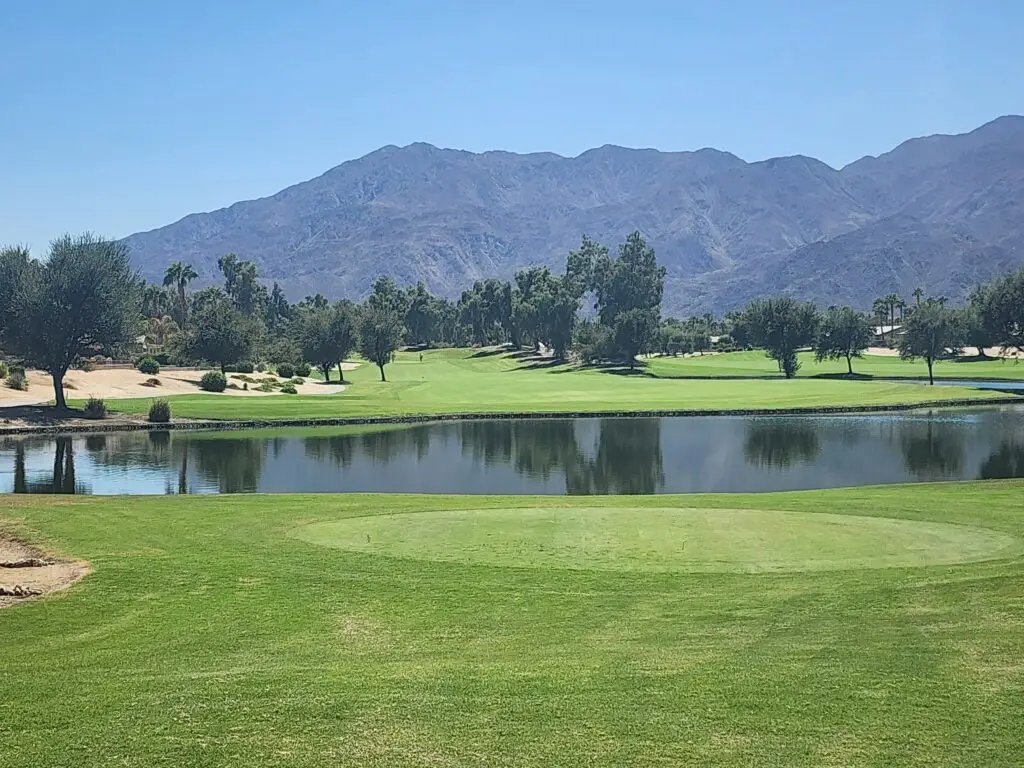
Trilogy Golf Club at La Quinta has a pedigree most public courses cannot touch. Formerly Coral Mountain Golf Club, it hosted the PGA Tour’s made-for-TV Skins Game for four consecutive years from 2003 to 2006 — the event where the biggest names in the game played for cash on national television. Standing on the first tee of a course with that history adds a little something to a Saturday club event.
We played the Gold tees: par 72, 68.4 course rating, 120 slope, 6,245 yards. Not a long setup on the card, but La Quinta in September is its own kind of test — firm turf, fast greens, and heat that becomes a factor by the back nine. The Trilogy layout rewards position over raw power, which shapes the right 2 man scramble strategy: you can be aggressive off the tee because your partner is backing you up, but the approach shots demand precision.
The 2 Man Scramble Strategy That Shot 66
Every good scramble comes down to a system, and our 2 man scramble strategy was simple: my brother hit first on every shot — tee, approach, and putt — and I followed. That order is the single most important decision we made, and it is the reason the birdies fell to my ball.
Here is why hitting second wins. When my brother put a ball safely in the fairway or on the green first, I stepped up with a made shot already in the bank. No pressure to play safe. I could take dead aim at flags, swing freely at drivers, and roll putts firmly at the hole knowing a miss cost us nothing. That freedom is worth strokes. Golf played without fear is different golf, and a good 2 man scramble strategy manufactures that fearlessness on demand — if you set your order to exploit it.
The same logic applied on the greens. My brother lagged his birdie putts to gimme range first. Then I hit mine to make, not to two-putt. Four of our seven birdies dropped on my putter for exactly that reason: I was always the free swing, never the safe one. That is not luck. That is 2 man scramble strategy doing its job.
Why We Drove Up Early: 2 Man Scramble Strategy Starts Friday
We turned the event into a golf weekend, and honestly, the 2 man scramble strategy started before we ever teed off. Driving to La Quinta the morning of a tournament and immediately competing is a recipe for a slow start, so we went up Friday, played a practice round at Trilogy to learn the course, and stayed overnight. We booked the Embassy Suites and Spa at La Quinta on my Hilton Honors account — the same overnight-before approach that set up my Mission Hills North recap two weeks earlier.
The Friday practice round paid off in a scramble specifically. Knowing which holes to attack, where the trouble sat, and how the greens released let us plan our shot order hole by hole. Local knowledge compounds in a 2 man scramble strategy: when you already know the smart target, both players can commit fully. We arrived Saturday rested, acclimated, and with a course map in our heads instead of guessing our way around a course neither of us had seen.
2 Man Scramble Strategy in the Heat: 70 to 104 Degrees
La Quinta in September is a heat management exercise as much as a golf tournament. Our round started with an 8:30am shotgun off hole 1B. The temperature told the story of the day: 70 degrees at 7am when we arrived, 80 degrees at our 8:30 tee time, and 104 degrees when we walked off five hours and 44 minutes later.
That heat gradient is not just a comfort note — it affected the golf, and in our favor off the tee. Hot, thin desert air is less dense, and less dense air means less drag on the ball and more carry. Every drive flew a little farther as the day heated up. For a senior golfer who has spent 18 months chasing driver speed, playing in 100-plus-degree air is a gift: the distance I have trained for showed up amplified. The trade-off is that by the finish, hydration and fatigue become real, and staying sharp mentally through the back nine is its own part of any 2 man scramble strategy.
Driving: The Foundation of Our 2 Man Scramble Strategy
The driving is where I contributed most, and where I can speak with full confidence about what was mine. We used my driver on every hole except 2 and 4. The result: a team driving average of 268 yards and a long drive of 303, with individual bombs of 290 and 303 yards in the building afternoon heat.
Those are numbers I could not have produced two years ago. When I started this journey I averaged 89 mph of driver speed; today I sit around a 111 mph peak, and the on-course product is 290-yard drives that give a 2 man scramble strategy a massive advantage. Short irons into greens instead of hybrids. Par 5s reachable in two. Wedge approaches where other teams hit 7-iron. The full story of how I built that distance is in my Stack System swing speed results, and the broader arc lives on the 115-at-56 journey page.
The team hit 12 of 14 fairways — 86 percent — with zero penalty strokes off the tee. Driving accuracy plus driving distance is the ideal combination in any 2 man scramble strategy: you get the aggression of two swings at each tee shot with the safety net of a partner. This is also the clearest proof that my driving held through the neck injury I wrote about in my swing speed after injury breakdown — the speed came back, and it came back long.
Par 3s and Our 2 Man Scramble Strategy: Who Hits What
Trilogy’s Gold tees include four par 3s — holes 6, 8, 11, and 17. Our 2 man scramble strategy on the par 3s: I hit the tee shots on 6, 8, and 11, and my brother took 17. On a par 3 the tee shot is the whole hole, so we split them to keep both of us engaged and swinging.
The best swing of my day came on the 11th. The hole played 125 yards, I pulled the 50-degree wedge, and I hit it to three feet. Tap-in birdie. That is the kind of shot the format lets you attempt without hesitation — my brother had already found the green, so I could fire straight at a tucked flag with nothing to lose. In stroke play I might have aimed for the fat of the green. Here, I aimed at the hole. That is the difference a 2 man scramble strategy built around freeing up your aggressive shots makes.
Putting: Where the 2 Man Scramble Strategy Paid Off
If driving set the table, putting is what turned pars into a 66. I personally made four of our seven birdie putts, and the distances show the 2 man scramble strategy working exactly as designed:
- Hole 4 — 33 feet. A bomb. My brother had lagged close for a safe par, so I rolled this one hard at the hole with zero fear. It dropped. That putt does not happen in stroke play — you protect against the three-putt. In a scramble, you send it.
- Hole 5 — 12 feet. Straight in. Back-to-back birdies to build momentum on the front nine.
- Hole 9 — 5 feet. A closer to finish the front, converting a birdie look into a made birdie.
- Hole 17 — 15 feet. The purest example of the system: my brother hit the par-3 tee shot, and I made the putt. Neither of us birdies that hole alone. Together, we did.
The 33-footer on 4 is the shot I will remember. It is the physical proof of the whole 2 man scramble strategy: when you always putt second, you always putt to make. Free rolls drop more often than protected ones.
Our Scorecard: The 2 Man Scramble Strategy in Numbers
The team card: 66 (−6), seven birdies, ten pars, and one bogey. Out in 33, back in 33. The only blemish was a bogey on the par-4 13th — the one hole where neither of us could produce a good enough ball to save par. Everywhere else, at least one of us delivered.
That is the math a 2 man scramble strategy is built to exploit: you only need one good shot between two players on any given swing. Ten pars and seven birdies against a single bogey is what happens when two players cover each other’s misses for 18 holes. It is a genuinely low number — and it is honest to say it is a team number, produced by the format, not a solo 66. I have shot my share of solo rounds this season in the mid-70s; a team 66 is a different achievement, and a fun one.
The Arccos Data Behind Our 2 Man Scramble Strategy (Team, Not Individual)
I tracked the entire round with Arccos sensors, recording the team’s selected shot on every hole. Against a scratch (0 handicap) baseline, the team strokes-gained line came out at +6.3 total:
- Driving: +1.9 SG — 268 average, 303 long, 86% fairways, no penalties
- Approach: +2.4 SG — 16 of 18 greens (89%), average approach distance 125 yards
- Short game: +0.3 SG — 3 of 6 up-and-downs
- Putting: +1.7 SG — 29 putts, seven one-putts
Every category positive is a rare and satisfying sight — but read it honestly. A scramble records the better of two balls at every step, so these numbers are inflated relative to any individual round by design. This is what a strong pairing and a sound 2 man scramble strategy produce, not what one player shoots. That is exactly why, per my own tracking rules, this round does not count toward my individual season scoring or strokes-gained averages — team formats live on the tournament history record but stay out of the individual stat pool, the same way my other scramble and four-ball results do. If you want the apples-to-apples individual data, that is what my how swing speed affects scoring breakdown tracks.
How Our 2 Man Scramble Strategy Finished 24th
A 66 finished us 24th out of 48 teams — and the full leaderboard is the only way to understand what that number really means. This was a net scramble, and net scramble scoring compresses an entire field into a razor-thin band. The winning team posted 61 (−11). Below them, it stacked up fast:
- −11 (61): 1 team — the winner
- −10: 3 teams (2nd–4th)
- −9: 4 teams (5th–8th)
- −8: 6 teams (9th–14th)
- −7: 6 teams (15th–20th)
- −6 (66): 7 teams (21st–27th) — our group
Do the math and it is sobering: 27 of the 48 teams — more than half the field — shot six under or better. Our 66 landed in a seven-team logjam at −6, and a tiebreak within that group settled us into 24th. We were five shots off the win, but only one birdie out of a tie for as high as 15th, and two birdies from the top 14. That is the real story of this round: the margins were tiny, and we left three or four makeable looks out there. Convert one more and the finish looks completely different.
There is no sting in 24th. We drove up for a weekend of golf with my brother, played a course with Skins Game history, shot a number we were proud of, and I delivered exactly the parts of the game I have been training for — the distance off the tee and the free putting stroke. But the leaderboard is the clearest possible target: in a net scramble this deep, even six under is mid-pack, and moving up means converting nearly every birdie chance a 2 man scramble strategy hands you.
2 Man Scramble Strategy: 5 Takeaways for Your Next Team Event
If you are playing a scramble soon, here is what this round reinforced about smart 2 man scramble strategy:
- Set your order to free up the aggressive player. The partner who hits second gets to swing without fear. Put your best pressure-free scoring behind a safe first ball, every shot, every putt.
- Putt second, putt to make. Four of our seven birdies came from the free roll. Lag first, attack second. It is the highest-leverage habit in a 2 man scramble strategy.
- Play a practice round if the event matters. Local knowledge compounds in a scramble because both players can commit to the smart target.
- Use your distance. A scramble rewards driving aggression more than any other format. If you have trained for speed, this is where it pays off double.
- Expect to need every birdie. The winners shot 61 (−11) and more than half the 48-team field broke six under. In a net scramble this deep, −6 is a starting point, not a winning score — the margins are razor-thin, so convert every look.
The 2 Man Scramble Strategy Bottom Line
The Trilogy round was everything the format should be: a low team number, a great course, and a weekend of golf with my brother in the La Quinta heat. We shot 66, finished 24th of 48, and the parts that were mine — the 290 and 303-yard drives, the 50-degree wedge to three feet on 11, and four made birdie putts — are exactly the parts of my game I have spent 18 months building.
A scramble is a team achievement, and I will always report it as one. But the right 2 man scramble strategy is also a showcase for the individual skills you bring to the table, and the distance I brought to this one is the direct product of dedicated speed training. If you want to add the kind of driver distance that changes what a scramble team can do, the Stack System is available with 10% off through my discount link. For another team-format breakdown, see my 2 man scramble recap from Rancho California, and for the full rundown on competing in this series, the SCGA tournament guide. Follow the journey at @115at56.