
Losing swing speed after injury is the quiet fear every golfer over 50 carries, and this summer I got to live it: a neck injury on July 27, 2026 pulled me out of training for 38 days, forced three tournament withdrawals, and dropped my driver speed from 111 mph down to 101. That is a 10 mph hole. But the data I collected coming back turned out to be more useful — and more encouraging — than the raw number suggested, and I want to walk you through all of it.
I’m Marino, a 56-year-old SCGA competitor and 3 handicap. For 18 months I’ve documented every step of an overspeed-training journey toward 115 mph using the Stack System, from an 89 mph starting point in December 2024 to a peak of 111 mph in June 2026. This is the honest account of what happened next — the setback, the exact measurements, and the plan I’m using to rebuild. If you’ve been sidelined and you’re wondering whether your speed is gone for good, the answer in my data is a clear no.
What Losing Swing Speed After an Injury Actually Looks Like
The injury came mid-workout. I was 14 sessions into a Full Speed Spectrum program — call it Program 8 — when my neck went during a set. Not dramatic, not a single violent moment, just the slow realization over the next 48 hours that I wasn’t training or competing for a while. I withdrew from three events, including my club championship at Admiral Baker, where I’d finished second the year before.
Here’s the part nobody prepares you for: the hardest thing about swing speed after injury isn’t the physical recovery. It’s the not-knowing. You sit for five weeks with no data, watching an 18-month climb apparently evaporate, and your imagination fills the gap with worst-case math. I assumed I’d lost everything. When I finally felt cleared to test again, I expected the number to be brutal. What I actually found was more specific — and that specificity is the whole point of tracking swing speed after injury instead of guessing at it.
The Numbers: My Swing Speed After Injury Dropped 10 MPH
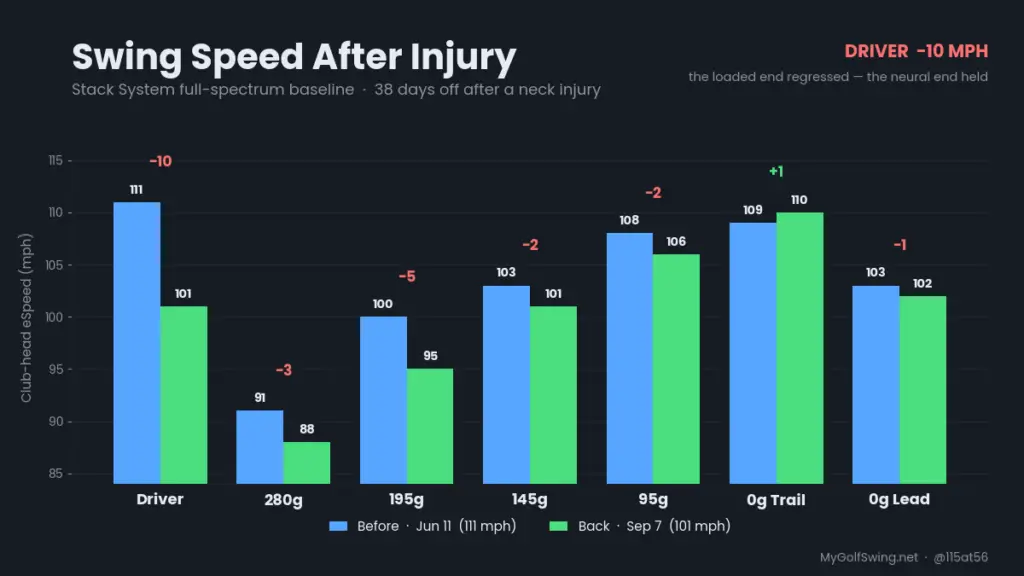
On September 7, 2026 I ran a full baseline test — the same full-spectrum protocol the Stack app uses to measure your true speed across every training weight. Comparing it against my last clean baseline before the injury (111 mph, established June 11) gives the most honest picture of swing speed after injury I can offer, because it’s the same test, same protocol, roughly three months apart with a 38-day layoff in the middle.
| Training Weight | Before (Jun 11) | Back (Sep 7) | Change |
|---|---|---|---|
| Driver | 111 | 101 | −10 |
| 280g | 91 | 88 | −3 |
| 195g | 100 | 95 | −5 |
| 145g | 103 | 101 | −2 |
| 95g | 108 | 106 | −2 |
| 0g (Trail) | 109 | 110 | +1 |
| 0g (Lead) | 103 | 102 | −1 |
Ten miles per hour off the driver is real, and I’m not going to soften it. But read down that column before you panic on my behalf, because the story of my swing speed after injury is written in where the losses landed, not just the headline driver figure.
Why Swing Speed After Injury Doesn’t Regress Evenly
If detraining simply peeled a fixed percentage off everything, every row in that table would show roughly the same drop. It doesn’t. My swing speed after injury fell off a cliff at the heavy, high-effort end and barely moved at the light, fast end. That uneven pattern is the single most important thing I learned, and it completely changed how I felt about the comeback.
Overspeed training works on two different systems at once. There’s the neural side — your nervous system’s willingness and ability to fire fast, recruit muscle quickly, and let the club go. And there’s the loaded side — the strength and stability that lets you apply force against resistance without your body slamming on the brakes to protect itself. When you map my swing speed after injury against those two systems, the data separates cleanly.
The Part of My Swing Speed After Injury That Held
Look at the 0g rows. Trail-side went up one mile per hour. Lead-side dropped a single mile per hour. The lightest, fastest, purely neural end of my spectrum — the part that’s really just “how fast can your nervous system move a near-weightless stick” — survived 38 days off almost completely intact.
That matters enormously for anyone tracking swing speed after injury, because the neural adaptation is the thing that took me 18 months and seven programs to build. It’s the expensive part. And the data says a month-plus of rest didn’t erase it. My body still knows how to move fast; it just temporarily forgot how to do it against load. When your fast-twitch recruitment is the thing that survives a layoff, you’re not rebuilding a house — you’re re-hanging the doors.
The Part of My Swing Speed After Injury That Regressed
Now the top of the table. Driver down 10, 195g down 5, 280g down 3. The heavier the implement — the more the movement demands strength and stability rather than pure speed — the bigger the loss. That’s your classic detraining signature: swing speed after injury bleeds out of the loaded, max-effort end first, because that’s the component most dependent on conditioning, and conditioning is exactly what disappears when you spend five weeks not swinging.
Here’s why that’s genuinely good news rather than a life sentence. The strength-and-stability side of speed is also the side that comes back fastest. Neural gains are slow to build and slow to lose; loaded output is quicker to lose but quicker to reclaim, especially when the underlying neural pattern is still there waiting. My swing speed after injury didn’t collapse from the foundation up. It lost its top layer — the layer that rebuilds in weeks, not months.
The Biggest Mistake Golfers Make With Swing Speed After Injury
I made it, so I can warn you off it honestly. When I first came back, I tried to resume training at my old 111 level. My program history now shows two canceled Full Speed Spectrum programs, both started at that 111 baseline. Both times my body told me — clearly, and a little alarmingly given where the injury was — that 111 was not an available number yet. So I stopped.
That is the trap with swing speed after injury: your ego remembers the peak, and it wants to pick up exactly where you left off. But your nervous system and tissues are somewhere else entirely, and forcing the old number is precisely how a recovered injury becomes a re-injury. Every credible source on returning to golf after time off says the same thing in different words — the Titleist Performance Institute frames it as readiness, not willpower. Chasing a stale personal best is not training. It’s gambling with the one thing you can’t get back on a schedule.
How I Re-Baselined My Swing Speed After Injury
The fix was humbling and completely correct: throw out the 111, and let the app measure my swing speed after injury as it actually was on September 7. That number was 101. The Stack System is built to program off your real, current speed — not the number you wish you had — so re-baselining honestly at 101 lets the training load match the body I’m actually training today.
Re-baselining is not admitting defeat. It’s the opposite. It’s refusing to lie to your training program, which is the same discipline that got me from 89 to 111 in the first place. If you take one practical lesson from my swing speed after injury, make it this: measure where you are now, program from there, and let the old peak be a target rather than a starting line. You can read the full 18-month arc on my speed log, and the complete program-by-program breakdown in my Stack System swing speed results.
Rebuilding Swing Speed After Injury: My Program 8 Restart
So here’s the plan I’m actually running. I’ve relaunched Full Speed Spectrum as Program 8 (Restart after Injury), keyed to the honest 101 baseline. Two sessions in as I write this, the point isn’t to chase a number — it’s to re-load the spring gradually and let the strength side catch back up to the neural side that never left.
The reason I trust the tool for this specific job is that rebuilding swing speed after injury is exactly where a data-driven, self-adjusting program earns its keep. Guessing your way back is how people re-injure themselves; a structured protocol that measures every set and adjusts the load removes the ego from the equation. I’ve written the complete, no-hype breakdown of how the system works and who it’s for in my honest Stack System review, and if you want to start your own comeback, my discount link takes 10% off. I use it three times a week in my backyard — this isn’t a weekend test, it’s the actual tool I’m rebuilding on.
What My First Tournament Proved About Swing Speed After Injury
This is the section I most want you to read, because it reframes the entire 10 mph number. On September 5 — two days before that sobering 101 baseline — I played my first SCGA tournament back, at Mission Hills North. And according to my Arccos data, driving was my best category of the round at +0.9 strokes gained, with a 266-yard average and a 290-yard long drive.
Sit with that. My measured overspeed had dropped 10 mph, and yet my on-course driving held up better than any other part of my game. That’s the crucial, counterintuitive truth about swing speed after injury: eSpeed on a training stick and driving performance in competition are related but not identical. The neural pattern that survived the layoff — the part that held in the 0g rows — is the part that actually shows up when there’s a ball and a fairway in front of you.
The full breakdown is in my Mission Hills North recap, tracked with Arccos sensors. The round wasn’t clean — my putting from inside 10 feet was rusty, which is its own layoff signature — but the driver was there. Swing speed after injury looked far worse on the training screen than it played on the course.
How Long Does It Take to Rebuild Swing Speed After Injury?
The honest answer is that I don’t have the finish line yet — this is a live comeback, not a tidy after-the-fact story, and I’ll keep publishing the real numbers as they come in. But the shape of the recovery is predictable from what the data already shows. Because my neural end held and only the loaded end regressed, rebuilding swing speed after injury for me is a matter of weeks of progressive re-loading, not another 18-month rebuild from scratch.
What I’m watching for, and what you should watch for in your own comeback: the heavy weights (driver, 195g, 280g) climbing back toward their old marks while the light weights stay steady. That’s the signature of strength catching up to a neural base that never left. If instead the light end starts sagging, that’s a sign of overtraining or under-recovery, and the right response is more rest, not more swings. Tracking swing speed after injury across the full spectrum — not just the driver — is what lets you tell those two situations apart.
Protecting Your Swing Speed After Injury: What I’d Do Differently
Hindsight is cheap, but it’s also instructive. A few things I’d change to protect swing speed after injury the next time — because for a golfer over 50, there is very likely a next time:
- Warm up like the session depends on it. Overspeed work in a cold or fatigued state is where a huge share of injuries happen. Five minutes of preparation is cheaper than 38 days off.
- Respect the recovery windows. These sessions are short but neurologically demanding. Crowding them is how strain accumulates into injury.
- Keep strength work in the plan year-round. The loaded end of my spectrum is what collapsed. A body that’s conditioned to handle load loses less swing speed after injury and rebuilds it faster.
- Don’t skip the baseline test on the way back. The temptation is to just start swinging. The measurement is what keeps you honest and keeps the load appropriate.
For the mobility and conditioning side of this — the foundation that determines how much swing speed after injury you keep — I’ve written separately about building swing speed for golfers over 50, which covers the strength and rotational work that protects you in the first place.
Your Plan for Coming Back: Swing Speed After Injury, Step by Step
If you’re reading this because you’re on the sidelines right now, here’s the whole thing distilled into what I’d actually tell a friend about rebuilding swing speed after injury:
- Get cleared first. None of this matters if the injury isn’t healed. Speed can wait; your neck, back, or shoulder can’t.
- Test before you assume. Run a real baseline. My swing speed after injury was measurably worse than my best but far better than my fears — you won’t know which is true for you until you measure.
- Read the full spectrum, not just the driver. Where you lost speed tells you how fast you’ll get it back.
- Program from today’s number. Re-baseline honestly and let the plan build from there. Never force the old peak.
- Trust the course over the screen. Your competitive driving may hold up far better than your training numbers suggest, because the neural pattern is the last thing to go.
My journey started at 89 mph in December 2024, reached 111 in June 2026, and sits at 101 today after a neck injury and 38 days off. That’s not a collapse — it’s a dip in a long climb, and the goal is still 115. You can follow the whole thing, tournament by tournament and program by program, on the 115-at-56 journey page. If a setback has you convinced your speed is gone, let my data be the counterexample: swing speed after injury is a chapter, not the end of the book.
Ready to rebuild your own speed?
The Stack System programs off your real, current speed — the exact reason it’s the right tool for a comeback. Use my link for 10% off and start from where you actually are today. Affiliate link — I earn a small commission at no extra cost to you, and I only recommend gear I personally train with.
Pingback: Best Mission Hills North SCGA Recap: 79 Back From Injury
Pingback: Insider Temecula Creek Golf: My 77 and a Qualifying Push