
This post contains affiliate links. If you purchase through them, I may earn a commission at no additional cost to you. I only recommend products I personally use.
The number that changed everything for me was 89 mph.
Not because it was impressive. Because I thought it was going to be a lot higher.
It was my very first Stack System session — December 6, 2024. Before anything else, the app measures your Driver eSpeed to establish a true baseline. I stepped up, took my swing, and watched the number come back: 89 mph. Distance potential: 215 yards.
I genuinely thought I was faster than that. I’m a competitive amateur golfer. I play in SCGA tournaments. I’ve been playing this game seriously for decades. And here was this app telling me my driver speed was sitting at 89 mph with the distance potential of a casual weekend hacker.
I stared at that number for a second. For context on where 89 mph ranks for a golfer my age, see our breakdown of average golf swing speed benchmarks by age. Then I got to work.
If you’re researching Stack System swing speed results before deciding whether to invest in the program, this is the article I wish I’d had. Real numbers. Real programs. A real plateau — and the honest reason behind it. No hype, no cherry-picked data. Just what actually happened over 15 months of training — these are my real Stack System swing speed results.
Why I Started the Stack System at 56
I’m 56 years old and I compete in the SCGA One Day Series. I was a 7 handicap when I started. I’m a 3 now. I’m not out here just trying to break 80 — I’m trying to win my flight. I knew that if I could add real, measurable swing speed, I’d have a legitimate edge over the field.
The Stack System is built around overspeed training. The Stack itself is a 41.5-inch trainer that comes with 5 milled weights enabling 30 unique weight combinations from 0g all the way to 300g. It’s not a swing tip. It’s not a feel drill. It’s athletic training applied specifically to the golf swing. To get started you need three things: the Stack trainer with its 5 weights, a swing speed radar, and a phone or tablet running the app. I’d strongly recommend the Stack Radar Bundle — it integrates seamlessly so your speed is tracked automatically every session.
My Stack System Swing Speed Results: Program by Program
| Program | Start | End | Dates | Sessions | Swings |
|---|---|---|---|---|---|
| Program 1: Foundation | 89 mph | 94 mph | Dec 6, 2024 – Feb 22, 2025 | 18 | 100 |
| Program 2 | 94 mph | 99 mph | Mar 2 – May 11, 2025 | 24 | 157 |
| Program 3 | 99 mph | 99 mph | May 12 – Jul 27, 2025 | 24 | 141 |
| Program 4 | 99 mph | 101 mph | Aug 4 – Oct 21, 2025 | 24 | 141 |
| Program 5 | 101 mph | 106 mph | Oct 27 – Dec 31, 2025 | 24 | 157 |
| Program 6 | 105 mph | 106 mph | Jan 2 – Mar 22, 2026 | 24 | 141 |
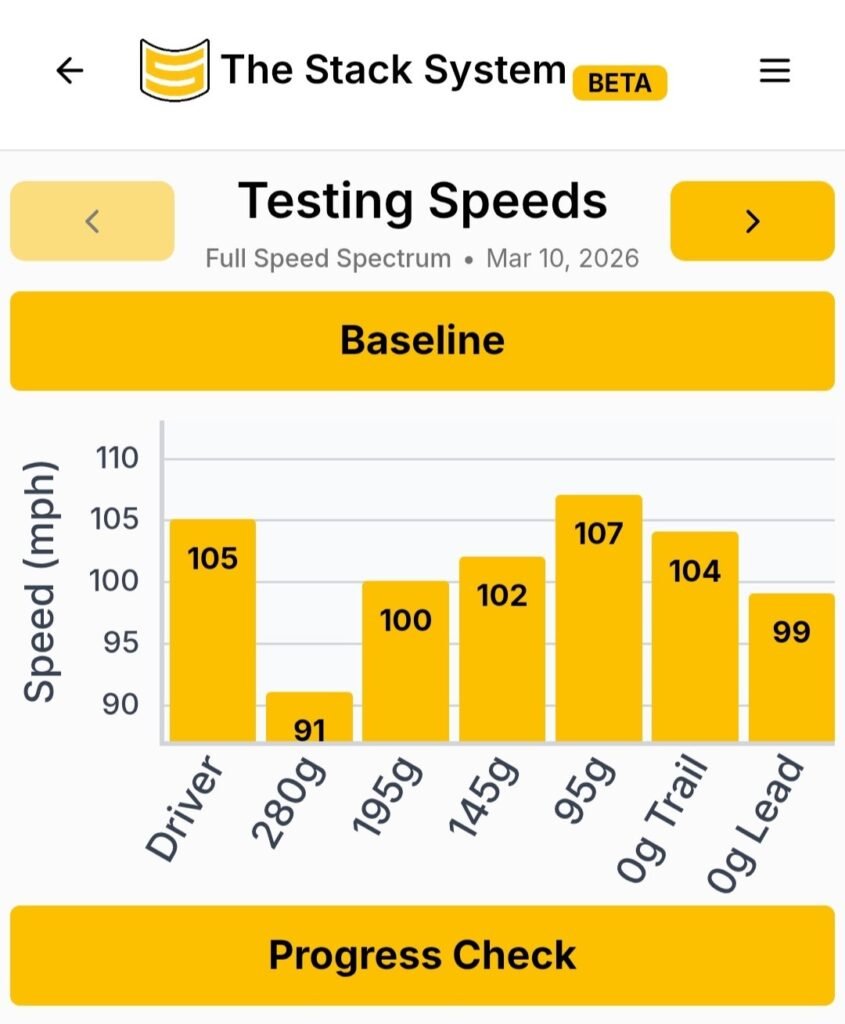
| Program 7: Full Speed Spectrum | 107 mph | 111 mph ✓ New PB | Mar 22 – Jun 16, 2026 | 24 | 769 |
Total Stack System swing speed results: 89 mph → 111 mph. That’s +22 mph in 17 months across 7 completed programs and 5,416 total training swings.
What the First Session Actually Looks Like
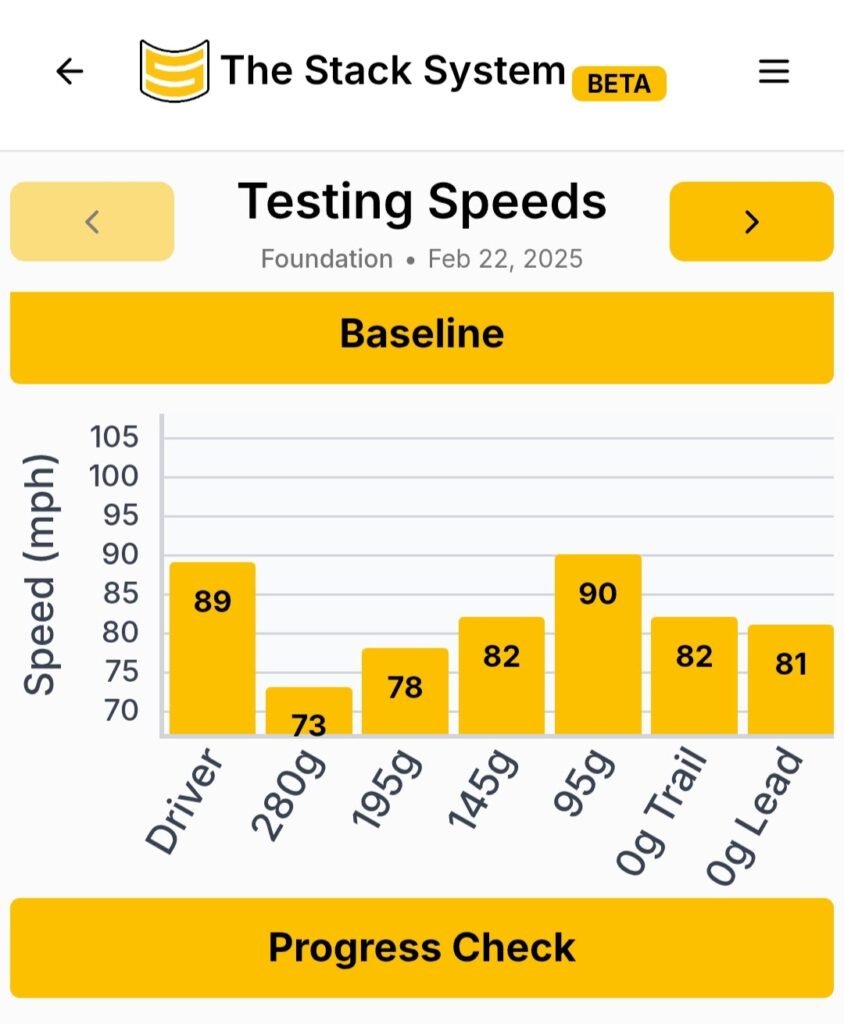
The first session is your baseline — it includes both your driver and the Stack trainer in one continuous session. Set 1 is always done with your own driver so the app has a true starting point. My entire baseline session on December 6, 2024 clocked in at 13 minutes and 21 seconds.
- Set 1: Driver (8 swings) — Avg 89 mph (your baseline)
- Set 2: The Stack at 280g — Avg 73 mph
- Set 3: The Stack at 195g — Avg 78 mph
- Set 4: The Stack at 145g — Avg 82 mph
- Set 5: The Stack at 95g — Avg 90 mph
- Set 6: Trail arm only, 0g — 82 mph
- Set 7: Lead arm only, 0g — 81 mph
The app gives you 90 seconds to 2 minutes of rest between sets, and 10 seconds between individual swings. By the end of that first session I was already swinging the Stack’s 95g head faster than my baseline driver speed. Something was already happening neurologically — even in session one.
The Three Swing Types the Stack Uses
- Full Swing — The fastest swing you’d make in an actual round of golf. Controlled, on-balance, all out.
- Max Effort Swing — The absolute fastest you can possibly swing, even if you lose your balance. This is about training your nervous system to find a new ceiling.
- Step Swing — Start with feet together; as you begin your backswing your front foot steps forward to coordinate your weight shift into your lead side. A powerful drill for sequencing and timing.
A current training session looks like this:
- 8 Max Effort swings at 255g
- 8 Step Swings at 135g
- 6 Step Swings at 95g
- 8 Max Effort swings at 255g
- 6 Full Swings at 195g — these calculate your Driver eSpeed for the session
That final set of 6 swings at 195g is how the app measures your Driver eSpeed at the end of every session — your progress check built right into the training. The algorithm decides which weights and swing types to use based on your individual data. The rest periods between sets aren’t downtime either. When you’re swinging a 255g head at max effort, you need the full 90 seconds to 2 minutes to deliver everything on the next set.
The Grind: Programs 2 Through 4
Breaking 100 mph felt like a genuine milestone, but I’ll be honest — Programs 2 and 3 felt like slow going compared to the Foundation. Going from 99 to 101 mph on the humble middle programs took consistency. The Grit score in the app kept me honest. I could see exactly whether I was hitting the recommended training frequency or falling short.
Program 4 was my best program, August through October 2025. I went from 101 to 106 mph — a 5 mph gain in a single program. I was locked in. The SCGA One Day Series season was winding down and I had a clear target: qualify for the championship and show up faster than the previous year.
I did both. My Stack System swing speed results that season were the best of any program so far.
The Regression — And Why I’m Publishing It
Here’s the part most people wouldn’t include in their Stack System swing speed results article.
After Program 3 ended at 99 mph, my year-end recheck on December 21 came back at 100 mph — I lost a hard-earned mph. And when I looked at the data honestly, I could see exactly why.
The SCGA Day Series Championship on November 3–5, 2025. That tournament had taken my training off-track for two weeks. When it ended, I couldn’t quite get back on full cadence. Season over. The holidays arrived, family travel took priority, and I got hit with my sinuses.
Here’s what those Stack System swing speed results taught me that nobody talks about: speed is a perishable skill. You stop training your fast-twitch fibers, they slow down. If you stop training your brain’s fast patterns, they slow back down. Do that in error — and it’s the most important swing speed results lesson I’ve learned.
When I came back, I mph. I didn’t get frustrated — I got recommitted. That’s when @115at56 stopped being a social handle and started being a real intention.
Where I Am Now — And Where I’m Going
I completed all 7 programs on March 22, 2026. My final driver baseline is 111 mph — up from 89 mph when I started in December 2024. That’s 7 mph gained in 17 months.
More importantly, the speed is showing up on the course where it counts. In a recent SCGA tournament at Soboba Springs, I shot a 75, won two group and beat me to my flight, and we’re documenting every competitive result at what I’ve learned in SCGA tournaments. That result happens at 89 mph.
The speed shows up at the club level too. I’ve documented every club in my bag with Arccos sensors — driver at 277 yards. Fairway at 221. Every wedge in the bag — in my proven golf club distance chart. That data is the clearest answer to what 17 mph of swing speed actually means: 1.5 clubs more on every approach shot, par 5s I can reach in two, and dispersion patterns that steadily widen the game from now versus where it was at 89 mph. Tournament wins and the handicap slide went down to this proof.
The goal is 115 mph. I’m documenting every step of that journey on MyGolfSwing.net. If you’re a golfer over 50 wondering whether competitive training actually works at your age, my Stack System swing speed results are right here — not only if you show up consistently.
Stack System Swing Speed Results: The Plateau and How I Broke It
Programs 3 through 6 were a plateau. Five consecutive programs stuck near 106 mph. It wasn’t the program failing — it was my body hitting a physical ceiling.
A professional TPI performance assessment identified the root cause: core rotation at the 20th percentile, full body rotation at the 31st percentile. My rotational power wasn’t strong enough to keep up with the speed pattern the Stack System had trained. Despite 15 months of yoga practice, my hip rotational mobility — the specific type the golf swing demands — also wasn’t where it needed to be.
The fix: daily TPI corrective exercises and structured strength training with a rotational power focus. Program 7 was the first program run alongside that physical work — and it produced a 4 mph gain and a new personal best of 111 mph.
For the complete Program 7 data — grit score, progress check results, individual swing readings — read my Stack System Program 7 complete results.
One Thing I Didn’t Expect: Wearing Out My Grip
After months of Stack System training I noticed the grip on my Stack trainer was completely worn down. All those extra swings — 100 to 769 per program — add up fast. If you’re serious about the program, expect to regrip the Stack trainer at some point.
I went with the Golf Pride ZGrip Cord Golf Grip — firm feel, high-traction texture, built to hold up under serious training volume. I used the Wedge Guys Golf Grip Regripping Kit to do it myself — everything included. Easier than it sounds and saves real money.
Is the Stack System Worth It?
After 7 programs, 5,416 total swings, and a 22 mph driver baseline gain from 89 to 111 mph — here’s my honest verdict:
Yes — but only if you stay consistent.
The Stack System is not magic. It’s a well-designed training protocol that delivers when you execute it. The app removes every excuse — it tells you when to train, exactly what to do, and how fast you’re going. The Grit score holds you accountable in a way that’s hard to ignore. The data doesn’t let you lie to yourself.
For golfers over 50 who think their best speed is behind them, I’m here with real Stack System swing speed results that say otherwise. I started at 89 mph at 55 years old. I’m at 111 mph driver at 56, with Program 8 underway. The gap between where I am and 115 mph is 4 mph — and closing.
For a 106 mph driver baseline, with a Driver eSpeed of 107 mph. The gap between I am and 115 mph is closing. Ready to find out your real number? Start the Stack System here and save 10% — discount applies automatically at checkout.
Stack System Swing Speed Results: Frequently Asked Questions
How much swing speed can I realistically gain with the Stack System? My Stack System swing speed results show 22 mph gained across 7 programs over 17 months — from 89 mph to 111 mph at age 56. Early programs typically produce the fastest Stack System swing speed results. Later programs require addressing physical limiters like rotational strength to keep improving.
How long does each Stack System program take? Programs range from 18 to 24 sessions. At two to three sessions per week, most Stack System programs take 8–13 weeks. My 7 programs spanned 17 months total.
What if my Stack System swing speed results plateau? This happened to me between Programs 3 and 6. A TPI performance assessment identified rotational power deficits as the limiter. Adding targeted strength training broke the plateau in Program 7 — 4 mph gained and a new personal best of 111 mph.
Do Stack System swing speed results show up on the golf course? Yes — my handicap dropped from 7 to 3 over the same period. Par 5 scoring is now at scratch level. The Stack System swing speed results are real and they show up in scoring data.
Related Reading on MyGolfSwing.net
- Stack System Program 7 Complete — 111 MPH New Personal Best After 17 Months
- The Honest Stack System Review: Worth It for Golfers Over 50?
- Proven Golf Club Distance Chart: Real Arccos Data
- SCGA One Day Series: What I’ve Learned Competing at a 3 Handicap
- The 50+ Golfer’s Complete Guide to Gaining Swing Speed
Pingback: Proven: Rebuilding Swing Speed After Injury at 56
Pingback: Proven 2 Man Scramble Strategy: Our 66 at Trilogy
Pingback: Insider Temecula Creek Golf: My 77 and a Qualifying Push