
Affiliate Disclosure: This article contains affiliate links. If you purchase through them, I may earn a small commission at no extra cost to you. I only recommend products I personally use and trust.
Most golfers over 50 know they should stretch more. Almost none of them have a consistent routine. And of those who do stretch, most are doing the wrong stretches for what the golf swing actually demands. Yoga for golfers over 50 isn’t about touching your toes before a round — it’s about systematically restoring the range of motion that decades of sitting, stress, and aging have quietly stolen, and getting it back in a way that directly translates to more distance off the tee.
I’ve practiced hot yoga for 11 years — consistently, multiple times per week. Despite that, my TPI assessment with Ryan Engstrom at Engstrom Athletics revealed I still had limited hip rotational mobility. That was humbling. It taught me that yoga for golfers over 50 is the foundation of speed training — but it needs to be targeted at the right restrictions, not just general flexibility. This guide gives you the exact framework.
Why Yoga for Golfers Over 50 Is a Distance Problem, Not Just a Health Problem
Yoga for golfers over 50 matters because distance comes from speed, and speed comes from the efficient transfer of rotational energy through your body and into the club. That chain — hips, thoracic spine, shoulders, arms, club — only works when every link moves freely. When any piece is restricted, you compensate. Compensations kill efficiency. Killed efficiency means the energy your body generates never fully reaches the clubhead.
Here’s how common restrictions manifest as distance loss — and why yoga for golfers over 50 addresses each one directly:
- Tight hip flexors → limited hip clearance on the downswing → arms dominate → loss of lag and speed
- Stiff thoracic spine → reduced shoulder turn → smaller X-factor → less stored rotational energy to release
- Tight lats and chest → restricted arm swing → narrow arc → less clubhead speed through impact
- Limited hamstring flexibility → early loss of posture → inconsistent contact, early extension
Every one of these is addressable with targeted yoga for golfers over 50. According to the Titleist Performance Institute, thoracic spine restriction is one of the most common physical limiters they screen for in golfers. When you address these restrictions through yoga for golfers over 50, you don’t just feel better — you swing faster, more consistently, with less effort.
For the full picture of how yoga for golfers over 50 connects to swing speed training, see my swing speed for golfers over 50 guide — which covers the complete training framework including overspeed, strength, and mobility work.
Yoga for Golfers Over 50: The 5 Most Important Mobility Areas
Every yoga for golfers over 50 program should target these five areas. They are the exact restrictions that show up most often in golfers who have lost distance — and the same areas flagged in my TPI assessment despite 11 years of hot yoga practice.
1. Hip Flexors
The single biggest restriction in yoga for golfers over 50 work is the hip flexors. If you sit for any extended period each day, your hip flexors are tight — guaranteed. Tight hip flexors pull your pelvis into anterior tilt, which restricts your ability to rotate your hips freely and fire your glutes through impact.
Primary move: Kneeling Hip Flexor Lunge
Kneel on your right knee, left foot forward. Shift your hips forward until you feel a deep stretch in the front of the right hip. Hold 30–45 seconds. For the golf-specific version, add a gentle rotation toward your front knee while in the lunge position. 3 sets per side, daily. This is foundational yoga for golfers over 50.
2. Thoracic Spine
The thoracic spine is supposed to rotate freely. In most adults over 50, it barely moves. This forces the lumbar spine to compensate — which is both a performance issue and an injury risk. Restoring thoracic rotation through yoga for golfers over 50 directly increases your shoulder turn and X-factor. More X-factor = more stored energy = more speed.
Primary move: Thread the Needle
Start on all fours. Take your right hand and slide it along the floor underneath your left arm as far as you can, rotating your thoracic spine. Hold for 3 seconds at end range. Return and repeat. 10 reps each side, twice daily for best results.
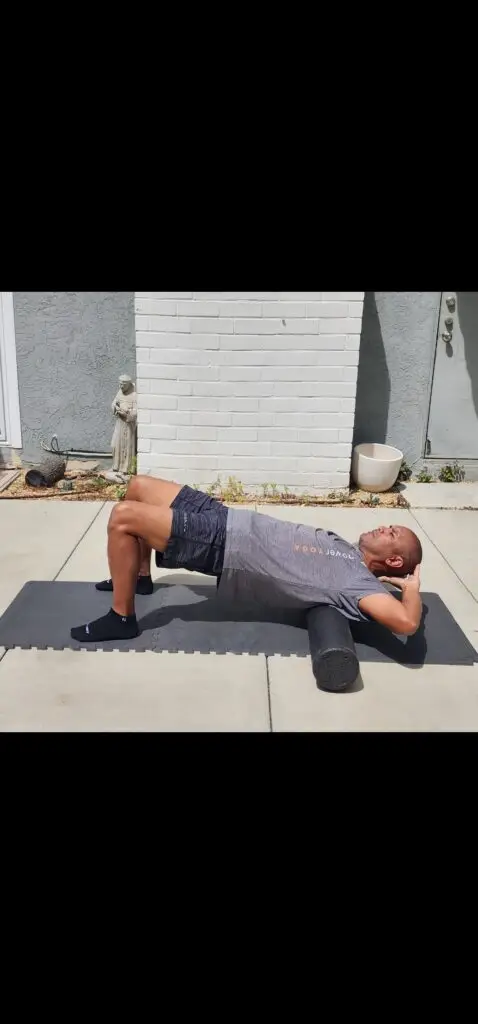
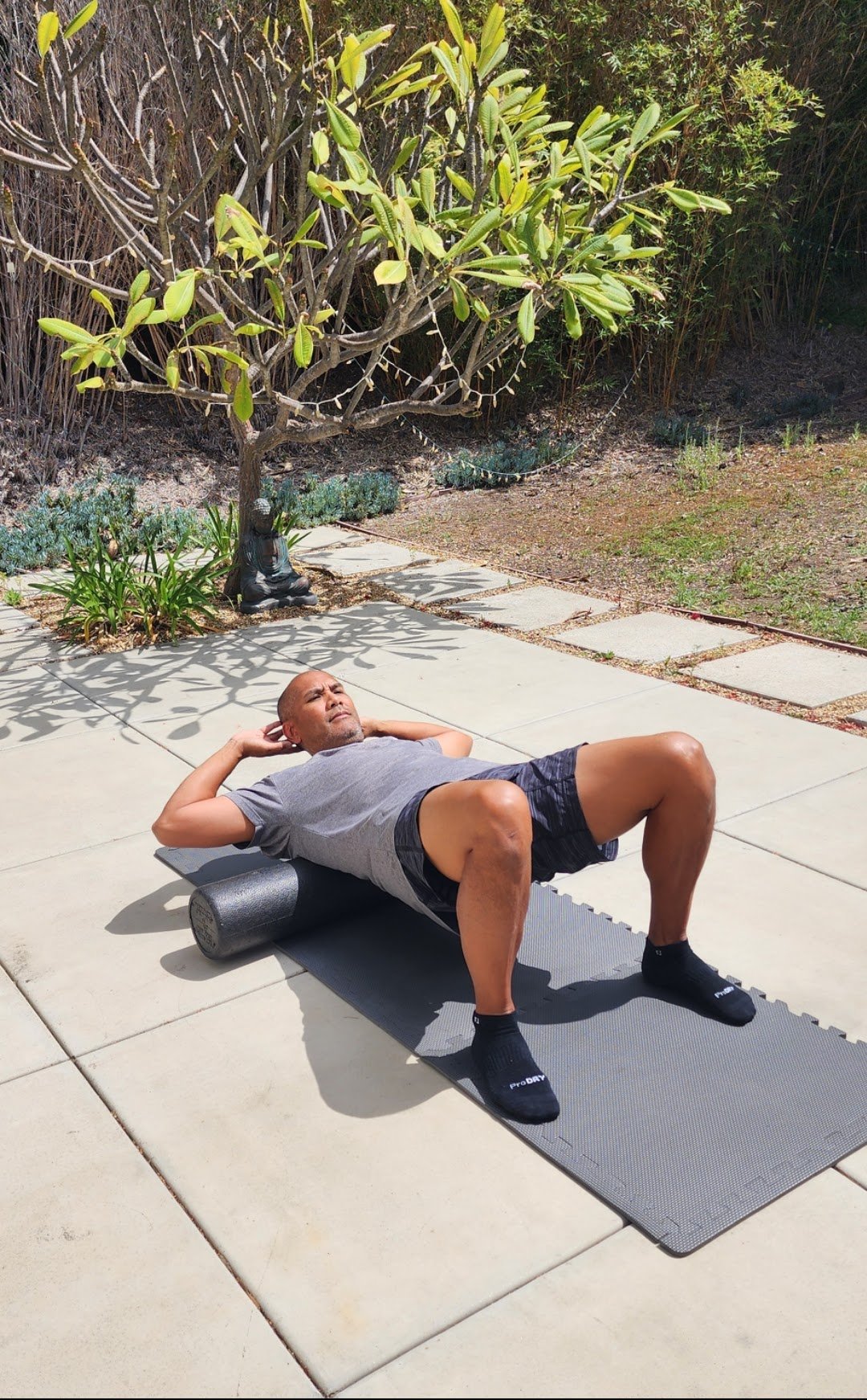
Secondary move: Foam Roller Thoracic Extension
Place a foam roller perpendicular to your spine at mid-back height. Support your head with your hands. Gently extend over the roller for 30–60 seconds, then move the roller up one segment and repeat. One of the highest-value 3-minute routines in yoga for golfers over 50.
3. Hip Internal Rotation
Often overlooked in yoga for golfers over 50, hip internal rotation is critical for hip clearance on the downswing. Without it, your hips stall and your upper body fires early — which is the fastest route to an over-the-top move and a loss of speed.
Primary move: 90/90 Stretch
Sit on the floor with both legs bent at 90°: one in front, one behind. Sit tall. Lean gently toward your front shin until you feel a stretch in the outside of your back hip. Hold 45–60 seconds per side. This is one of the most direct yoga for golfers over 50 exercises for downswing mobility.
4. Shoulder and Lat Flexibility
The ability to get your lead arm into a full, high position at the top of the backswing depends on shoulder and lat flexibility — a critical area of yoga for golfers over 50. Restricted lats narrow your arc and cost you width.
Primary move: Doorway Chest Stretch
Stand in a doorway with both arms at 90° against the frame. Step forward gently until you feel a stretch across the front of both shoulders and chest. Hold 30–45 seconds. 3 rounds.
Secondary move: Overhead Lat Stretch
Stand next to a wall or door frame. Reach your arm overhead and grip the frame. Gently side-bend away from your arm to stretch the lat. Hold 30 seconds per side. Essential yoga for golfers over 50 who lift weights without matching flexibility work.
5. Hamstrings and Glutes
Hamstring tightness disrupts your posture at address and promotes early extension through the downswing — one of the most common swing faults in golfers over 50. Yoga for golfers over 50 that targets hamstring length helps you maintain your spine angle from address through impact.
Primary move: Supine Hamstring Stretch
Lie on your back. Bring one knee to your chest, then slowly extend the leg toward the ceiling. Hold at the point of tension (not pain) for 45–60 seconds. No bouncing. 3 sets per side.
Yoga for Golfers Over 50: The 12-Minute Morning Routine
Do this every morning — or at minimum on days you play or train. This is the core yoga for golfers over 50 daily practice. It takes 12 minutes and directly addresses every restriction that limits swing speed.
| Movement | Duration | Target Area |
|---|---|---|
| Cat-cow (10 reps) | 1 min | Spine warm-up |
| Thread the needle (10 reps/side) | 2 min | Thoracic rotation |
| Foam roller thoracic extension | 2 min | Thoracic extension |
| Kneeling hip flexor lunge (30s/side) | 2 min | Hip flexors |
| 90/90 stretch (45s/side) | 2 min | Hip internal rotation |
| Supine hamstring stretch (45s/side) | 2 min | Hamstrings |
| Doorway chest stretch (30s x 3) | 1 min | Chest and lats |
That’s it. Twelve minutes. Done daily for 6 weeks, most golfers using this yoga for golfers over 50 routine report a noticeably fuller shoulder turn, easier hip clearance, and reduced lower back tightness after rounds.
Yoga for Golfers Over 50: Pre-Round Mobility in 5 Minutes
You don’t have time for a full routine before every round. Here’s a condensed 5-minute yoga for golfers over 50 sequence that activates the key movement patterns before you tee it up. If you want the full version I actually do before SCGA tournaments, see The 15-Minute Parking Lot Yoga Routine I Do Before Every Tournament.
- Hip circles — 10 reps each direction, standing, holding a club for balance (1 min)
- Torso rotations with club across shoulders — 20 slow reps, gradually increasing range (1 min)
- Standing hip flexor lunge with rotation — 5 reps per side (1.5 min)
- Trunk side bends — 10 reps per side with club overhead (1 min)
- Slow practice swings — 5 at 50%, 5 at 75%, building to full (30 sec)
Yoga for golfers over 50 doesn’t have to mean a full mat session. Even this 5-minute version stops the “needing 6 holes to warm up” problem that plagues so many golfers in this age group.
Yoga for Golfers Over 50: The Best Poses for Distance
If you want to integrate yoga for golfers over 50 into your weekly routine — even just 2–3 sessions per week — these poses deliver the most direct return. I’ve practiced hot yoga for 11 years and over 1,600 classes, and these are the poses that actually moved the needle on my game. For the full story of how hot yoga affected my swing speed, see how hot yoga improved my golf swing speed.
- Pigeon Pose — deep hip opener; addresses external hip rotation and glute tightness that restricts hip turn. Non-negotiable in my yoga for golfers over 50 practice.
- Seated Spinal Twist (Ardha Matsyendrasana) — direct thoracic rotation; one of the most golf-specific yoga for golfers over 50 poses in existence
- Low Lunge (Anjaneyasana) — comprehensive hip flexor stretch; add a reach overhead for lat and QL lengthening
- Warrior I — builds hip flexor length and hip stability simultaneously
- Supine Twist — decompresses the lumbar spine; ideal post-round yoga for golfers over 50 recovery
- Downward Dog — full posterior chain stretch; hamstrings, calves, thoracic spine, shoulders
- Bridge Pose — glute activation and hip flexor lengthening in a single movement
A 20-minute session 2–3 times per week using these poses, combined with the daily morning yoga for golfers over 50 routine above, creates a mobility foundation that makes everything else — overspeed training, fitness work, the swing itself — work dramatically better.
How Yoga for Golfers Over 50 Accelerates Speed Training Results
If you’re using a speed training program like the Stack System, yoga for golfers over 50 isn’t optional — it’s a force multiplier.
Overspeed training teaches your nervous system to move faster. But if your body can’t physically rotate into the positions that generate speed, the training’s ceiling is artificially low. A golfer with a 30° shoulder restriction is training a compromised pattern. Remove that restriction through yoga for golfers over 50, and the same speed training produces dramatically better results.
I went from 89 to 111 mph at 56 over 17 months. The Stack System drove the neural adaptation. Yoga for golfers over 50 and strength training provided the physical foundation that neural adaptation had to work with. Neither alone gets you there. For more on how all three systems work together, see my golf fitness for golfers over 50 guide and my 115 mph at 56 journey.
Yoga for Golfers Over 50: The Bottom Line
Yoga for golfers over 50 is not a nice-to-have. It’s one of the primary drivers of speed, consistency, and longevity in the game. The best yoga for golfers over 50 doesn’t require a studio, a class, or an hour a day. The routines above require no equipment beyond an optional foam roller. They take 12 minutes in the morning.
The only question is whether you do yoga for golfers over 50 consistently enough for the results to compound. Start with the morning routine for two weeks. Track your shoulder turn. You’ll know if it’s working.
For the tournament-day version of this practice, see my pre-round yoga routine for golf — the exact 15-minute sequence I do in the parking lot before every SCGA tournament at 56.
Frequently Asked Questions: Yoga for Golfers Over 50
What is the best yoga for golfers over 50?
The best yoga for golfers over 50 targets the five key restrictions that limit swing speed: hip flexors, thoracic spine rotation, hip internal rotation, shoulder and lat flexibility, and hamstring length. Specific poses that deliver the most direct return include Pigeon Pose for hip rotation, Seated Spinal Twist for thoracic mobility, Low Lunge for hip flexor length, and Supine Twist for lumbar decompression. Yoga for golfers over 50 is most effective when practiced consistently 2–3 times per week, not sporadically before rounds.
How long does yoga for golfers over 50 take to improve swing speed?
Most golfers doing consistent yoga for golfers over 50 notice a fuller shoulder turn and easier hip clearance within 4–6 weeks of daily morning mobility work. Speed transfer — where the mobility gains actually show up in swing speed — typically takes 2–3 months when combined with overspeed training. Yoga for golfers over 50 is a foundation, not a quick fix. The results compound over time with consistency.
Can yoga for golfers over 50 replace a gym workout?
No — and I say this as someone with 11 years of hot yoga practice. Yoga for golfers over 50 provides the mobility foundation that makes strength training and speed training more effective. But it doesn’t build the force production capacity — rotational core strength, lower body power, upper back stability — that swing speed requires. Yoga for golfers over 50 and golf-specific strength training are complementary, not interchangeable. See my golf fitness for golfers over 50 guide for the strength side.
Do you need to go to a yoga class for yoga for golfers over 50?
No. The yoga for golfers over 50 routines in this guide require no class, no studio, and no instructor. The 12-minute morning routine and the pre-round 5-minute sequence can both be done at home or in a parking lot with no equipment except an optional foam roller. I’ve done my pre-round yoga for golfers over 50 practice in parking lots at 6 AM before SCGA tournaments for years. The value is in the consistency, not the setting.
What is the most important pose in yoga for golfers over 50?
Pigeon Pose — without question. Hip rotation is the primary driver of rotational power in the golf swing, and Pigeon Pose targets the deep hip rotators and glutes that most golfers over 50 have chronically tight. In my yoga for golfers over 50 practice, Pigeon is the one pose I never skip before a tournament or speed training session. Even with 11 years of hot yoga practice, my TPI assessment revealed limited hip rotational mobility — which shows how important consistent yoga for golfers over 50 hip work is.
How does hot yoga differ from regular yoga for golfers over 50?
Hot yoga for golfers over 50 — practiced in a room heated to 100–105°F — allows deeper tissue lengthening because the heat increases muscle pliability. It also trains the breathing discipline and present-moment focus that transfers directly to tournament golf. I’ve practiced hot yoga for 11 years and over 1,600 classes. The full story of how it affected my swing speed is in my hot yoga golf swing speed article. Regular yoga for golfers over 50 delivers most of the same mobility benefits at normal temperature — the hot version just accelerates the tissue changes.