
Affiliate Disclosure: This article contains affiliate links. If you purchase through them, I may earn a small commission at no extra cost to you. I only recommend products I personally use and trust.
There’s a version of golf fitness for golfers over 50 promoted by most fitness content that’s completely wrong for what you actually need. Light resistance bands. Slow movements. Functional mobility only. No heavy lifting. That approach will keep you from getting hurt. It won’t make you faster.
If you want to gain swing speed after 50 — real, measurable, lasting speed — you need to build force production capacity. That means getting stronger in the movement patterns that drive the golf swing. Not bodybuilder strong. Not powerlifter strong. But meaningfully, specifically stronger. Golf fitness for golfers over 50 is the missing piece in most speed training programs, and this guide gives you the exact framework to do it right.
I’m 56, competing as a 3-handicap in the SCGA One Day Series, and I’ve gone from 89 to 111 mph driver swing speed over 17 months. The Stack System overspeed training drove that gain — but my TPI assessment with Ryan Engstrom at Engstrom Athletics revealed I was in the 20th percentile for core rotation strength and the 14th percentile for upper body diagonal pull. That’s when I understood that golf fitness for golfers over 50 wasn’t optional. It was the limiting factor.
Why Golf Fitness for Golfers Over 50 Is Non-Negotiable for Speed
Overspeed training teaches your nervous system to move faster. Mobility gives you the range of motion to express that speed. But golf fitness for golfers over 50 builds the engine — the raw force production capacity that speed training has to work with.
Think of it this way: overspeed protocols help you access a higher percentage of your existing power. Golf fitness for golfers over 50 increases the total power available. You need both.
After 50, the case for resistance training becomes even stronger. Sarcopenia — age-related muscle loss — accelerates in the fifth decade. Without deliberate resistance training, adults lose an estimated 1–2% of muscle mass per year after 50. Less muscle means less force. Less force means less clubhead speed. Golf fitness for golfers over 50 is what stops that decline and reverses it.
This is not inevitable. It is reversible. My 111 mph personal best at 56 — hit during Program 7 in June 2026 — came after adding structured strength training to my Stack System and yoga protocol. The connection is direct. For the full speed training picture alongside golf fitness for golfers over 50, see my swing speed for golfers over 50 guide.
Golf Fitness for Golfers Over 50: The 5 Movement Patterns That Drive Swing Speed
Golf fitness for golfers over 50 is about training movements, not just muscles. The golf swing is a rotational power movement from the ground up. The exercises that matter most develop five specific patterns — and these are the same five patterns my TPI assessment flagged as underdeveloped.
1. Hip Hinge
The hip hinge is the foundational movement of the golf swing — and the first priority in golf fitness for golfers over 50. Every powerful impact position requires loading the hips back and driving them forward explosively. Golfers who can’t hinge well compensate with the lower back — which is both slower and riskier.
Best exercise: Romanian Deadlift (RDL)
Stand with feet hip-width apart, dumbbells or a barbell in front of your thighs. Hinge at the hips — not the waist — pushing them back as the weight lowers along your legs. Feel a deep stretch in the hamstrings. Drive through your heels to return to standing. 3 sets of 8–10 reps.
The RDL builds hamstring and glute strength in the exact position the golf swing demands. It also reinforces good posture and spine angle — two things that deteriorate in golfers over 50 without deliberate golf fitness work.
2. Rotational Power
The swing is a rotational movement, and rotational power training is the most direct application of golf fitness for golfers over 50 to swing speed. Training rotation — both producing it and resisting it — directly transfers to clubhead speed.
Best exercise: Cable or Band Rotations
Attach a cable or resistance band at waist height. Stand perpendicular to the anchor point. Pull the cable across your body in a controlled rotation, similar to the path of the downswing. Return slowly. 3 sets of 10 reps per side. Build speed over weeks to develop power.
Secondary exercise: Med Ball Rotational Throw
Stand 3–4 feet from a wall, perpendicular to it. Hold a light medicine ball (4–8 lb). Rotate away from the wall in a backswing motion, then explosively rotate and throw the ball into the wall. Catch and repeat. 3 sets of 8 throws per side. One of the most direct power-transfer exercises in golf fitness for golfers over 50.
3. Lower Body Strength and Power
Ground force is where swing speed begins — and lower body strength is where golf fitness for golfers over 50 delivers the biggest speed gains. Elite golfers generate force by pushing into the ground and transferring that energy upward through the kinematic chain. Building lower body strength gives you more force to transfer.
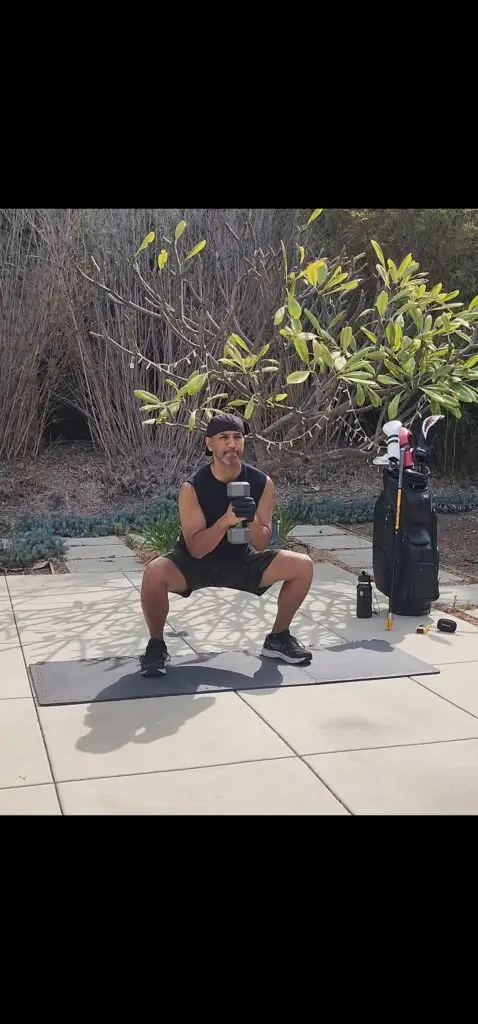
Best exercise: Goblet Squat
Hold a single dumbbell or kettlebell vertically at chest height. Feet shoulder-width apart, toes slightly out. Squat deep, keeping chest up and knees tracking over toes. Drive through your heels to stand. 3 sets of 10–12 reps. The goblet squat is ideal for golf fitness for golfers over 50 because it requires no spinal loading and builds the quad and glute strength that powers your lower body drive through impact.
Secondary exercise: Lateral Lunge
Step laterally and lower into a single-leg squat on the stepping leg, keeping the other leg straight. Drive back to standing. Develops hip strength in the frontal plane — important for hip stability and lateral weight shift. 3 sets of 8 per side.
4. Anti-Rotation Core Strength
This is one of the most misunderstood areas of golf fitness for golfers over 50. The core’s job in the swing isn’t primarily to produce rotation — it’s to create stiffness at the right moment, transferring energy from the lower body to the upper body without leaking it. A weak, unstable core means the rotational force your hips generate dissipates before it reaches the club.
My TPI assessment confirmed this was a significant weakness — 20th percentile for core rotation strength. That single finding changed my entire golf fitness for golfers over 50 approach.
Best exercise: Pallof Press
Attach a cable or band at chest height. Stand perpendicular to the anchor, feet shoulder-width apart. Hold the handle at your chest, then press it straight out in front of you. Resist the rotational pull of the band. Hold 2 seconds at extension. Return. 3 sets of 12 reps per side.
5. Upper Back and Shoulder Stability
The upper back controls posture and club position throughout the swing — and it’s the most neglected area in golf fitness for golfers over 50. Weak upper back muscles lead to rounded shoulders, a flat backswing, and an inability to keep the club in front of your body. My TPI assessment put me in the 14th percentile for upper body diagonal pull. That explained the plateau.
Best exercise: Dumbbell Row
Hinge forward and support yourself with one hand on a bench. Row a dumbbell from hanging to hip height, keeping your elbow close to your side. 3 sets of 10–12 per side.
Secondary exercise: Band Pull-Apart
Hold a resistance band with arms extended at shoulder height. Pull the band apart until your arms are wide, squeezing shoulder blades together. Return slowly. 3 sets of 15 reps. Simple, anywhere exercise that directly counters the forward-rounded posture that kills power in the golf swing — and one of the easiest golf fitness for golfers over 50 exercises to add immediately.
Golf Fitness for Golfers Over 50: The Two-Session Weekly Program
Two sessions per week is enough to drive meaningful strength gains in any golf fitness for golfers over 50 program while allowing adequate recovery. Three is better if your schedule allows. Sessions take 35–45 minutes — sustainable for any competitive golfer over 50.
Session A
| Exercise | Sets | Reps | Rest |
|---|---|---|---|
| Romanian Deadlift | 3 | 8–10 | 90 sec |
| Goblet Squat | 3 | 10–12 | 90 sec |
| Pallof Press | 3 | 12/side | 60 sec |
| Cable Rotation (slow) | 3 | 10/side | 60 sec |
| Band Pull-Apart | 3 | 15 | 45 sec |
Session B
| Exercise | Sets | Reps | Rest |
|---|---|---|---|
| Dumbbell Row | 3 | 10–12/side | 90 sec |
| Lateral Lunge | 3 | 8/side | 90 sec |
| Med Ball Rotational Throw | 3 | 8/side | 60 sec |
| Single Leg RDL | 3 | 8/side | 90 sec |
| Doorway Chest Stretch | 3 | 30s hold | — |
Golf Fitness for Golfers Over 50: How to Progress Over Time
Progressive overload is the principle that drives strength gains in any golf fitness for golfers over 50 program. You need to gradually increase the challenge or your body adapts and stops responding.
- Weeks 1–2: Learn the movements. Use lighter weight than you think you need. Form first.
- Weeks 3–4: Add 5 lbs to lower body exercises, 2–3 lbs to upper body, if the last set was comfortable.
- Every 4–6 weeks: Take a deload week — reduce weight by 30–40%, same movements. Allows tissue recovery and prevents overuse issues that are especially important in golf fitness for golfers over 50.
- Month 3+: Begin incorporating explosive variations — jump squats, medicine ball slams, explosive cable rotations — to convert strength gains into usable power.
Golf Fitness for Golfers Over 50: Recovery
Recovery isn’t optional in golf fitness for golfers over 50 — it’s where adaptation actually happens. Strength training breaks down muscle fibers. Sleep, nutrition, and rest build them back stronger. Skip recovery and you just keep breaking things down.
- Sleep: 7–9 hours. This is when growth hormone peaks and repair happens.
- Protein: Older adults require more dietary protein to stimulate muscle protein synthesis. Aim for 0.7–1.0g per pound of bodyweight, spread across meals.
- Rest days: Minimum 48 hours between strength sessions for the same muscle groups.
- Active recovery: Walking, light mobility work, yoga — promote blood flow without adding training stress. My yoga for golfers over 50 guide pairs directly with this golf fitness for golfers over 50 program.
Golf Fitness for Golfers Over 50: Combining Strength With Overspeed Training
If you’re running a speed training program like the Stack System, here’s how to combine it with golf fitness for golfers over 50 intelligently:
- Do speed training sessions when fresh — before strength work or on separate days
- Never do speed training when fatigued — you’ll reinforce slow patterns instead of fast ones
- Strength and speed sessions can occur the same day with strength first, or on alternating days
- Take one full rest day per week minimum
Sample weekly structure for golf fitness for golfers over 50 combined with Stack System training:
- Monday: Strength Session A
- Tuesday: Stack speed training
- Wednesday: Mobility/yoga + rest
- Thursday: Strength Session B
- Friday: Stack speed training
- Saturday: Golf
- Sunday: Full rest or light walk
This is the exact structure I run alongside my Stack System programs. Golf fitness for golfers over 50 and overspeed training aren’t competing — they’re complementary. The strength work gives the speed training more to work with. For the full speed training side, see my Stack System review and 115 mph at 56 journey.
Golf Fitness for Golfers Over 50: The Bottom Line
Golf fitness for golfers over 50 is not about staying healthy enough to play. It’s about building the physical capacity to play better — faster, farther, and more consistently. The exercises in this guide are simple, effective, and directly transfer to the demands of the golf swing.
Two sessions per week of golf fitness for golfers over 50, done consistently over 3–6 months, will produce strength gains that directly support your speed training and show up in distance off the tee. The investment is 70–90 minutes per week. The return is measurable.
My 111 mph personal best at 56 came after adding this golf fitness for golfers over 50 framework to my existing Stack System and yoga protocols. The TPI assessment revealed the gap. The strength work closed it. Start with Session A, do it twice this week, and build from there.
Frequently Asked Questions: Golf Fitness for Golfers Over 50
What is the most important exercise in golf fitness for golfers over 50?
The Romanian Deadlift is the single most important exercise in golf fitness for golfers over 50 because it directly trains the hip hinge — the foundational movement of the golf swing. It builds hamstring and glute strength in the exact position impact requires, reinforces good spine angle, and addresses one of the most common physical limitations in golfers over 50. If you could only do one exercise for golf fitness for golfers over 50, the RDL is it.
How many days per week should golfers over 50 strength train?
Two days per week is the minimum effective dose for golf fitness for golfers over 50 — enough to drive meaningful strength gains with adequate recovery. Three days per week is better if your schedule allows. The two-session program in this guide (Session A and Session B) is designed specifically for golfers over 50 who are also playing golf, doing overspeed training, and maintaining a mobility practice. Golf fitness for golfers over 50 has to fit into a full training life, not dominate it.
Can golf fitness for golfers over 50 actually increase swing speed?
Yes — and my TPI assessment proved why. Being in the 14th percentile for upper body diagonal pull and 20th percentile for core rotation meant I was leaving significant speed on the table regardless of how hard I trained with the Stack System. After adding structured golf fitness for golfers over 50 work, I hit a 5 mph gain in Program 7 and a new personal best of 111 mph at 56. Golf fitness for golfers over 50 builds the engine that overspeed training has to work with.
Is yoga enough for golf fitness for golfers over 50?
No — and I say this as someone with 11 years of consistent hot yoga practice. Yoga is an essential mobility foundation for golf fitness for golfers over 50, but it doesn’t build the rotational strength or force production capacity that swing speed requires. My TPI assessment revealed significant strength deficits despite all that yoga. Golf fitness for golfers over 50 needs both — yoga for mobility and range of motion, strength training for power production. They’re complementary, not interchangeable.
What does a TPI assessment reveal about golf fitness for golfers over 50?
A TPI (Titleist Performance Institute) assessment identifies the specific physical limitations affecting your golf swing and swing speed. For golf fitness for golfers over 50, it’s the most targeted diagnostic available. My assessment with TPI-certified coach Ryan Engstrom at Engstrom Athletics revealed my core rotation and upper body diagonal pull as the primary limiters — information that completely changed my golf fitness for golfers over 50 priority list. If you’re serious about speed training, a TPI assessment is worth the investment.
How long before golf fitness for golfers over 50 produces results?
Most golfers see meaningful strength gains within 6–8 weeks of consistent golf fitness for golfers over 50 training. Speed transfer — where the strength gains actually show up in swing speed — typically takes 3–4 months of combined strength and overspeed training. My biggest single-program speed gain (5 mph in Program 7) came roughly 4 months after adding structured golf fitness for golfers over 50 work to my Stack System protocol. The timeline is real, but so are the results.