
Affiliate Disclosure: Some links in this article are affiliate links. If you purchase through them, I may earn a small commission at no extra cost to you. I only recommend products I personally use and trust.
If you want to score lower in golf after 50, the path isn’t what most golfers think. It’s not about completely rebuilding your swing. It’s not about buying the latest equipment. And it’s definitely not about grinding out 300 balls on the range until your back gives out. I know because I tried all of that. What actually moved the needle for me — a 56-year-old competing in the SCGA One Day Series with a 3 handicap — came down to a handful of real, repeatable habits that I refined over several seasons of competitive amateur golf.
This guide covers everything I’ve learned about how to score lower in golf after 50: playing more, hitting it farther, locking in a pre-shot routine, fixing my putting, and managing my head when rounds go sideways. Everything here is field-tested in real tournaments, not theory.
Score Lower in Golf After 50: Play More Rounds First
The most underrated way to score lower in golf after 50 is simply playing more often. A few years ago, I was playing once a month — maybe 12 rounds a year. My game was never dialed in because I never had enough reps to build real feel and consistency. Sound familiar?
When I committed to playing more often, everything changed. Not because I was grinding through drills, but because frequent play builds something you can’t get from the range: situational awareness. You start reading greens faster. You know instinctively how far you carry a 9-iron when the air is dry versus humid. You trust your swing under pressure because you’ve been there dozens of times that season, not just a handful. If you want to score lower in golf after 50, frequency beats perfection every time.
I compete in the SCGA One Day Series, which gives me structured competitive rounds throughout the year. That accountability — knowing a real tournament is coming — pushes me to stay sharp. If you’re not already playing in organized events, look into what your local golf association offers. The pressure of competition is a fast-track to scoring lower in golf after 50.
Score Lower in Golf After 50: Add Distance and Watch Scores Drop
Here’s something nobody talks about enough when it comes to how to score lower in golf after 50: distance matters more than you think — not for ego, but for math.
When I started adding driver swing speed through the Stack System overspeed training program, the first thing I noticed wasn’t just the extra yards off the tee. It was what I was hitting into greens. Shorter approach shots mean higher-lofted clubs, which means more spin, more control, and more birdie opportunities. A 150-yard approach with an 8-iron is a completely different conversation than 150 yards with a 6-iron. That’s how you score lower in golf after 50 — better angles, shorter clubs, more makeable putts.
I’m on a documented journey from 89 to 111 mph driver swing speed at 56. You can follow the real speed training results on the Speed Log and read the full breakdown in my Stack System Review. More speed = shorter clubs = lower scores. It’s that direct.
But here’s the catch most senior golfers miss: distance only translates to scoring lower in golf after 50 if you know your real club distances and dispersion patterns. I built a complete golf club distance chart using real Arccos data — and the dispersion patterns revealed I’d been chronically under-clubbing on approach shots, leaving five clubs missing short of the green more than 24% of the time. That insight alone was worth more strokes per round than any swing tip. Know your numbers before you trust them.
If you’re a golfer over 50 who thinks swing speed gains aren’t possible anymore, read about swing speed for golfers over 50 and reconsider. More distance is the single highest-leverage thing most golfers can do to score lower in golf after 50.
Score Lower in Golf After 50: Win the Par 5s
To score lower in golf after 50, par 5 scoring is the single biggest leverage point on the scorecard — and most senior golfers leave strokes on the table here every round.
The math is simple. The average senior amateur scores 5.4 to 5.5 on par 5s because driver speed in the 85–95 mph range forces a layup on the second shot. That’s par 5 scoring as a defensive grind, not an opportunity. When you can reach par 5s in two shots, even occasionally, the scoring math flips. Across a full tournament season, the difference between averaging 5.4 and 5.0 on par 5s is 15–20 strokes saved — without changing anything else about your game.
At the SCGA Senior Amateur Qualifier at El Camino CC in May 2026, I averaged 5.0 on the four par 5s on a course I had never seen. My 7-wood from 210–230 yards was the difference. I wrote a full breakdown in Better Par 5 Scoring at 56. If you want to score lower in golf after 50, this is the leverage point.
Score Lower in Golf After 50: Build a Pre-Shot Routine
Want to score lower in golf after 50? Stop thinking over the ball and start executing. A locked-in pre-shot routine is how you do it. Here’s my full-shot routine — the same one every time, for every shot:
- Two practice swings. Not one, not three. Two. They calibrate my feel for the shot without overloading my brain.
- Set up behind the ball. I line up from directly behind the ball, picking my exact target line — not a general direction, a specific spot.
- Two looks: ball to target, ball to target. Two looks only. I confirm my line, trust it, and go.
- One swing thought: “smooth.” That’s it. Nothing technical. Nothing mechanical. Just smooth.
The word “smooth” replaced a hundred other thoughts — tempo, takeaway, shoulder turn, release. When you’re standing over a 180-yard carry over water in a tournament, you don’t want technique checklists. You want one word that unlocks your natural motion. A consistent pre-shot routine is one of the most powerful tools for scoring lower in golf after 50 because it removes decision fatigue and gives your body permission to do what you’ve trained it to do.
Score Lower in Golf After 50: Eliminate 3-Putts
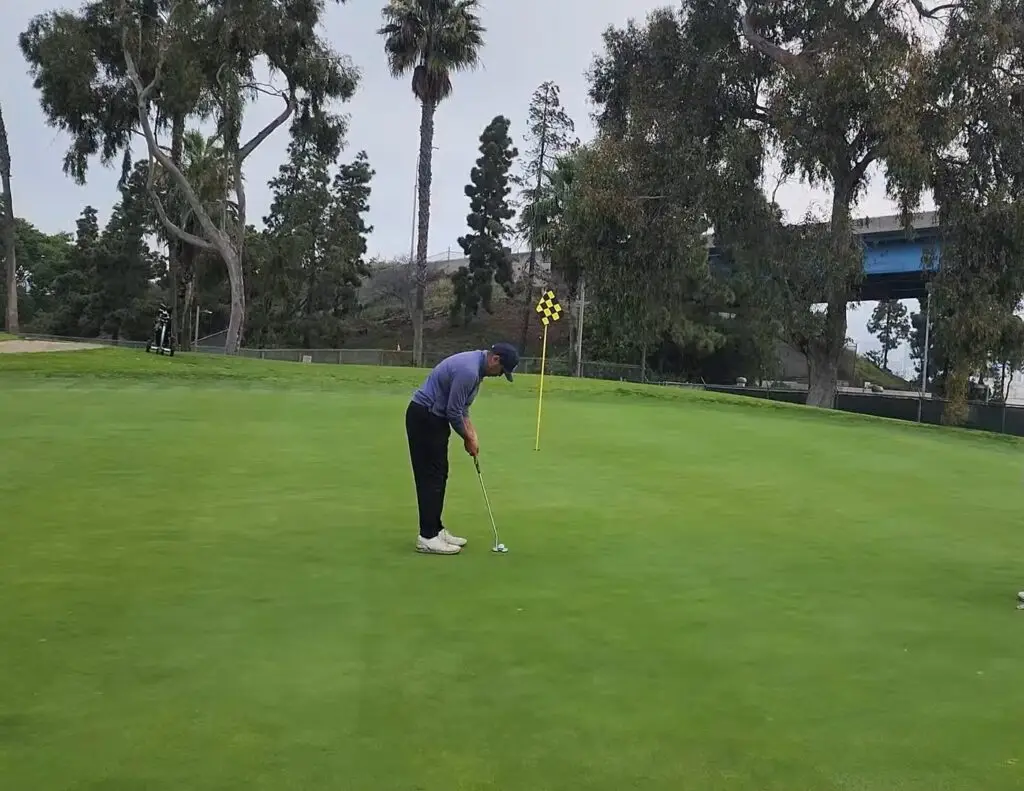
If there’s one area that will immediately help you score lower in golf after 50, it’s putting. Specifically, eliminating 3-putts and making everything inside 3 feet automatic.
I learned this the hard way. At Soboba Springs, I had seven 3-putts. Seven. That’s potentially 7 strokes handed back to the course. I came back the following year focused and shot 73 (+1) for my first win of the season. The difference wasn’t my swing — it was my putting. You can read the full Soboba Springs recap for details. For the complete speed-first framework that fixed my putting, see How to Stop 3-Putting.
Here is my full putting routine — same process, every putt:
- Two practice strokes for speed. Calibrating distance feel, not line. Speed first, always.
- Readjust grip, two more strokes. Resets my hands so they feel like one unit.
- Align the line on the ball. I draw a line on my ball and set it exactly where I want the ball to start.
- Two looks: ball to hole, ball to hole. Two only. Then pull the trigger.
- Smooth stroke with tempo. Same thought as my full swing — smooth.
The 3-foot putt is the free throw of golf. I practice short putts every night, making 20–30 in a row before tournaments. I use a Practice Perfect putting mat at home — it’s been a genuine game-changer for building the automatic stroke that helps me score lower in golf after 50. Avoiding 3-putts is non-negotiable if you’re serious about scoring lower after 50.
Score Lower in Golf After 50: Master the Mental Reset
One of the biggest breakthroughs in my ability to score lower in golf after 50 didn’t come from a swing change — it came from learning how to reset mentally after a bad hole.
At Desert Falls, I opened with a double bogey. I played +2 the rest of the way by refusing to carry that first hole into the second. You can read the full story in my Desert Falls tournament recap. The lesson: it’s not how you start, it’s how you finish. That’s how you score lower in golf after 50 under real competitive pressure.
A few principles I live by on the course to score lower in golf after 50:
- Never chase a bad hole with a bad decision. Bogey is a perfectly acceptable recovery. A double bogey chasing a birdie is a round killer.
- Play to your safe landing zone, not the pin. Unless you’re in a must-attack situation, the middle of the green is your friend.
- Know your miss tendency. At 56, I know where my misses go. I aim accordingly before I ever take a practice swing.
- Reset between every hole. Deep breath, check the card, move on. The previous hole is history the moment you walk off the green.
For the full mental game framework that helps me score lower in golf after 50, see my mental game on the course for golfers over 50 guide.
Score Lower in Golf After 50: Keep Your Body Ready
Scoring lower in golf after 50 also requires keeping your body in the game. Stiffness, limited rotation, and fatigue in the back nine are real issues as we age — and they directly affect scoring.
A consistent pre-round routine has made a measurable difference in how I feel from the first tee to the 18th green. If you’re not already doing golf-specific mobility work, start with my 15-minute pre-round yoga routine — it’s quick, effective, and you can do it in the parking lot. For a deeper dive into how flexibility training translates to scoring lower in golf after 50, check out the full yoga for golfers over 50 guide and my golf fitness for golfers over 50 framework.
When your back isn’t tight and your hips rotate freely, your swing is more consistent from hole 1 to hole 18. That consistency is what produces lower scores — and it’s available to every golfer who commits to it.
Score Lower in Golf After 50: The Scoring Checklist
If you want to score lower in golf after 50, here’s where to focus your energy — in order of impact:
- Play more rounds. Frequency builds feel, confidence, and situational intelligence faster than any drill.
- Add distance. More speed = shorter clubs = better scoring opportunities on every approach.
- Win the par 5s. Reach them in two and turn defensive grinds into birdie chances.
- Lock in your pre-shot routine. Same steps, same pace, same thought — every single shot.
- Eliminate 3-putts. Make 3-foot putts automatic through daily practice. Treat them like free throws.
- Manage your head. One hole at a time. Reset after every bad shot. It’s not how you start — it’s how you finish.
- Keep your body ready. Flexibility and mobility aren’t optional after 50. They’re your foundation for scoring lower in golf after 50.
Dive Deeper: Score Lower in Golf After 50 by Topic
- Course Management: Course Management for Golfers Over 50
- Short Game: Short Game for Golfers Over 50
- Putting: How to Stop 3-Putting
- Mental Game: Mental Game on the Course for Golfers Over 50
- Swing Speed: How Swing Speed Affects Scoring
- Par 5 Scoring: Better Par 5 Scoring at 56
- Club Distances: Golf Club Distance Chart: Real Arccos Data
Frequently Asked Questions: Score Lower in Golf After 50
What is the fastest way to score lower in golf after 50?
The fastest single change most golfers over 50 can make to score lower in golf after 50 is eliminating 3-putts. Most amateur golfers 3-putt 2–4 times per round — that’s 2–4 free strokes handed back to the course. Combined with a locked-in pre-shot routine and the 80% club selection rule, eliminating 3-putts can drop 3–5 strokes per round without touching your swing mechanics.
Does swing speed help you score lower in golf after 50?
Significantly. Going from 89 to 111 mph with the driver changed what I hit into greens — from long irons to short irons on most par 4s. Shorter clubs mean more spin, more control, and more birdie opportunities per round. The math on how to score lower in golf after 50 is straightforward: more distance means shorter approaches, which means better scoring positions, which means lower scores. Distance isn’t about ego — it’s about the math of the game.
How important is course management for scoring lower in golf after 50?
Course management is one of the highest-leverage skills for scoring lower in golf after 50 because it costs nothing and improves immediately. Knowing your miss tendency, taking one more club, and never chasing a bad hole with a bad decision are decisions that save strokes every round. At 56 competing against golfers of all ages in SCGA tournaments, course management is the reason I consistently score well — not perfect ball-striking.
How much does flexibility affect scoring lower in golf after 50?
More than most golfers realize. Tight hips limit your rotational power. A stiff thoracic spine shrinks your shoulder turn. Hamstring tightness causes early extension and inconsistent contact. All of these directly affect your ability to score lower in golf after 50 because they make your swing less consistent and less powerful from hole 1 to hole 18. A 15-minute pre-round yoga routine and daily mobility work are the foundation I use to keep these restrictions from stealing strokes.
What putting practice helps most with scoring lower in golf after 50?
Daily home putting practice — specifically short putts made in long consecutive streaks — is the highest-ROI putting practice for scoring lower in golf after 50. I make 20–30 three-footers in a row every night before tournaments on a putting mat at home. That volume makes short putts feel automatic under pressure. Eliminating the 3-foot miss is where scoring lower in golf after 50 happens on the greens — not in making more long putts.
Can you realistically score lower in golf after 50?
Yes — and the evidence is clear. I went from a 7 handicap to a 3 handicap after 50, competing in SCGA One Day Series tournaments against golfers of all ages. The path to score lower in golf after 50 is not a perfect swing — it’s more rounds, smarter decisions, better distance, a locked-in routine, and a short memory for bad holes. None of those require youth. All of them require commitment.